- Product
- Black ruby barb (pair)


Black Ruby Barb (Pair)
Couldn't load pickup availability
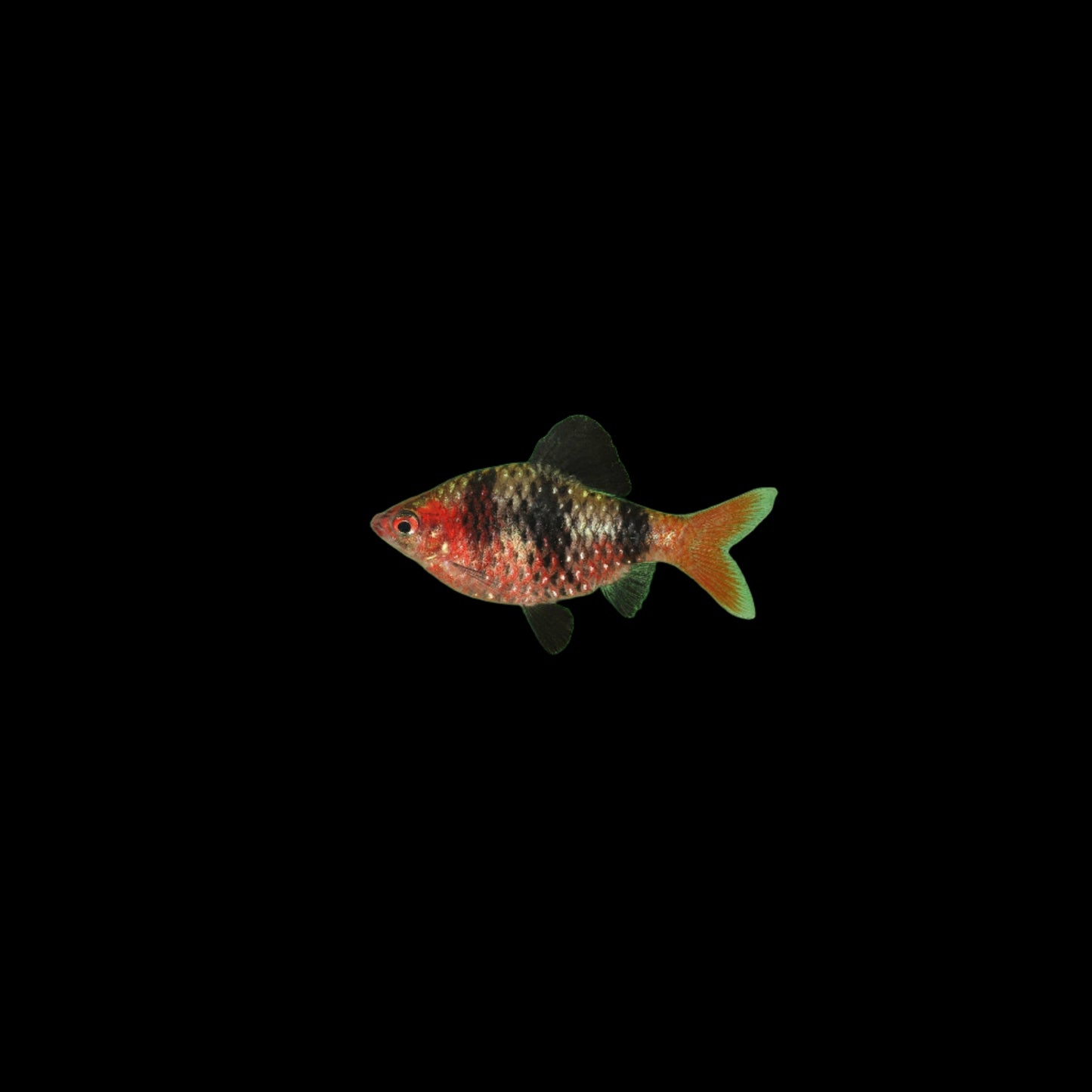
In breeding colour, the male turns velvet-black with a ruby face. Most of the time a Black Ruby Barb is a gold-and-black striped fish. When a male is in condition and displaying, the stripes merge into velvety black and the whole head and front of the body flood deep ruby red. It is one of the most dramatic colour changes in any small community fish.
This is a Sri Lankan barb that is far more peaceful than its tiger-barb cousins. Males jostle each other for the attention of females, which is exactly what produces the colour, but they leave other fish largely alone. A planted tank with a group of six to ten, more females than males, is how you get the ruby red to show up regularly.
Keep a proper group with more females than males.
The ruby colour is a male display colour. It appears when males compete for females, and it fades when a male is kept alone or stressed. A group of six or more, roughly one male to two females, keeps the display constant without any one fish being harassed.
Care Snapshot
| Scientific name | Pethia nigrofasciata |
| Also known as | Ruby Barb, Purple-headed Barb; formerly Puntius nigrofasciatus |
| Family | Cyprinidae — barbs and minnows |
| Origin | Native to Sri Lanka |
| Adult size | 5–6 cm |
| Lifespan | 4–6 years |
| Minimum tank | 75 litres, minimum 75 cm length |
| Temperature | 22–27 °C |
| pH | 6.0–7.5 |
| Hardness | 2–15 dGH — soft to moderately hard |
| Diet | Omnivore — flake, granules, frozen foods and plant matter |
| Temperament | Mostly peaceful; keep 6+ |
| Care level | Easy |
| Swimming zone | Middle and lower |
Setting Up For It
- Dense planting with open space. Plants give females cover from courting males; open space lets the group swim.
- Dark substrate and moderate light. The ruby red and black show strongest against dark tones.
- Moderate flow and clean water. Stream fish that appreciate well-oxygenated water.
- Driftwood and leaf litter. Softer, tannin-tinted water brings out the colour.
- Lid recommended. Barbs can jump when startled.
Tank Mates
Good matches
Cherry Barb, Rasboras, Danios, medium tetras, Corydoras, Loaches, Bristlenose Pleco, Gouramis, Rainbowfish.
Keep away from
Long-finned slow fish such as Bettas and fancy guppies, which may be nipped, and large aggressive cichlids.
Mild nipping is only usually a problem when they are kept in too small a group.
Feeding — Varied For Colour
Black Ruby Barbs are unfussy omnivores, but the ruby red depends on a varied, carotenoid-rich diet.
Feed twice a day. From the AQA range, a small colour granule or flake as the staple, with frozen foods and blanched vegetables through the week.
Foods they enjoy: frozen bloodworm, brine shrimp, daphnia, mosquito larvae, blanched spinach.
Sexing & Breeding
Males develop the black body and ruby-red head when mature and displaying. Females keep their gold-and-black stripes and are rounder. Easy to sex once adult.
An egg-scatterer that spawns among fine-leaved plants or a spawning mop. Adults eat eggs, so remove them after spawning. Fry hatch in a day or two and need infusoria.
Keeping It In Indian Conditions
- A near-neighbour. Sri Lankan in origin, this barb is comfortable at most Indian room temperatures without a heater outside the north and hill stations.
- Summer: above 28 °C add aeration and a fan — they are stream fish that need oxygen.
- Water: copes with moderately hard municipal water; very hard borewell water benefits from blending.
- Monsoon: keep changes regular and dechlorinated.
- Food supply is easy with standard dry foods and frozen extras.
What You Receive
Juveniles and young adults, quarantined and conditioned at our Bengaluru facility before dispatch. A pair here means two fish; male and female cannot be guaranteed at this size. The ruby head is a mature male display colour and will not be visible on young or newly arrived fish. Packed with oxygen and insulation for pan-India delivery.
Covered by the Best4Pets live arrival guarantee. Please film an unboxing video before opening the bag — it is required for any DOA claim.