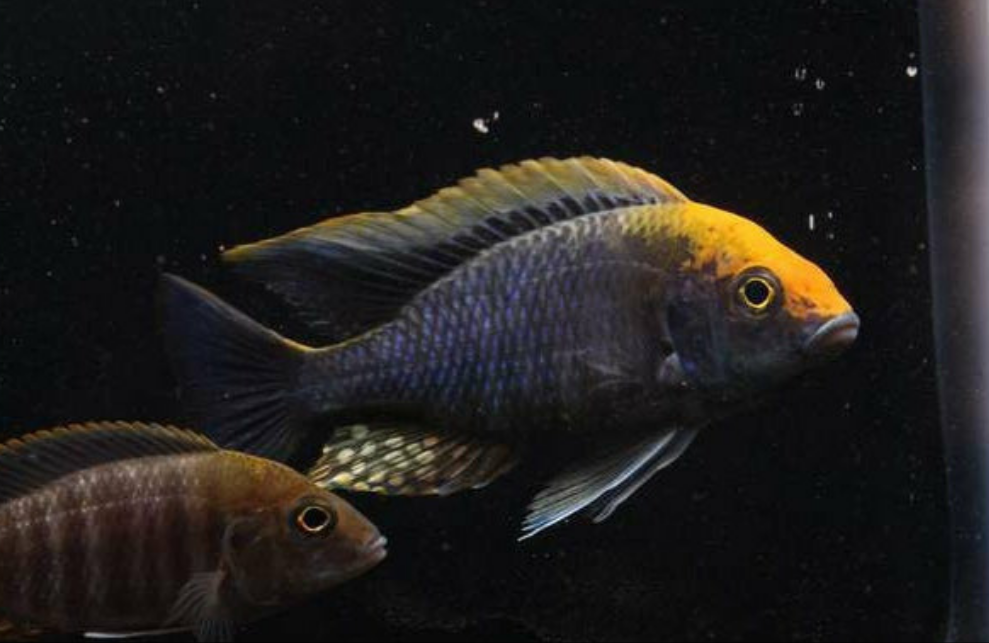
Sulphur Head Cichlid / Aulonocara maylandi 2.5" (Pair)
Couldn't load pickup availability
A blue fish that looks dipped in sulphur. A mature male is a deep, even blue from snout to tail, with a broad blaze of pale yellow running across the forehead and along the top of the dorsal fin as if the fish had been lowered head-first into a pot of paint. It is one of the simplest colour schemes among the peacocks and one of the most striking, because nothing on the fish competes with that contrast.
Like every Aulonocara, it is a hunter of the sand rather than a scraper of rock. In the lake it hovers just above the bottom, listening for invertebrates moving in the sediment through enlarged sensory pores on the head, then dives in and sifts. In the aquarium that translates into a fish that is calmer than the mbuna it is often wrongly mixed with, that spends its time in the lower half of the tank over open sand, and that colours up best in a group of its own kind with a couple of other peaceful peacocks for company.
Keep it with peacocks and haps, never in an mbuna tank.
This is the decision that makes or breaks a Sulphur Head. Mbuna are faster, more aggressive and eat a vegetable-heavy diet that does not suit a peacock; housed together, the peacock is harassed into hiding, never shows its colour, and is outcompeted at every feed. A peacock-and-hap tank with open sand, one male per Aulonocara species and more females than males is where this fish thrives.
Care Snapshot
| Scientific name | Aulonocara maylandi |
| Also known as | Sulphur Head Peacock, Sulphurhead Aulonocara; the Kande Island population is sold as A. maylandi kandeensis |
| Family | Cichlidae — Lake Malawi haplochromine cichlids (peacocks) |
| Origin | Farm-bred and imported stock; wild form from West Reef and Eccles Reef in south-eastern Lake Malawi |
| Adult size | 10–13 cm (males larger than females) |
| Arrival size | about 2.5 inch |
| Lifespan | 8–10 years |
| Minimum tank | 250 litres for a male with three or more females, minimum 120 cm length |
| Temperature | 24–28 °C |
| pH | 7.6–8.6 |
| Hardness | 8–20 dGH — hard, alkaline water |
| Diet | Carnivore leaning omnivore — small sinking foods |
| Temperament | Moderately peaceful for a Malawi cichlid; males territorial with each other |
| Care level | Moderate — easy in the right company, poor in the wrong one |
| Swimming zone | Bottom and lower middle |
Setting Up For It
- Open sand is the main event. Fine, rounded sand across most of the floor gives the fish somewhere to hunt and sift. Coarse sharp gravel stops the natural feeding behaviour and dulls the fish.
- Rock around the edges, not everywhere. A few stacked caves along the back and sides give females and subordinate males a retreat, while leaving the open floor that peacocks actually use. Set the bottom stones on the base glass so digging cannot topple them.
- Length over height. Males stake out a patch of floor and display across it. A 120 cm tank holds one male comfortably; a 150 cm tank or longer lets you keep two or three different peacock males without constant squabbling.
- Hard, alkaline, stable water. pH 7.6–8.6 and plenty of carbonate hardness. Crushed coral or aragonite in the filter or mixed into the sand holds the pH steady between water changes.
- Strong biological filtration. Malawi tanks are stocked more heavily than community tanks. Run a canister or sump rated at least three to four times the tank volume per hour, and change 30–40% of the water weekly.
- Moderate lighting shows the blue. Very bright, cool-white light flattens the colour. A slightly warmer or blue-enhanced light over pale sand brings out both the blue body and the yellow blaze.
Tank Mates
Good matches
Other Aulonocara peacocks of clearly different colour, such as Yellow Sunshine Peacock (A. baenschi) or OB and Red peacocks; peaceful haps such as Copadichromis, Taiwan Reef (Protomelas sp.), Blue Dolphin and Placidochromis; Synodontis catfish from the Rift Lakes; Yellow Labs in a large tank.
Keep away from
Aggressive mbuna such as Maylandia, Pseudotropheus, Labeotropheus and Melanochromis. Large predatory haps such as Venustus or Livingstonii once they outgrow the peacocks. Soft-water community fish of any kind.
Keep only one male of each peacock species, and avoid mixing females of several Aulonocara species with only one male — the females look very alike and cross-breeding is common.
Feeding — Small, Sinking, Meaty — But Not Rich
Peacocks eat small invertebrates in the wild, so they need more protein than the algae-grazing mbuna. That does not mean beef heart or fatty foods: Malawi cichlids of every type are prone to bloat when fed heavy, high-fat diets, and peacocks are no exception.
Feed a quality sinking cichlid pellet once or twice a day, only what is cleared in a minute or two. From the AQA range, a small sinking cichlid pellet makes a good daily staple, with frozen foods two or three times a week and one fasting day each week to keep the gut clean.
Foods it takes well: frozen mysis, brine shrimp, krill, cyclops and daphnia, plus a spirulina-containing pellet for balance. Skip bloodworm as a staple and avoid live tubifex.
Sexing & Breeding
Males develop the full blue body and yellow head blaze, with egg spots on the anal fin and longer, more pointed fins. Females stay grey-brown with faint barring. Juveniles all start out grey-brown, so young fish are very hard to sex; males begin to colour from around 6–8 cm, and the full colour can take a year or more.
A maternal mouthbrooder. The male cleans a spot in the sand or in a cave mouth and displays to females; after spawning, the female carries the eggs and then the fry in her mouth for around three to four weeks, eating little during that time. Moving a holding female to a quiet tank a few days before release gives the best survival. Fry take crushed flake and baby brine shrimp straight away.
Keeping It In Indian Conditions
- Hard borewell water is an advantage here. Most of Bengaluru's borewell water and many Indian municipal supplies are already hard and alkaline — close to what this fish wants. Test pH and hardness, but you will rarely need to do more than add some crushed coral for buffering.
- Watch the summer ceiling. Peacocks are comfortable up to around 28 °C. In April and May, tanks can climb past 30 °C; run a fan across the surface, add an air stone and feed less on the hottest days.
- Power cuts hit stocked Malawi tanks hard. A heavily stocked cichlid tank uses oxygen quickly once the filter stops. A battery-backed air pump or an inverter line for the filter is cheap insurance.
- Winter heating is a light job. In the south a heater set to 25–26 °C is mostly a safety net for cold nights; in the north and in hill stations it is essential from November to February.
What You Receive
Farm-bred juveniles and young adults (import listings are sourced from overseas farms), supplied at about 2.5 inch, quarantined and conditioned at our Bengaluru facility before dispatch. Sex is not guaranteed at smaller sizes, and young fish are grey-brown — the blue body and yellow blaze only appear as males mature, and pair listings are sexed by eye to the best of our ability. Expect fish to look washed out after transit; colour returns within days once they settle. Packed with oxygen and insulation for pan-India delivery.
Covered by the Best4Pets live arrival guarantee. Please film an unboxing video before opening the bag — it is required for any DOA claim.