- Product
- Echinodorus tenellus

Echinodorus tenellus
Couldn't load pickup availability
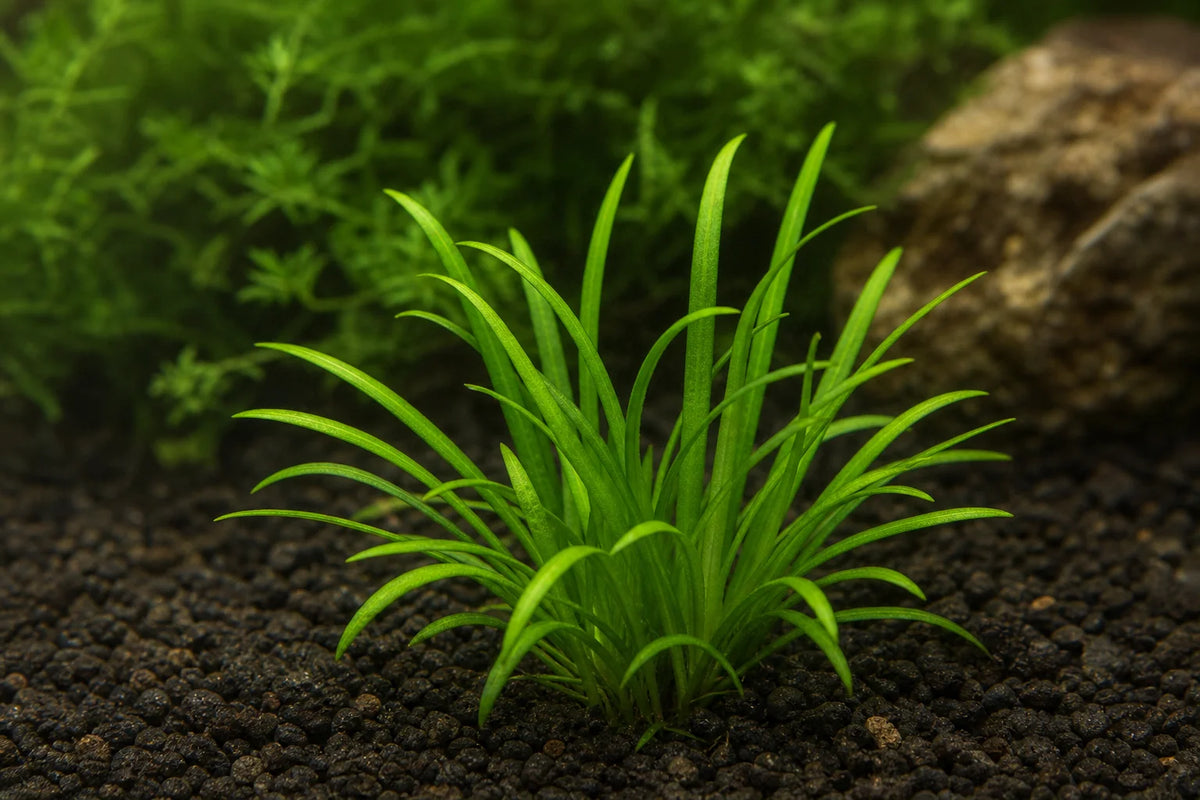
A carpet you can actually grow without CO2. Pygmy Chain Sword throws narrow, grass-like leaves a few centimetres tall and then sends runners sideways across the substrate, each one rooting and putting up a new plant. Left to it, a handful of plants becomes a continuous lawn. It is the one foreground carpet available to a low-tech Indian tank, and it is why this unremarkable-looking little plant is worth more attention than it usually gets.
Under strong light it stays short, dense and often takes on a bronze-red flush at the leaf tips. Under moderate light it grows taller and looser, more meadow than lawn, which is a perfectly good look in its own right. Either way it is a sword underneath — tough, tolerant of hard alkaline water, and content at Indian room temperature with no equipment at all.
Light decides whether you get a carpet or a meadow.
This plant will survive low light, but it will not carpet in it — the leaves stretch upward toward the surface, the runners slow, and you end up with sparse tufts of tall grass rather than a lawn. Nothing is wrong with the plant. If a tight, low carpet is what you are after, put it directly under the brightest part of the tank and keep the substrate fed. That is the whole trick.
Care Snapshot
| Scientific name | Echinodorus tenellus (accepted: Helanthium tenellum) |
| Also known as | Pygmy Chain Sword, Micro Sword, Narrow-leaf Chain Sword |
| Family | Alismataceae |
| Origin | Nursery-propagated; the genus ranges through the Americas |
| Plant type | Small rosette, spreads by runners |
| Placement | Foreground carpet, or mid-ground in nano tanks |
| Height | 3–6 cm in strong light; 10–15 cm in weaker light |
| Growth rate | Moderate to fast once established |
| Lighting | Medium to high — determines whether it carpets |
| CO2 | Not required; produces a denser carpet with it |
| Temperature | 22–29 °C |
| pH | 6.0–8.0 — wide tolerance |
| Hardness | Soft to hard — handles Indian tap water well |
| Substrate | Fine sand or aquasoil, 3–5 cm deep |
| Fertilisation | Root tabs in inert substrate; it is a root feeder |
| Difficulty | Easy to moderate — easy to grow, harder to carpet |
Compared With The Other Carpet Plants
Why choose this one
It is the only common carpet plant that works without injected CO2 and without soft water. It spreads on its own by runner rather than needing a hundred separate plantings, and it tolerates the temperatures an Indian tank actually runs at.
What you give up
It is grassy rather than the tight cushion you get from Monte Carlo or dwarf hairgrass in a high-tech tank, and it takes months rather than weeks to fill in. If you are running pressurised CO2 and want a manicured carpet, those are better choices.
Planting It
- Separate the clump into small portions. Tissue-cultured or potted stock arrives as a dense mass. Wash off any gel or rockwool and divide it into pieces of two or three plantlets each — far more ground covered from the same purchase.
- Plant portions 3–5 cm apart across the area you want covered. The runners close the gaps themselves; planting tight just wastes plants.
- Bury the roots, keep the crowns clear. Push the roots in with tweezers and leave the base of the leaves sitting at the substrate surface. Buried crowns rot.
- Fine substrate only. The roots are delicate and shallow. Coarse gravel makes it hard to anchor and hard to spread.
- Root tabs under the carpet area. Spread a few across the planting zone rather than clustering them, and top up every few months.
- Expect emersed-grown stock to convert. Nursery plants raised out of water shed their original leaves and regrow shorter submersed ones. The first few weeks look disappointing; this is normal.
Keeping The Carpet Healthy
A mature carpet thickens into layers, and the lower layer eventually loses light and dies off. Left long enough, the whole mat detaches from the substrate in sheets. Prevent it by thinning every few months: pull out sections, trim the carpet back with scissors, and let the runners refill. This is the maintenance job that keeps a chain sword lawn going for years.
Keep detritus off it. Fine grassy foliage traps mulm and uneaten food, which encourages algae and smothers the base. A gentle siphon over the carpet at each water change is enough.
Propagation
It propagates itself. Runners travel horizontally just under or along the substrate, putting up a new rosette every few centimetres — a chain of plants, which is where the name comes from. To move growth elsewhere, snip a runner between two established plantlets and replant the piece with its roots buried and crown clear. Because it multiplies this freely, buying a modest quantity and letting it spread costs far less than buying enough to cover the area outright.
What It Pairs With
Shrimp-safe and snail-safe, and the dense grassy base is excellent cover for shrimplets and fry — worth considering if you are breeding Neocaridina or small fish. Corydoras and loaches forage happily through it without much damage once it has rooted, though they will unsettle newly planted portions, so let it establish for a few weeks first. Underneath a Cryptocoryne mid-ground and a sword at the back, it completes a low-tech layout with no stem plants and no CO2 anywhere in it.
Growing It In Indian Conditions
- This is the realistic carpet option for an Indian tank. Hard alkaline tap water, room temperature, no CO2 — the conditions that rule out Monte Carlo, dwarf hairgrass and HC for most keepers here. Light is the only thing you need to invest in.
- Summer is survivable. Comfortable to around 29 °C. Growth slows in peak heat and the carpet may thin, but it recovers once temperatures drop rather than melting away.
- No heater needed anywhere in India for most of the year.
- Spend on light and root tabs, not on quantity. Buying a large amount into a dim tank gives you tall sparse grass. Buying a modest amount into a well-lit, root-fed tank gives you a lawn within a few months, for less money.
What You Receive
Nursery-propagated plants held and conditioned at our Bengaluru facility. No wild-collected stock. Divide the clump into small portions before planting for far better coverage. Leaf length and density vary with growing conditions and will change to match your tank over the following weeks, and some original leaves may be shed as the plant converts to submersed growth.
Covered by the Best4Pets live arrival guarantee. Please film an unboxing video before opening the bag — it is required for any DOA claim.