- Product
- Echinodorus red rubin

Echinodorus Red Rubin
Couldn't load pickup availability
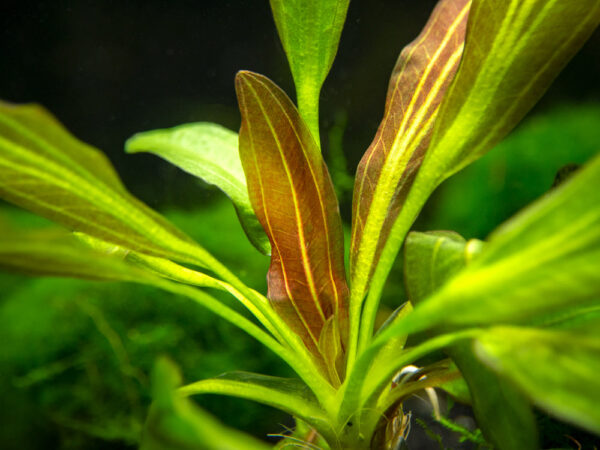
Red, without a CO2 cylinder. 'Red Rubin' is a hybrid sword that holds genuine wine-red to ruby colour in its leaves — not just in the new growth, but through the mature foliage, with darker veining running the length of each blade. It is the only realistic way to get a large, properly red plant into an ordinary low-tech tank, and it is why this cultivar has stayed in the trade for decades.
Every red stem plant worth having — Ludwigia, the Rotalas, Red Cabomba — wants injected CO2, soft acidic water and a dosing routine. 'Red Rubin' wants a deep substrate, a root tab and a decent light. It is a large plant with broad upright leaves that anchors the back of a tank, and it will still be there, still red, long after a stand of stem plants has melted through an Indian summer.
The red is earned by light and root feeding, not bought.
In a dim tank with no root tabs this plant survives perfectly well — as a large green plant with a faint reddish cast on new leaves. The colour you saw in the photograph comes from strong light reaching the foliage and a well-fed root zone. If you buy it for the red, budget for those two things. No liquid fertiliser will substitute.
Care Snapshot
| Scientific name | Echinodorus 'Red Rubin' |
| Also known as | Red Rubin Sword, Ruby Sword |
| Family | Alismataceae |
| Origin | Nursery hybrid; the genus is South American |
| Plant type | Rosette, heavy root system |
| Placement | Background or central specimen |
| Size | Roughly 25–45 cm tall, 25–30 cm across when mature |
| Growth rate | Moderate |
| Lighting | Medium to high — determines how red it gets |
| CO2 | Not required; grows faster and redder with it |
| Temperature | 22–29 °C |
| pH | 6.0–8.0 — wide tolerance |
| Hardness | Soft to hard — handles Indian tap water well |
| Substrate | Fine sand or gravel, 5 cm+ deep |
| Fertilisation | Root tabs essential in inert substrate; iron supports the colour |
| Difficulty | Easy to grow; moderate to colour well |
'Red Rubin' Or 'Ozelot'?
'Red Rubin' — this plant
Solid red-to-ruby colour held through mature leaves, with darker veining. Slightly taller and more upright. Choose it when you want an unbroken block of red at the back of the tank.
'Ozelot'
Green ground with scattered dark red spots, and red new growth that greens up with age. Choose it when you want pattern and contrast rather than a solid colour mass.
Both are large background swords on identical care. In a 120 cm tank, one of each at either end works better than two of the same.
Planting It
- Bury the roots, keep the crown clear. The point where leaves emerge must sit at the substrate surface. A buried crown rots — the one planting mistake that actually kills a sword.
- Depth matters. At least 5 cm of substrate, more if you can. This plant puts enormous mass below the surface.
- Plant for the mature size. Leave a 25–30 cm clear radius. Almost everyone plants swords too close to something else and regrets it within a year.
- Keep it under the light, not behind something. A red plant shaded by taller foliage reverts to green. If the tank has a bright zone, that is where this goes.
- Set the position once. Swords resent being lifted and sulk for weeks afterwards.
- Emersed-grown stock will convert. Nursery plants raised out of water shed their original leaves and regrow submersed ones, which are longer, thinner and usually redder. The first month can look alarming; it is normal.
Getting And Keeping The Red
Three things drive the colour, in order of importance: light intensity reaching the leaves, a well-fed root zone, and available iron. Get the first two right and the third is a refinement. Get the first one wrong and nothing else matters — a shaded 'Red Rubin' is a green plant.
New leaves emerge deepest in colour and hold it far better than most red plants as they mature, which is the cultivar's real advantage. Expect a gradient rather than uniformity, and expect the plant to shift over its first couple of months as it adjusts to your tank. Do not judge the colour until it has put out three or four leaves of its own.
Propagation
Swords throw a long flower stalk or runner carrying daughter plantlets that grow their own leaves and roots while still attached. Leave each one in place until it has four or five leaves and visible roots, then cut it free and plant it with the crown clear of the substrate. A well-fed plant does this unprompted, and a single specimen will supply several over a couple of years. Dividing the rhizome of a mature plant is possible but sets the parent back badly — take plantlets instead.
What It Pairs With
Shrimp-safe and snail-safe, with thick tough leaves that shrug off Corydoras, loaches and most community fish. Like the other large swords it stands up to Angelfish and peaceful cichlids better than almost anything else planted, which makes it a natural background for a South American community tank. Underplant with Cryptocoryne and let it rise above them — a single red mass above green mid-ground foliage is one of the easiest ways to make a low-tech layout look designed. Goldfish and large aggressive cichlids will still uproot or eat it.
Growing It In Indian Conditions
- This is the practical red plant for India. Hard alkaline tap water, no RO, no CO2, no buffering. Every red stem plant that competes with it on colour needs all three. If you have tried and failed with Ludwigia or Rotala in local water, this is the plant that solves the problem.
- Summer is survivable. Comfortable to around 29 °C. Growth slows in peak heat but the plant holds its structure rather than melting the way fine-leaved stems do.
- No heater needed anywhere in India for most of the year.
- Spend on light and root tabs. Most Indian tanks run plain river sand under a modest hood light — the exact combination that turns this plant green and then starves it. Those two purchases matter far more than any fertiliser bottle.
What You Receive
Nursery-propagated plants held and conditioned at our Bengaluru facility. No wild-collected stock. Leaf size and colour intensity vary with growing conditions and will change to match your tank over the following weeks — colour on arrival is not a guide to colour in your aquarium. Some existing leaves may be shed after planting as the plant converts to submersed growth; this is normal and is not a fault.
Covered by the Best4Pets live arrival guarantee. Please film an unboxing video before opening the bag — it is required for any DOA claim.