- Product
- Blue peacock cichlid 2.5" (pair)

Blue Peacock Cichlid 2.5" (Pair)
Couldn't load pickup availability
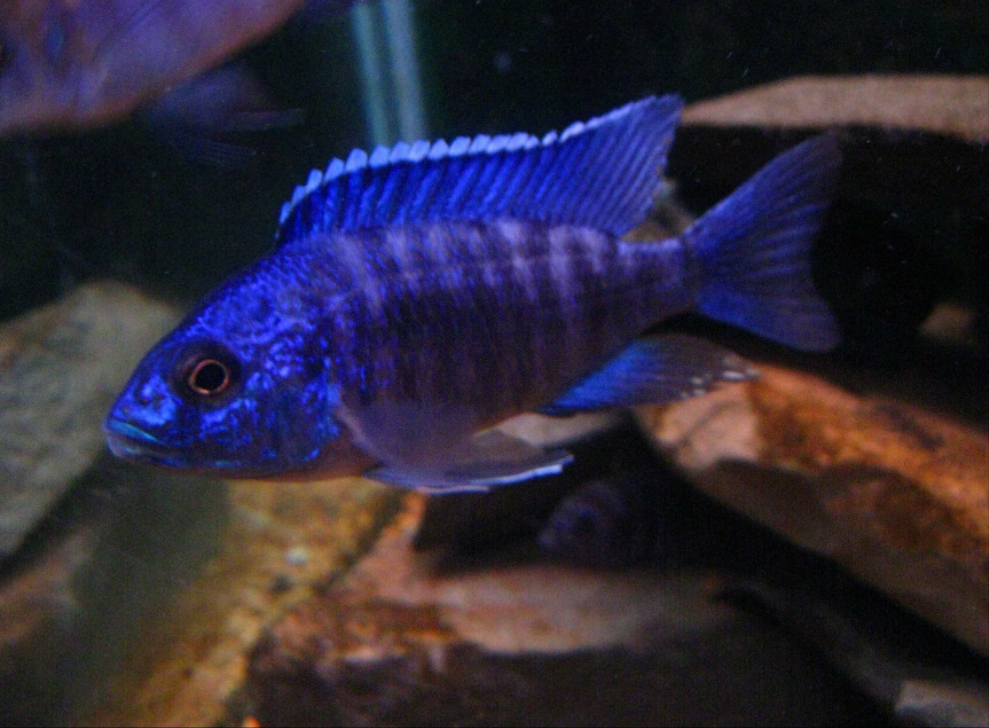
The classic peacock, in deep blue. A mature male Blue Peacock is a rich, even blue from nose to tail, often with darker vertical barring and a shining pale edge to the dorsal fin. It is the fish that made peacock cichlids famous, and a group of males over a sand floor still turns heads.
Be clear about the name. Blue Peacocks sold in India come from farm stock, usually labelled Aulonocara nyassae — a name that scientists now treat as uncertain, and which the trade has applied to several blue peacocks over the years. We sell this as a farm-bred blue Aulonocara rather than claim a precise species. Its care is clear, though: peacocks are sand-dwelling invertebrate hunters, calmer than mbuna, with only the males showing colour.
A peacock and hap tank — and keep the females separate from other peacocks.
Blue Peacocks fade and hide among aggressive mbuna. Keep them with other peacocks and calm haps. Because farm stock is of uncertain species, never let these females breed with named peacock species or locality forms; keep any breeding to this strain alone.
Care Snapshot
| Scientific name | Aulonocara sp. — farm-bred blue peacock |
| Also known as | Blue Peacock, Emperor Cichlid; often sold as Aulonocara nyassae |
| Family | Cichlidae — Lake Malawi peacocks (Aulonocara) |
| Origin | Farm-bred; peacocks are native to sandy-rocky zones of Lake Malawi |
| Adult size | 12–15 cm (males larger) |
| Arrival size | about 2.5 inch |
| Lifespan | 8–10 years |
| Minimum tank | 300 litres, minimum 120–150 cm length |
| Temperature | 24–28 °C |
| pH | 7.6–8.6 |
| Hardness | 10–20 dGH — hard and alkaline |
| Diet | Omnivore, invertebrate hunter — quality sinking pellets |
| Temperament | Peaceful for a Malawi cichlid; males territorial |
| Care level | Easy to moderate |
| Swimming zone | Bottom and middle, over sand |
Setting Up For It
- Open sand in front, rock behind. Peacocks feed and display over sand. Give them a wide sandy area with rockwork at the back and ends.
- Choose your stocking model. One male with three or four females, or an all-male peacock tank for the strongest colour. One male with one female rarely goes well.
- Hard, alkaline water. pH 7.8–8.4 with good hardness. Buffer with aragonite or crushed coral if needed.
- Strong filtration, gentle flow. Filtration well above tank volume and 30% weekly water changes, without blasting the sand.
- Dark backdrop. The blue shows best against dark backgrounds and under moderate light.
Tank Mates
Good matches
Other peacocks of different colour in all-male setups, Blue Dolphin, Placidochromis, Copadichromis and other calm haps, plus Synodontis catfish.
Keep away from
Aggressive mbuna, predatory haps large enough to eat it, and females of other Aulonocara, which look alike and hybridise.
This is farm stock of uncertain exact species. Do not breed it with pure, named peacocks.
Feeding — Sinking Food For A Sand Hunter
In the lake peacocks hover over sand and pick out small invertebrates. They need more protein than mbuna, but rich mammal meat and overfeeding still cause bloat and dirty water.
Feed a quality sinking cichlid pellet once or twice a day. From the AQA range, a sinking cichlid pellet makes a good staple, with frozen crustaceans two or three times a week and some spirulina food for balance.
Good extras: frozen mysis, brine shrimp, krill, daphnia and chopped prawn.
Sexing & Breeding
Juveniles are hard to sex. Males begin to show blue from around 6–8 cm and colour fully over several months. Females stay greyish brown with faint bars.
A maternal mouthbrooder that breeds readily. The female holds eggs and fry for around three weeks. Keep breeding to this strain only, away from other peacock females.
Keeping It In Indian Conditions
- Hard borewell water is an advantage. Malawi peacocks want hard, alkaline water — exactly what much of India already has.
- Keep the tank below 28 °C in summer. Add a surface fan and extra aeration through April and May.
- Plan for power cuts. A battery air pump keeps a stocked peacock tank safe during outages.
- Avoid cheap, high-filler pellets. Quality sinking cichlid foods are easy to find in India and make a visible difference to colour.
What You Receive
Farm-bred juveniles and young adults, supplied at about 2.5 inch, quarantined and conditioned at our Bengaluru facility before dispatch. Young peacocks are hard to sex; pairs are chosen on the best cues available, and sex is not guaranteed. Males colour up blue as they mature — juveniles look plainer. Packed with oxygen and insulation for pan-India delivery.
Covered by the Best4Pets live arrival guarantee. Please film an unboxing video before opening the bag — it is required for any DOA claim.