- Product
- Albino congo tetra 1.5" (pair)

Albino Congo Tetra 1.5" (Pair)
Couldn't load pickup availability
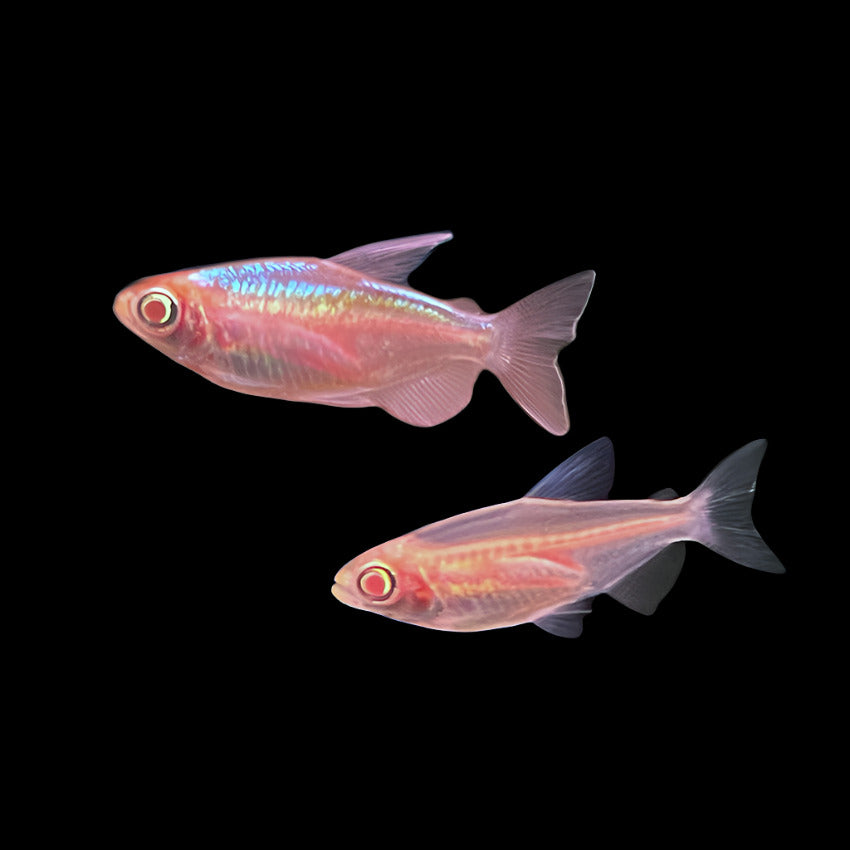
Take away the pigment and the iridescence stays. That is the whole point of the Albino Congo Tetra. Strip the dark scale pigment from a standard Congo and what remains is a pearl-white and gold body that still throws the same shifting blue-green sheen across the flank — but now it glows rather than flashes, and it reads from across a room in a way the wild form never does.
Mature males carry the same elegant fin extensions as the standard form: long dorsal and anal fins, and the distinctive elongated middle rays of the tail, here rendered in translucent white and soft gold rather than dark plum. Eyes are pink-red. Temperament is unchanged — peaceful, shoaling, and an easy fit in a medium to large community tank. A group of these against dark substrate and dim light is one of the most striking centrepiece displays available in freshwater.
Dim the lights — this one genuinely needs it. Albino fish have no protective eye pigment. Bright overhead lighting is uncomfortable for them and keeps them hiding and washed out. Floating plants, a dark substrate and a moderate light are not aesthetic suggestions here; they change how the fish behaves.
Care Snapshot
| Scientific name | Phenacogrammus interruptus — line-bred albino form |
| Family | Alestidae — African tetras |
| Origin | Aquacultured in Asia; species endemic to the Congo River basin |
| Adult size | 8 cm+ (males larger than females) |
| Lifespan | 3–5 years |
| Minimum tank | 110 litres, minimum 75 cm length |
| Temperature | 23–28 °C |
| pH | 6.0–7.5 — slightly acidic preferred |
| Hardness | 4–8 dKH |
| Diet | Omnivore and micropredator — dry, frozen and live foods |
| Temperament | Peaceful, shoaling; keep 6+ |
| Care level | Easy to moderate |
| Swimming zone | Top and middle, feeds at all levels |
Setting Up For It
- Dark substrate is doing the work. A pearl-white fish over pale gravel disappears. Over black sand it becomes a lit object. This is the single decision that determines whether the tank looks like the photographs.
- Diffuse the light. Floating plants, tall background stems, or simply a dimmer setting. Direct high-intensity light over an albino fish means a shy fish.
- Length over height. An active swimmer that patrols. Keep the front two-thirds open and plant to the back and sides.
- Tannins suit it. Catappa leaves and driftwood give the soft, acidic, shaded water this species evolved in, and the warm tint flatters the gold tones.
- Tight lid. Congo Tetras jump, particularly in the first fortnight and when a dark room is suddenly lit.
Tank Mates
Good matches
Standard Congo Tetras — the two forms school together and the contrast is superb. Also rainbowfish, larger rasboras, Denison Barb, Kribensis, Corydoras, Bristlenose Pleco, Synodontis, and larger invertebrates such as Amano, Bamboo and Vampire shrimp, Nerite and Mystery snails.
Keep away from
Dwarf shrimp — Neocaridina and Caridina will be hunted. Also avoid fin-nippers such as Tiger Barbs, which target the males' extensions, plus fast greedy feeders that will out-compete an albino at the surface, and anything aggressive or small enough to swallow.
Note: kept in a group of only three or four, Congo Tetras become nervous and may nip each other. This stops once the school is large enough.
Feeding
Undemanding, but the mouth stays small relative to the body, so keep particle sizes modest even on adults. Albino stock has weaker eyesight than the standard form and locates food more slowly — feed in two or three smaller portions rather than one large drop, and watch that faster tank mates are not clearing everything first.
From the AQA range, run a quality community flake or small pellet as the daily staple twice a day, with a frozen or freeze-dried meaty food two or three times a week. Feed only what the group clears in about two minutes.
Foods it responds to particularly well: frozen bloodworm, brine shrimp, daphnia, mysis, and live blackworm for conditioning.
Sexing & Breeding
Males grow larger and deeper-bodied, carry stronger gold iridescence, and develop the extended dorsal, anal and central tail-fin rays. Females stay smaller, rounder and plainer. Sexing is unreliable below about 4 cm, and the usual colour cues are subtler on albinos than on the standard form — go by fin length and body depth instead.
Breeding follows the standard form: condition heavily on live food, spawn over fine-leaved plants or a mop in soft, acidic, shaded water, and remove the adults afterwards. The eggs are unusually light-sensitive and take around six days to hatch — keep the tank dark. Albino is a recessive trait, so albino × albino breeds true, while albino × standard produces standard-looking fry carrying the gene.
Keeping It In Indian Conditions
- Room temperature across most of India sits inside the 23–28 °C range for much of the year. A heater set to 24 °C is worth it only for northern and hill-station winters where night-time dips are sharp.
- Summer is the real constraint. Above 30 °C, dissolved oxygen falls and this active species shows it early — surface gasping and lethargy. Increase surface agitation and run a fan across the water during peak heat.
- Hard, alkaline municipal water is tolerated well by aquacultured stock, though colour is best in softer, tannin-stained water. Catappa leaves are the cheapest route to it.
- Keep the tank out of direct sunlight. Indian window light is far stronger than in temperate climates, and an albino fish has no eye pigment to shield it.
What You Receive
Aquacultured juveniles, quarantined and conditioned at our Bengaluru facility before dispatch. Sex cannot be guaranteed at this size, and full male finnage and colour develop over 12–18 months. Packed with oxygen and insulation for pan-India delivery.
Covered by the Best4Pets live arrival guarantee. Please film an unboxing video before opening the bag — it is required for any DOA claim.