- Product
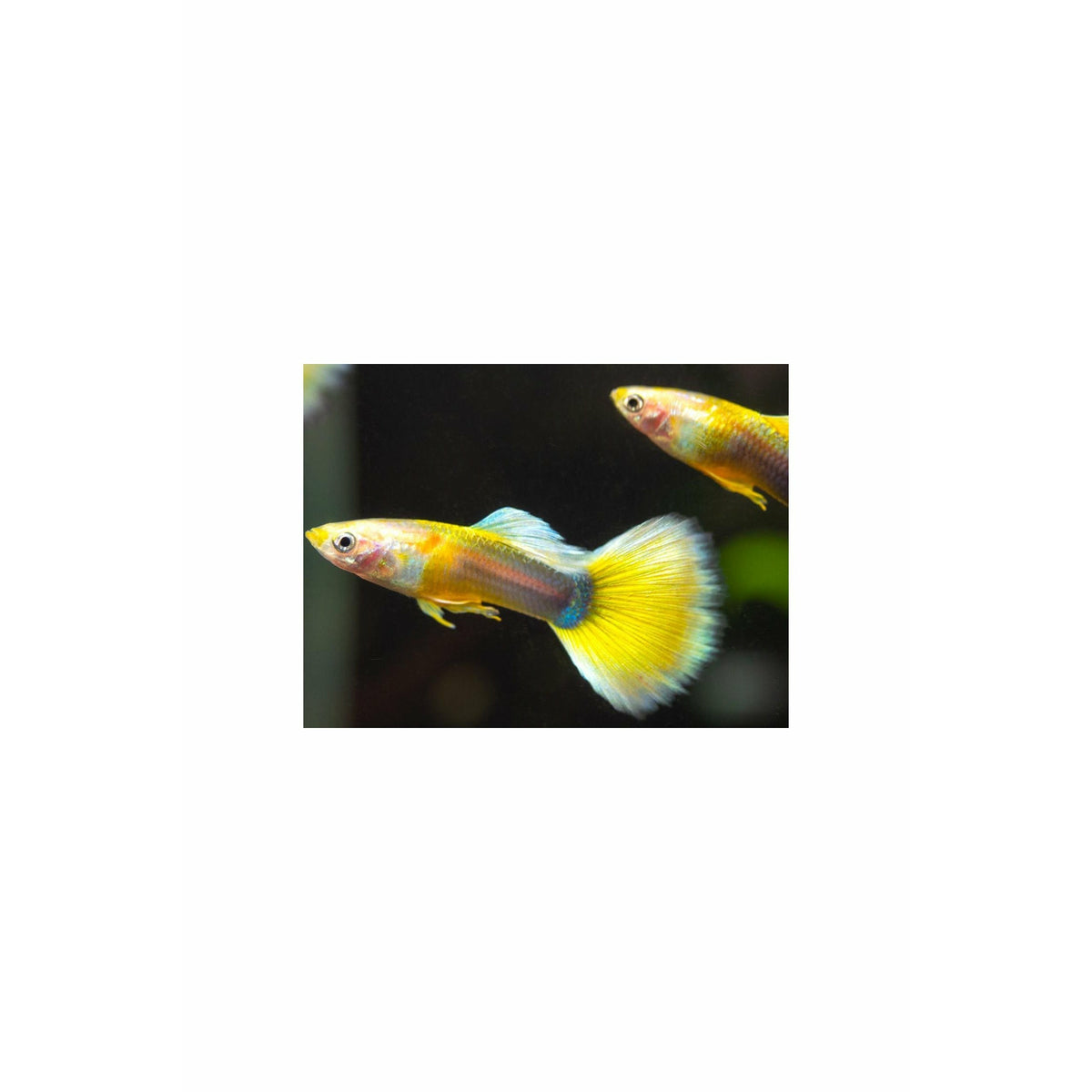
- Yellow tuxedo guppy (pair)

Yellow Tuxedo Guppy (Pair)
Couldn't load pickup availability
Gold fins with a black saddle. The Yellow Tuxedo carries the half-black saddle across the rear body with warm yellow-to-gold fins and tail. The black frames the yellow so it glows — one of the brightest-looking guppies you can keep, and one of the toughest.
Half-black yellows are a classic, stable strain and an excellent choice for a first breeding pair: they breed true, colour up early and handle Indian conditions well. The yellow deepens with a good diet and the saddle darkens as the fish mature.
Feed for colour.
Yellow pigment depends on diet. On flake alone it fades towards cream. Live and frozen foods and a colour-rich staple keep the gold strong.
Care Snapshot
| Scientific name | Poecilia reticulata |
| Also known as | Yellow Half-Black Guppy; a half-black strain of Poecilia reticulata |
| Family | Poeciliidae — livebearers |
| Origin | Tank-bred line; wild species native to north-east South America and the Caribbean |
| Adult size | 3–6 cm — females noticeably larger |
| Lifespan | 1.5–3 years |
| Minimum tank | 40 litres for a small group |
| Temperature | 22–28 °C |
| pH | 7.0–8.0 |
| Hardness | 8–20 dGH — hard water |
| Diet | Omnivore — small, varied foods |
| Temperament | Peaceful |
| Care level | Easy |
| Swimming zone | Top and middle |
Setting Up For It
- Dark substrate. Yellow shows far stronger over dark sand than over pale gravel.
- Soft, bushy planting over hardscape. Guppies have no use for caves. What they want is dense, fine-leaved growth near the top of the water, which doubles as a nursery and a refuge.
- Filter for the bioload, not the current. Livebearers eat a lot and multiply quickly. Oversize the filter media but baffle the outlet so the water surface moves without a pull across the tank.
- Keep the water fresh and the nitrate low. A heavily stocked livebearer tank fouls faster than people expect. A regular 25–35% weekly change does more for fin quality than any supplement.
- One male to two or three females. This listing is a pair, which is fine to start, but one male will wear a single female down. Adding one or two females of the same strain spreads his attention and keeps the line consistent.
- Fit a lid. Guppies live near the surface and a startled male will jump, particularly in the first week.
Tank Mates
Good matches
Other peaceful hard-water fish: Platies, Mollies, small Rasboras, Corydoras, Bristlenose Pleco, Otocinclus, Neocaridina and Amano shrimp, Ramshorn and Nerite snails.
Keep away from
Tiger Barbs, Serpae Tetras, Black Widow Tetras and other fin-nippers; male Bettas, which see guppy fins as a challenge; Angelfish and anything large enough to eat a 3 cm fish; boisterous cichlids.
Adult shrimp are safe; guppy fry and shrimplets will both get eaten by larger tank mates, so dense moss is your friend.
Feeding — Do Not Overfeed
They are surface feeders with small mouths, so food that floats or sinks slowly suits them best. Offer a little two or three times a day rather than a heap once, and skip a day each week to keep the digestion clear.
From the AQA range, use a fine flake or micro granule as the daily staple, and add frozen or live foods several times a week — this is what drives colour and fin growth in young males.
Favourites: baby brine shrimp, moina, daphnia, finely chopped bloodworm, spirulina-based foods and the occasional crushed pea.
Sexing & Breeding
Males are slim with the gonopodium, the deepest saddle and the broadest yellow tail. Females are larger and rounder with a gravid spot and a smaller, paler yellow tail.
Breeding is effortless; the planning is not. Fry are born free-swimming and take crushed flake and baby brine shrimp from day one. Have somewhere to grow them on and someone to take the surplus — a guppy tank with no plan doubles its population every couple of months.
Keep the strain pure: guppy strains interbreed freely, and mixed lines lose their pattern within a generation or two. Do not cross with Endlers (Poecilia wingei) either if you want the line to stay true.
Keeping It In Indian Conditions
- Skip the softening. Bengaluru and most Indian tap and borewell water sits comfortably in the guppy range. RO water, peat and catappa leaves work against them; keep those for your soft-water fish.
- Keep them under 30 °C if you can. Warm water speeds up metabolism, breeding and ageing all at once. Shade, a fan and extra aeration are worth the effort in the hottest months.
- Never add untested guppies straight to the display. Flukes and columnaris spread quickly in a livebearer tank. Our fish are quarantined at our Bengaluru facility; fish from markets and fairs should get a fortnight on their own first.
- Power cuts: a crowded livebearer tank loses oxygen quickly in summer. A battery-backed air pump is cheap insurance.
What You Receive
Yellow Tuxedo Guppy from a tank-bred line. One male and one female. All stock is quarantined and conditioned at our Bengaluru facility before dispatch. Colour, pattern and fin size continue to intensify with age — young fish are a preview, not the finished article. Packed with oxygen and insulation for pan-India delivery.
Covered by the Best4Pets live arrival guarantee. Please film an unboxing video before opening the bag — it is required for any DOA claim.