- Product
- Yellow-tail congo tetra (pair)

Yellow-Tail Congo Tetra (Pair)
Couldn't load pickup availability
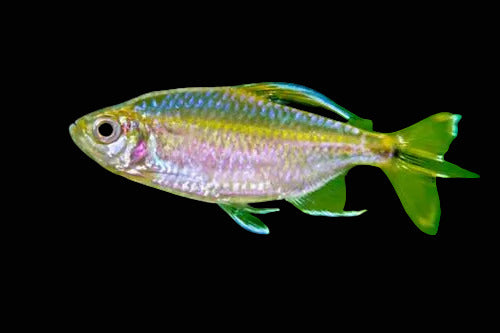
The tail is the whole signature. A mature male Yellow-Tail Congo Tetra carries a bright lemon-yellow caudal fin split by a black central stripe, above a flank that shifts through violet, steel blue and green depending on the angle. The dorsal and anal fins extend into long white-tipped points. Nothing else in the hobby looks like it.
This is a genuinely uncommon African tetra — a different genus from the familiar Congo Tetra, smaller, slimmer and, to many keepers, better proportioned for a mid-sized planted tank. Juveniles arrive plain silver and give no hint of what is coming; the yellow and the violet build in over several months. Temperament is easy throughout: peaceful, constantly active, and content in a community as long as it is in a proper school.
Buy 8, mixed sexes, and grow them on. Males only produce their full colour and fin extensions when they have rivals to display to and females to display for. A group of four will stay silver and nervous, and the fish will be written off as dull when it simply has no reason to perform.
Care Snapshot
| Scientific name | Alestopetersius caudalis |
| Also known as | Yellow-Tailed African Tetra, Yellowtail Tetra |
| Family | Alestidae — African tetras |
| Origin | Tank-bred; native to the Congo River basin, DR Congo |
| Adult size | 5–6 cm |
| Size on arrival | Approx. 2.5 cm |
| Lifespan | 3–5 years |
| Minimum tank | 115 litres, minimum 75 cm length |
| Temperature | 22–26 °C |
| pH | 5.0–7.5 — acidic strongly preferred |
| Hardness | 3–15 dKH |
| Diet | Omnivore — dry, frozen and live foods |
| Temperament | Peaceful, shoaling; keep 8+ |
| Care level | Easy to moderate |
| Swimming zone | Top and middle, feeds at all levels |
Setting Up For It
- Open swimming length at the front. A restless mid-water swimmer. Plant the back and sides, leave the front two-thirds clear, and prioritise tank length over height.
- Dark substrate and softened light. Over pale gravel under a bright light the fish stays washed out and jumpy. Dark sand plus a partial screen of floating plants is what brings out the violet on the flank and makes the yellow tail read.
- Blackwater conditions genuinely help here. This species tolerates pH down to 5.0 and comes from tannin-stained, leaf-littered water. Catappa leaves and driftwood are worth the effort for both colour and settling behaviour.
- Keep nitrate low. Less forgiving of accumulated nitrate than the standard Congo Tetra — long-fin quality in males suffers first. Weekly water changes, not fortnightly.
- Tight lid. Skittish for the first fortnight and a capable jumper, especially if a dark room is suddenly lit.
Tank Mates
Good matches
Kribensis and other peaceful West African cichlids, African Butterfly Cichlid, standard Congo Tetra, rasboras, Corydoras, Bristlenose Pleco, Synodontis, and larger invertebrates — Amano, Bamboo and Vampire shrimp, Nerite and Mystery snails.
Keep away from
Dwarf shrimp — Neocaridina and Caridina will be hunted. Also avoid Tiger Barbs and other fin-nippers, which go straight for the males' extensions, plus any aggressive cichlid or boisterous fast feeder.
Note: in a group of only three or four, this species becomes nervous and males may nip one another. The behaviour disappears once the school is large enough.
Feeding
Not fussy, but the mouth is small even on adults — keep particle sizes modest. Colour and fin development respond directly to diet, so this is not a fish to run on basic flake alone if you want the yellow tail and violet flank to arrive properly.
From the AQA range, use a colour-enhancing community flake or small pellet as the daily staple twice a day, rotating in a frozen or freeze-dried meaty food two or three times a week. Feed only what the school clears in about two minutes.
Foods it responds to particularly well: frozen daphnia, cyclops, baby brine shrimp, chopped bloodworm, and live blackworm for conditioning.
Sexing & Breeding
Males carry the bright yellow caudal with its black central rays, extended white-tipped dorsal and anal fins, and much stronger violet-blue iridescence. Females are smaller, rounder in the belly, with plain short fins and a far paler tail. The difference is obvious by around 4 cm and absent below that.
Breeding is possible in a dedicated tank but is not a beginner project. Condition a group on live food, then spawn over fine-leaved plants or a mop in soft, acidic, dimly lit water. Eggs are scattered and are light-sensitive, so shade the tank. Remove the adults after spawning — they will eat the eggs. Fry are small and need infusoria or liquid fry food before they can take baby brine shrimp.
Keeping It In Indian Conditions
- The 26 °C ceiling is the thing to plan around. This species runs cooler than the standard Congo Tetra and is less tolerant of heat. In Chennai, Mumbai, Kolkata and the plains, summer tank temperatures will exceed its comfort range without active cooling.
- Manage summer with a fan blown across the water surface, increased aeration, a lifted lid for evaporative cooling, and slightly reduced feeding during the hottest stretch. Bengaluru, Pune and hill-station keepers will rarely need any of this.
- Winter in the north may call for a heater set to 23 °C to prevent sharp night-time dips.
- Hard, alkaline municipal supplies are tolerated by tank-bred stock, but this species shows the difference more than most. Catappa leaves, driftwood, or a share of RO water will visibly change the colour within weeks.
What You Receive
Tank-bred juveniles, approximately 4.5 cm, quarantined and conditioned at our Bengaluru facility before dispatch. At this size the fish are silver and unsexed — the yellow tail, violet flank and male finnage develop over the following months. Packed with oxygen and insulation for pan-India delivery.
Covered by the Best4Pets live arrival guarantee. Please film an unboxing video before opening the bag — it is required for any DOA claim.