- Product
- Venus cichlid 4-5"

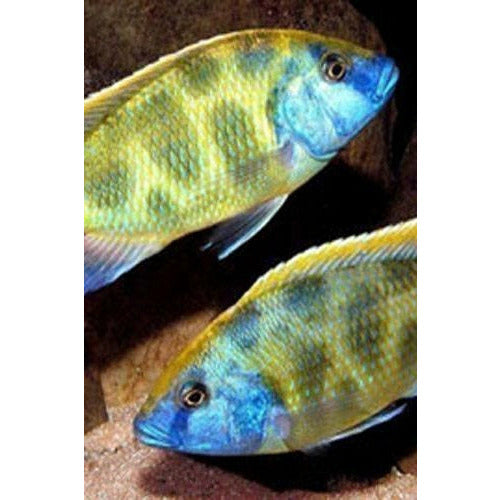
Venus Cichlid 4-5"
Couldn't load pickup availability
It plays dead to catch dinner. In the lake, a Venustus will bury itself partly in the sand and lie still, its blotched giraffe-print pattern breaking up its outline, until a small fish comes close enough to pick at what looks like a carcass. Then it strikes. It is one of the most remarkable hunting strategies in Lake Malawi, and an aquarium Venustus still shows hints of it, lying motionless on the sand before a feed.
It is also a big, beautiful display fish. A mature male turns electric blue across the face and head, with a gold-yellow body and those irregular brown patches running down the flanks. It is a hap rather than an mbuna — calmer, bigger and more open-water — but it is a predator first, and that shapes every decision about tank size and tank mates.
Plan for a 25 cm predator before you buy a 7 cm juvenile.
A Venustus grows fast and eats anything that fits in its mouth, including small mbuna and Yellow Labs it grew up with. It needs a tank of 450 litres or more, 180 cm long, with tank mates that will stay too big to swallow. Buy one only if that tank is already running.
Care Snapshot
| Scientific name | Nimbochromis venustus |
| Also known as | Venustus, Giraffe Cichlid, Venus Cichlid; formerly Haplochromis venustus |
| Family | Cichlidae — Lake Malawi haplochromine cichlids (haps) |
| Origin | Farm-bred; wild form widespread over sandy areas of Lake Malawi |
| Adult size | 20–25 cm (males larger) |
| Arrival size | 4–5 inch |
| Lifespan | 10–12 years |
| Minimum tank | 450 litres, minimum 180 cm length |
| Temperature | 24–28 °C |
| pH | 7.6–8.6 |
| Hardness | 8–20 dGH — hard, alkaline water |
| Diet | Piscivore — meaty sinking foods, kept lean |
| Temperament | Calm towards fish its size; predatory towards small fish |
| Care level | Moderate — easy to keep, demanding to house |
| Swimming zone | Bottom and middle |
Setting Up For It
- Big, long tank. 180 cm minimum length for an adult with a few companions. Venustus need room to cruise and turn, and a stunted fish in a small tank never reaches its full colour.
- Open sand floor. Fine sand across most of the tank, with rock piled at one or both ends. Haps want swimming space more than caves.
- Strong filtration. Large, messy, meat-eating fish. Use a canister or sump rated at four times the tank volume per hour, and change 30–40% weekly.
- Hard, alkaline water. pH 7.6–8.6, buffered with crushed coral or aragonite if your source drifts lower.
- Heavy, stable rockwork. A 25 cm fish can move loose stones. Stack rock on the base glass and keep it low and secure.
- Secure lid. Big haps can jump when startled.
Tank Mates
Good matches
Other large haps and peacocks that will stay too large to eat: Blue Dolphin, Fossorochromis rostratus, Livingstonii, larger Protomelas and Copadichromis, adult peacocks of 10 cm or more, large Synodontis.
Keep away from
Small mbuna, Yellow Labs, juvenile peacocks and anything under about 8 cm — they will be eaten. Very aggressive mbuna that harass the calmer hap. Other Nimbochromis such as Livingstonii if you plan to breed, as females look similar and hybrids occur.
Add tank mates at the same size or larger. A group of juveniles grown out together is the smoothest way to stock a Venustus tank.
Feeding — A Predator That Still Needs A Lean Diet
In the wild it eats fish, but feeder fish in the aquarium are the fastest route to disease and a fish that refuses everything else. Prepared foods are better and safer, and Venustus takes them readily.
Feed a large sinking cichlid pellet once a day for adults and twice for juveniles. From the AQA range, a sinking cichlid pellet sized to the fish makes a good staple, with frozen meaty foods two or three times a week. Keep it lean — haps get bloat too, and fatty foods such as beef heart are a mistake.
Foods it takes eagerly: frozen krill, mysis, chopped prawn, silversides, and a spirulina pellet occasionally for balance. No live feeder fish.
Sexing & Breeding
Males grow larger and develop the bright blue face and head, a golden body and egg spots on the anal fin. Females and juveniles stay silvery-yellow with brown giraffe blotches. Juveniles cannot be sexed; males usually colour up from 12–15 cm.
A maternal mouthbrooder. A female can carry a large brood — often 50 or more — for around three weeks. Fry are big enough for crushed pellets and baby brine shrimp on release. Keep only one Nimbochromis species to avoid hybrids.
Keeping It In Indian Conditions
- Hard borewell water is ideal. The hard, alkaline water found across Bengaluru and much of India is close to what this fish wants. Test and buffer only if the pH slips below 7.5.
- Big tanks still overheat. Keep the tank below 29 °C in summer with a fan and extra aeration, and reduce feeding during heatwaves.
- Large fish, large oxygen demand. A tank of 20 cm haps runs short of oxygen fast during a power cut. An inverter line for the filter or a battery-backed air pump is essential.
- Avoid feeder fish. Live guppies and mollies from Indian markets often carry parasites and disease. Frozen krill and prawn are widely available and far safer.
What You Receive
Farm-bred juveniles and young adults, supplied at 4–5 inch, quarantined and conditioned at our Bengaluru facility before dispatch. Sex cannot be reliably determined until fish are 12 cm or more; pair listings are selected by eye and are not guaranteed. Young fish show the giraffe pattern but not the blue face, which develops in males with age. Packed with oxygen and insulation for pan-India delivery.
Covered by the Best4Pets live arrival guarantee. Please film an unboxing video before opening the bag — it is required for any DOA claim.