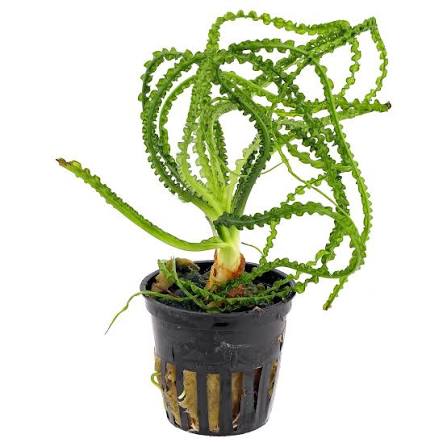
Title: African Onion Plant (Crinum calamistratum)
Couldn't load pickup availability
Long dark ribbons with crimped edges, growing from an onion. Crinum calamistratum is a bulb plant from Cameroon that throws narrow, almost black-green leaves a metre long, each one deeply corrugated along both edges so it twists and ripples in the current. Nothing else in a freshwater tank looks remotely like it.
It is also close to indestructible. The leaves are leathery and unpalatable, which makes this one of the very few plants that survives large cichlids and goldfish. It needs no CO2, tolerates hard alkaline water and Indian room temperature without complaint, and a settled bulb will keep going for years — this is a plant you buy once and still have a decade later.
Do not bury the whole bulb.
Plant the roots and the lower half of the bulb, leaving the top third to half sitting proud of the substrate. A fully buried bulb rots, and that is the single most common way this plant is lost. It should look slightly awkward when you have planted it correctly.
Care Snapshot
| Scientific name | Crinum calamistratum |
| Also known as | African Onion Plant, Crinkled Crinum, Thin Onion Plant |
| Family | Amaryllidaceae |
| Origin | Nursery-propagated; the species is West African (Cameroon) |
| Plant type | Bulb plant with heavy root system |
| Placement | Background or corner specimen |
| Leaf length | 60–120 cm, roughly 1 cm wide |
| Growth rate | Slow — very long-lived |
| Lighting | Low to medium — undemanding |
| CO2 | Not required |
| Temperature | 23–29 °C |
| pH | 6.0–8.0 — wide tolerance |
| Hardness | Soft to hard — handles Indian tap water well |
| Substrate | Fine sand or gravel, 6 cm+ deep |
| Fertilisation | Root tabs — it feeds almost entirely through the roots |
| Difficulty | Easy — the hard part is patience and space |
How Big It Actually Gets
Works well in
Tanks 45 cm tall or deeper, 90 litres upward, with 6 cm or more of substrate. Best in a back corner where the leaves can arc up and then trail along the surface — that sprawl is part of the look, not a problem to solve.
Think twice in
Shallow or nano tanks. Leaves reaching a metre will lie flat across the surface of a 30 cm tank and shade everything beneath. Trimming them short does not work — cut leaves do not regrow from the tip and simply die back.
Planting It
- Top of the bulb stays exposed. Bury the roots and the bottom half of the bulb only. Leave the upper third to half above the substrate line.
- Deep substrate. 6 cm or more. The root system is substantial and the bulb needs to sit stably without being pushed deeper over time.
- Root tabs from day one. This plant feeds through its roots almost exclusively. In plain sand or gravel with no tabs it will survive but barely grow.
- Back corner, and leave it there. Crinum resents being lifted and can sulk for months afterwards. Place it once, properly.
- Be patient for the first few months. A newly planted bulb often does nothing visible for weeks, then sends up one leaf at a time. This is normal. Do not dig it up to check on it.
- Do not trim the leaves to fit. A cut leaf will not regrow from the cut and usually dies back to the bulb. If the leaves are too long for your tank, the tank is the problem, not the leaves.
What Usually Goes Wrong
The bulb rots. Buried too deep, nearly always. A soft, mushy bulb that smells is finished. Caught early, lift it, cut away the soft tissue with a clean blade and replant the firm portion with more of it exposed.
Nothing happens for months. Usually just the establishment period, sometimes a lack of root nutrition. Add a root tab and wait. This plant operates on a timescale closer to a garden shrub than an aquarium stem plant.
Old leaves yellow and die back. Normal turnover. Trim the dead leaf off at the base once it has gone, and check that new ones are still coming — a plant producing new leaves while shedding old ones is healthy.
Propagation
A mature, well-fed bulb eventually produces small offset bulbs alongside it. Leave each one attached until it has several leaves and its own root mass — often a year or more — then separate it carefully and plant it with the top of the bulb exposed. This is slow by any standard, which is precisely why established Crinum is expensive everywhere. Under good conditions the plant may also flower, sending a stalk to the surface with a white, spidery bloom. It is rare in aquaria and harmless to the plant.
What It Pairs With
This is the cichlid and goldfish plant. The leaves are tough and unpalatable enough that Oscars, Severums, larger Africans and goldfish generally leave them alone — a very short list of aquarium plants can say that, and it is the main reason people seek this species out. It is also shrimp-safe and snail-safe, and it stands up to Corydoras and loaches digging around the base. Underplant with Cryptocoryne or Anubias on wood; the fine ribbon leaves above broad foliage below is a good contrast.
Growing It In Indian Conditions
- Hard, alkaline tap water suits it. No RO, no buffering, no CO2. Another of the small group of genuinely striking plants that will simply grow in an ordinary Indian tank.
- Heat is not an issue. Comfortable to around 29 °C, so peak Indian summers cause no trouble. Where fine-leaved stem plants melt in April and May, this carries on unchanged.
- No heater needed anywhere in India for most of the year.
- Buy one good bulb rather than several small ones. Growth is slow, so a larger established bulb is worth the difference — and one plant is usually all a tank has room for.
What You Receive
Nursery-propagated bulbs held and conditioned at our Bengaluru facility. No wild-collected stock. Bulb size and leaf count vary naturally, and leaves reach full length only over months of growth in your own tank. Plant with the top of the bulb exposed; some older leaves may be shed after planting while the plant establishes, which is normal and is not a fault.
Covered by the Best4Pets live arrival guarantee. Please film an unboxing video before opening the bag — it is required for any DOA claim.