- Product
- Tiger oscar cichlid 2.5" (pair)

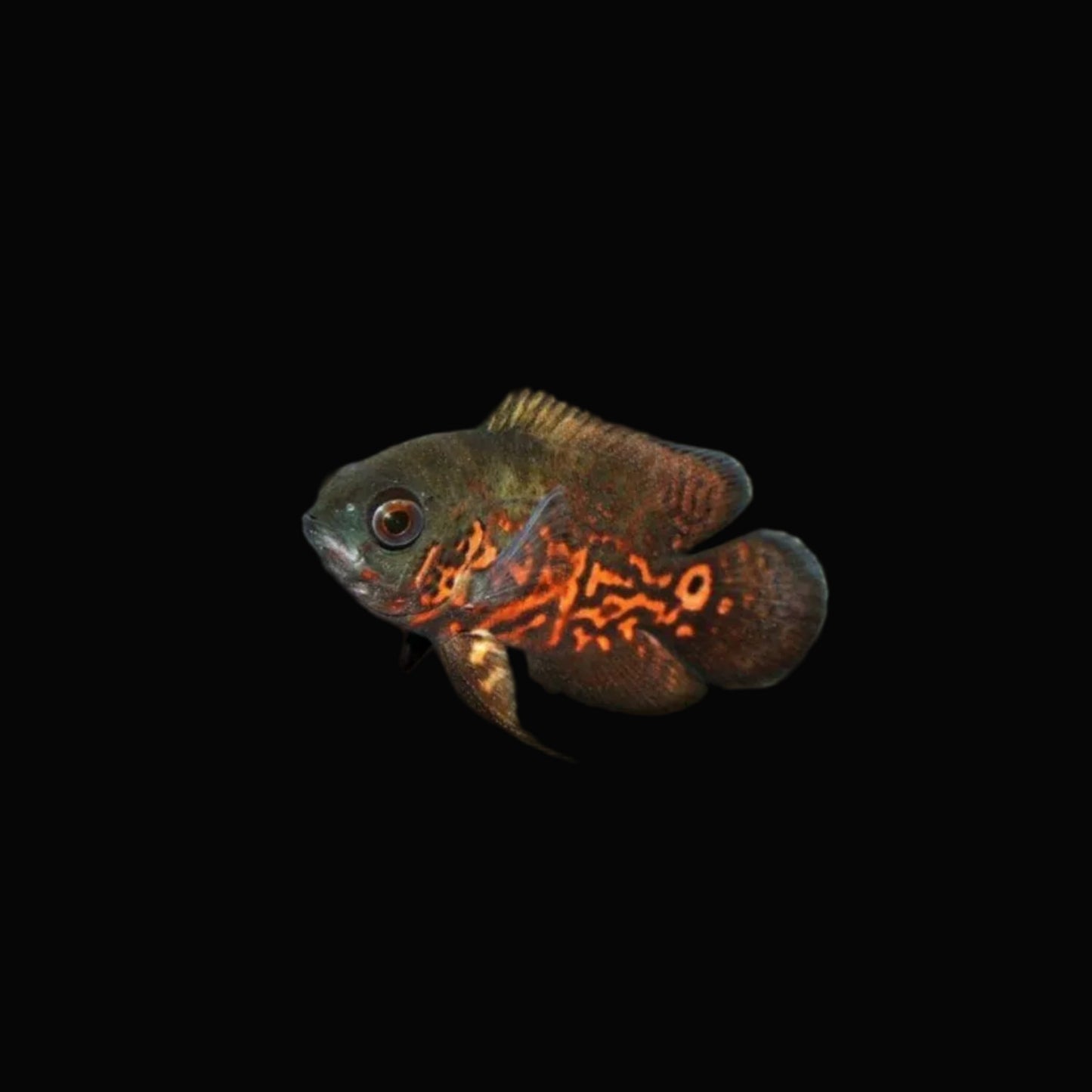
Tiger Oscar Cichlid 2.5" (Pair)
Couldn't load pickup availability
A pet fish that knows your face. Oscars recognise the person who feeds them, follow you along the glass, sulk when the décor is moved and beg like a dog. The Tiger Oscar adds bold red-orange marbling over a near-black body, and a full-grown one is one of the most commanding fish you can keep in a home aquarium.
The Tiger is a line-bred colour form of Astronotus ocellatus, selected on farms for heavier, brighter red patterning than the wild fish. Underneath it is a big, fast-growing, heavily eating predator. It will be 25 cm within a couple of years and 30 cm or more as an adult, it produces a great deal of waste, and it treats any fish that fits in its mouth as food. Given the right tank, it is a rewarding companion for well over a decade.
The tank is the decision: 300–400 litres for one adult.
A 2-inch Oscar grows into a 30 cm, heavy-bodied fish in about two years. Kept in a small tank it becomes stunted, develops hole-in-the-head and lives a fraction of its natural span. If a tank of at least 300 litres — ideally more, and more again for a pair — is not part of the plan, do not buy an Oscar.
Care Snapshot
| Scientific name | Astronotus ocellatus |
| Also known as | Tiger Oscar, Red Tiger Oscar; line-bred colour form of the Oscar |
| Family | Cichlidae — South American cichlids |
| Origin | Farm-bred colour strain; wild Oscars native to the Amazon basin |
| Adult size | 30–35 cm |
| Arrival size | about 2.5 inch |
| Lifespan | 10–15 years, sometimes longer |
| Minimum tank | 300–400 litres for one adult, more for a pair; minimum 150 cm length and 50 cm depth front to back |
| Temperature | 24–29 °C |
| pH | 6.0–7.8 |
| Hardness | 3–15 dGH — soft to moderately hard |
| Diet | Carnivore-leaning omnivore — large pellets and meaty foods |
| Temperament | Semi-aggressive; eats anything that fits in its mouth |
| Care level | Moderate — hardy fish, demanding tank |
| Swimming zone | Middle and lower |
Setting Up For It
- Oversized filtration. Oscars are among the messiest aquarium fish. Run a large canister or sump rated for at least double the tank volume, and change 30–50% of the water weekly.
- Simple, heavy décor. They redecorate. Use large smooth rocks resting on the glass and a few big pieces of driftwood. Anything light or loose will be moved.
- Sand or bare bottom. Fine sand is easy to keep clean and safe when the fish digs. Avoid small gravel that can be swallowed.
- Secure the heater and lid. Adults can crack glass heaters by ramming them; use a guard or an inline heater. A strong, heavy lid stops jumping.
- Skip delicate plants. Rooted plants get uprooted and eaten. Anubias on wood, or floating plants, may survive.
Tank Mates
Good matches
Other Oscars in a big enough tank, Silver Dollars, large plecos such as Sailfin pleco, Severums, Green Severums, large Geophagus, Clown Knifefish and Arowana in very large systems.
Keep away from
Any fish small enough to swallow — tetras, guppies, danios and small catfish. Aggressive Central Americans and Flowerhorns, which cause serious fights. Fin-nippers. Shrimp and snails are food.
Many keepers end up with a single Oscar as a pet fish, and that is a perfectly good choice.
Feeding — Big Appetite, Not Live Feeders
Oscars will eat almost anything, which is exactly why diet goes wrong. Live feeder fish carry disease and teach the Oscar to refuse prepared food; fatty meats such as chicken or beef heart cause fatty liver. A quality pellet should do most of the work.
Feed juveniles twice a day and adults once a day, only what is eaten in a couple of minutes. From the AQA range, a large-grade cichlid pellet makes a sound staple, with frozen prawn, krill and earthworms two or three times a week and the occasional piece of blanched pea.
Foods it takes eagerly: large pellets and sticks, frozen krill and prawn, chopped fish, earthworms, crickets, mussel.
Sexing & Breeding
Oscars cannot be sexed reliably from the outside. During spawning, the female shows a blunt breeding tube and the male a narrower, pointed one. The only dependable route is to raise five or six young fish together and let a pair form — which needs a very large tank.
A pair cleans a flat stone and lays several hundred to a thousand or more eggs. Both parents guard eggs and fry. Breeding is common in big tanks, but finding homes for hundreds of fish that need 300 litres each is the real challenge.
Keeping It In Indian Conditions
- Hardy in Indian heat. Oscars handle 28–30 °C comfortably. Above 31 °C, warm water holds little oxygen for such a large fish — add an air stone and a fan.
- Power cuts are serious. A big Oscar in a heavily stocked tank can go short of oxygen within an hour. A battery air pump or inverter line for the filter is essential, not optional.
- Heater for winter. In Bengaluru and northern winters, set a guarded heater to 26–27 °C; cold, sluggish Oscars stop eating and get sick.
- Most water works. Dechlorinated municipal or borewell water is fine, but very hard water plus infrequent changes is a common route to hole-in-the-head. Water volume and changes matter more than chemistry.
- Food is easy to source. Large pellets and frozen prawn are widely available. Avoid market feeder fish.
What You Receive
Farm-bred juveniles, supplied at about 2.5 inch, quarantined and conditioned at our Bengaluru facility before dispatch. Where sold as a pair, it is two fish; sex cannot be determined or guaranteed at this size. The red tiger pattern varies between fish and strengthens with age. Packed with oxygen and insulation for pan-India delivery.
Covered by the Best4Pets live arrival guarantee. Please film an unboxing video before opening the bag — it is required for any DOA claim.