- Product
- Threadfin goby 3inch

Threadfin Goby 3inch
Couldn't load pickup availability
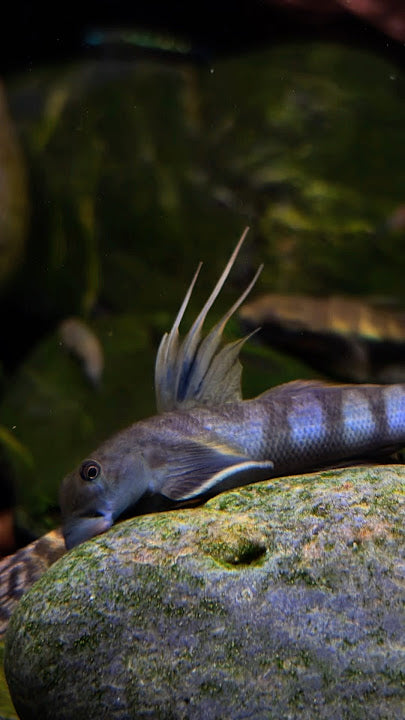
The name means "long thread", and it refers to the fins. Displaying males of Sicyopterus longifilis raise a first dorsal fin whose leading rays extend into fine trailing filaments, held up like a banner during standoffs over grazing territory. The rest of the time the fish is a mottled stone-coloured shape clamped to a rock, and you would walk past it. The switch between the two is the whole appeal.
This is a waterfall-climbing goby. Its pelvic fins are fused into an adhesive disc strong enough to hold station in torrential current and haul the fish up wet vertical rock — the same architecture that lets its relatives colonise island streams hundreds of metres above the sea. Its mouth is equally specialised: an underslung scraper carrying rows of fine teeth that are shed and replaced continuously as they wear against stone.
Specialist species — please read before ordering.
Wild-collected, impossible to breed in home aquaria, and an obligate algae scraper that will not switch to conventional aquarium food. It needs a mature, algae-covered river tank with strong flow, high oxygen and water held below about 26 °C. Placed in an ordinary tropical community tank it will starve over several weeks while appearing outwardly healthy. If that setup is not something you can commit to, we would genuinely rather you bought something else.
Care Snapshot
| Scientific name | Sicyopterus longifilis (Weber, 1895) |
| Family | Oxudercidae, subfamily Sicydiinae — rock-climbing gobies |
| Origin | Wild-collected — island streams of the New Guinea region |
| Habitat | Fast, clear, rocky stretches of coastal and upland streams |
| Life history | Amphidromous — marine larval stage, freshwater adult |
| Minimum tank | 100 litres, minimum 90 cm length, river-tank layout |
| Temperature | 22–26 °C — cooler than most tropicals |
| pH | 7.0–8.0 |
| Water quality | Ammonia 0 · Nitrite 0 · Nitrate under 20 ppm |
| Flow | Strong and directional, high oxygen — essential |
| Diet | Obligate algae and diatom scraper; gel diets essential in captivity |
| Temperament | Peaceful; males defend grazing territories |
| Care level | Advanced — dedicated setup required |
Building The Right Tank
- Hardscape is the habitat, not decoration. Smooth river cobbles and flat slabs over sand, stacked into ledges and channels. Surface area of grazeable stone is what determines how many fish the tank supports — far more than water volume does.
- Directional flow, 15–20× turnover. Drive current along the tank's length rather than churning it. A powerhead or circulation pump alongside the filter is the standard approach, with the return kept below the surface to avoid microbubbles.
- Oxygen saturation is the priority. These fish come from broken water at the base of rapids. Strong surface movement is mandatory, and becomes critical as the tank warms.
- Mature the tank for six months before the fish arrives. Run the light hard, let the stones green over, and leave them alone. A scraped-clean tank is an empty larder. This step is not optional and cannot be rushed.
- Bright light, deliberately. You are farming diatoms and green film on rock. Resist every instinct to clean the hardscape — glass only.
- Seal the tank completely. This fish climbs wet rock faces in the wild and will climb silicone seams and pipework. Any gap around a hose or heater cable is an exit.
Tank Mates
Good matches
A species tank is best. Otherwise only fellow hillstream specialists on the same cool, high-flow regime — Sewellia and Gastromyzon hillstream loaches, Stiphodon and Rhinogobius gobies, and fast-water danionins that occupy the water column rather than the rocks.
Keep away from
Standard tropical community fish — wrong temperature, wrong flow, and they will clear any food before a deliberate grazer reaches it. Also avoid efficient algae-eaters such as Bristlenose Plecos and large snail colonies, which strip the biofilm this fish depends on. No aggressive or large species.
Males hold grazing territories and will display at rivals. Keep either a single male, or a group in a tank long enough and complex enough that a displaced fish has somewhere to go.
Feeding — This Is What Decides Success
Sicyopterus is among the most specialised feeders in freshwater. The mouth is built to scrape film from stone, and the fish does not chase food, does not take flake from the surface, and will frequently ignore pellets sitting on the substrate. Nearly every failure with this genus is starvation, and it is slow enough that keepers usually blame something else.
Gel food smeared onto a flat stone is the working solution. An algae or spirulina-based gel diet spread thinly across a slab reproduces the scraping action and lets you actually watch the fish feed — which is the only reliable way to know it is eating. Place the stone in a sheltered pocket out of the main current and feed daily.
Supplement with sinking algae wafers, blanched courgette or spinach, and from the AQA range a vegetable-based sinking tablet. Small frozen foods — cyclops, daphnia, baby brine shrimp — are occasionally taken and useful for condition, but they are not the diet.
Watch the belly profile weekly. A hollowing abdomen is the early warning, and by the time behaviour changes it is usually late.
Sexing & Breeding
Males are larger, develop the extended dorsal filaments the species is named for, and show far stronger colour and contrast when displaying. Females remain smaller and plainer, with a shorter dorsal and mottled cryptic patterning. As with all sicydiine gobies, male colour is a mood state rather than a fixed feature — the same fish looks completely different before and after a rival appears.
Captive breeding is not possible in a home aquarium. The species is amphidromous. Adults spawn in freshwater, the tiny larvae are washed downstream to the sea, spend weeks to months developing in marine plankton, and the postlarvae then re-enter river mouths and climb upstream — often over waterfalls — to reach adult habitat. No part of that cycle can be replicated in a tank, which is why every specimen in the trade is wild-caught.
A Note On Wild-Collected Stock
Every one of these fish came out of a wild stream and none can be replaced by captive breeding. Amphidromous species are unusually exposed: they depend on an unbroken connection between headwater, river mouth and sea, so a single weir, culvert or diversion low down a catchment can cut off the entire population above it. Mining, logging and water extraction across the region compound that. We state this on the listing rather than in the small print because we think it should inform the decision. Buy this fish to keep it properly for its full life, not to find out whether you can.
Keeping It In Indian Conditions
- Cooling is the deciding constraint. The working ceiling is around 26 °C. Across the plains and the coast an unmanaged tank sits well above that for months, and heat combined with falling oxygen is precisely what this fish is least able to tolerate. For most of the country, plan for a chiller from the outset and budget it alongside the tank.
- Bengaluru, Pune and hill-station keepers have the easiest run, though even there a surface fan and a cool room will be needed through April and May.
- Because the tank must run cool and heavily oxygenated, this is a dedicated build and will not share a room-temperature tropical community.
- Indian tap water generally sits in the right pH range and suits this species without adjustment. Hard, alkaline water is fine. The ongoing work is nitrate control and keeping the algae film growing faster than the fish grazes it.
What You Receive
Wild-collected specimens, quarantined at our Bengaluru facility and conditioned onto gel and prepared foods before dispatch. Sex, size and colour intensity vary between individuals and cannot be guaranteed. Packed with oxygen and insulation for pan-India delivery.
Covered by the Best4Pets live arrival guarantee. Please film an unboxing video before opening the bag — it is required for any DOA claim. We strongly recommend confirming your tank is mature, cool, algae-established and running strong flow before ordering.