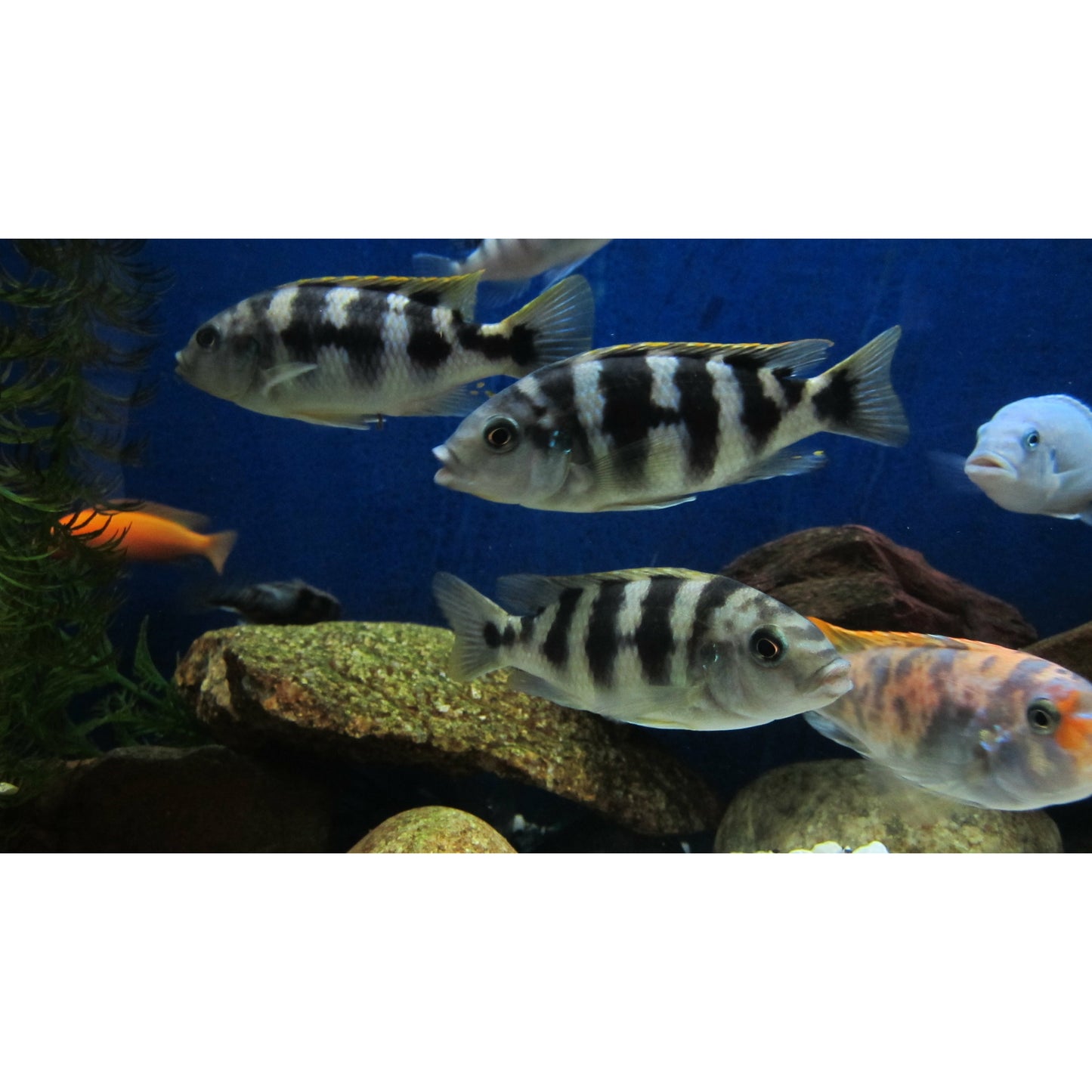
Thick Bar Chitimba (Petrotilapia sp.) 2"
Couldn't load pickup availability
Teeth like a scrubbing brush. Petrotilapia are the heavyweight algae scrapers of Lake Malawi, with a wide mouth packed with fine, comb-like teeth for raking the algae film off rock. The Chitimba "Thick Bar" form adds bold, broad dark bars over a blue body in mature males — a strong, chunky-looking mbuna with real presence.
It is a bigger and tougher fish than the familiar small mbuna, and it needs to be planned for as such. Males grow to around 15 cm and defend a large slice of rock with conviction. It is also one of the stricter vegetarians among Malawi cichlids, which makes diet the other half of the job. Taxonomically it is an undescribed Petrotilapia, named in the trade after the Chitimba area of the lake.
Feed it like a grazer — this is the strictest herbivore in the tank.
Petrotilapia are built to eat algae, and they are among the most bloat-prone Malawi cichlids when fed rich food. Use a vegetable-based staple, keep protein to a rare treat, and never let tank mates' meaty foods become its diet.
Care Snapshot
| Scientific name | Petrotilapia sp. 'Chitimba Thick Bar' |
| Also known as | Thick Bar Chitimba, Petrotilapia Chitimba |
| Family | Cichlidae — Lake Malawi mbuna (rock-dwelling cichlids) |
| Origin | Farm-bred; wild form from the rocky northern shoreline of Lake Malawi around Chitimba |
| Adult size | 13–15 cm (males larger) |
| Arrival size | about 2 inch |
| Lifespan | 8–12 years |
| Minimum tank | 300 litres, minimum 150 cm length |
| Temperature | 24–28 °C |
| pH | 7.6–8.6 |
| Hardness | 8–20 dGH — hard and alkaline |
| Diet | Herbivore — algae scraper, low-protein diet essential |
| Temperament | Aggressive and territorial; a large, assertive mbuna |
| Care level | Moderate to demanding — size and diet both matter |
| Swimming zone | Lower and middle, on and around rock |
Setting Up For It
- 150 cm or longer. A male claims a large territory. In shorter tanks it dominates everything.
- Big, stable rockwork. Large stones set on the base glass, with caves and channels. These are strong fish that dig and push.
- Grow algae on purpose. Good light on the rock lets an algae film develop for constant grazing.
- Heavy filtration. Large, messy herbivores in a densely stocked tank need turnover of five to eight times the volume per hour and weekly 30–40% changes.
- Coral sand or aragonite. Buffers the water and stays clean under heavy grazing.
- One male per tank. Keep one male with three or more females.
Tank Mates
Good matches
Other robust, similarly sized mbuna: Labeotropheus, larger zebras of different colour, Red Zebra, Yellow-tail Acei in numbers, and large synodontis catfish.
Keep away from
Small or mild mbuna such as Perlmutt and Yellow Lab in tight tanks, peacocks and haps, other Petrotilapia forms, community fish and shrimp.
If mixing with smaller mbuna, a long tank and dense rock are the minimum requirement.
Feeding — Greens, Greens, Greens
Petrotilapia have the long gut and comb-like teeth of a pure grazer. Meaty food, high-protein pellets and frequent feeding bring on Malawi bloat, which shows as a swollen belly, white stringy faeces and refusal to eat — and kills within days if not treated.
Feed small amounts two or three times a day. From the AQA range, a spirulina or vegetable-based pellet or flake should be essentially the whole diet; blanched vegetables give it something to graze on.
Foods it takes readily: spirulina flake, vegetable pellets, blanched spinach, cucumber, courgette and peas, and algae growing on rock.
Sexing & Breeding
Males grow larger, develop the bold thick barring over blue and carry egg-spots on the anal fin. Females are smaller and duller. Juveniles cannot be sexed with confidence.
A maternal mouthbrooder. The female holds eggs and fry for around three weeks; move her to a separate tank to save the brood. Fry take crushed spirulina flake and baby brine shrimp from release.
Keeping It In Indian Conditions
- Hard borewell water is an advantage. It already matches what this species needs. Dechlorinate and match temperature.
- Watch summer heat. Above 29 °C, a large herbivore-heavy tank loses oxygen quickly. Increase aeration and run a fan.
- Power cuts. Large, heavily stocked mbuna tanks need backup aeration. Keep a battery air pump or inverter line.
- Vegetable foods are widely available. Spirulina flake and fresh vegetables are easy to source across India — use them as the main diet.
What You Receive
Farm-bred juveniles, supplied at about 2 inch, quarantined and conditioned at our Bengaluru facility before dispatch. Sex cannot be guaranteed at this size, and the thick barred blue colour belongs to mature males. Colour is muted on arrival. Packed with oxygen and insulation for pan-India delivery.
Covered by the Best4Pets live arrival guarantee. Please film an unboxing video before opening the bag — it is required for any DOA claim.