- Product
- Sparkling gourami (pair)

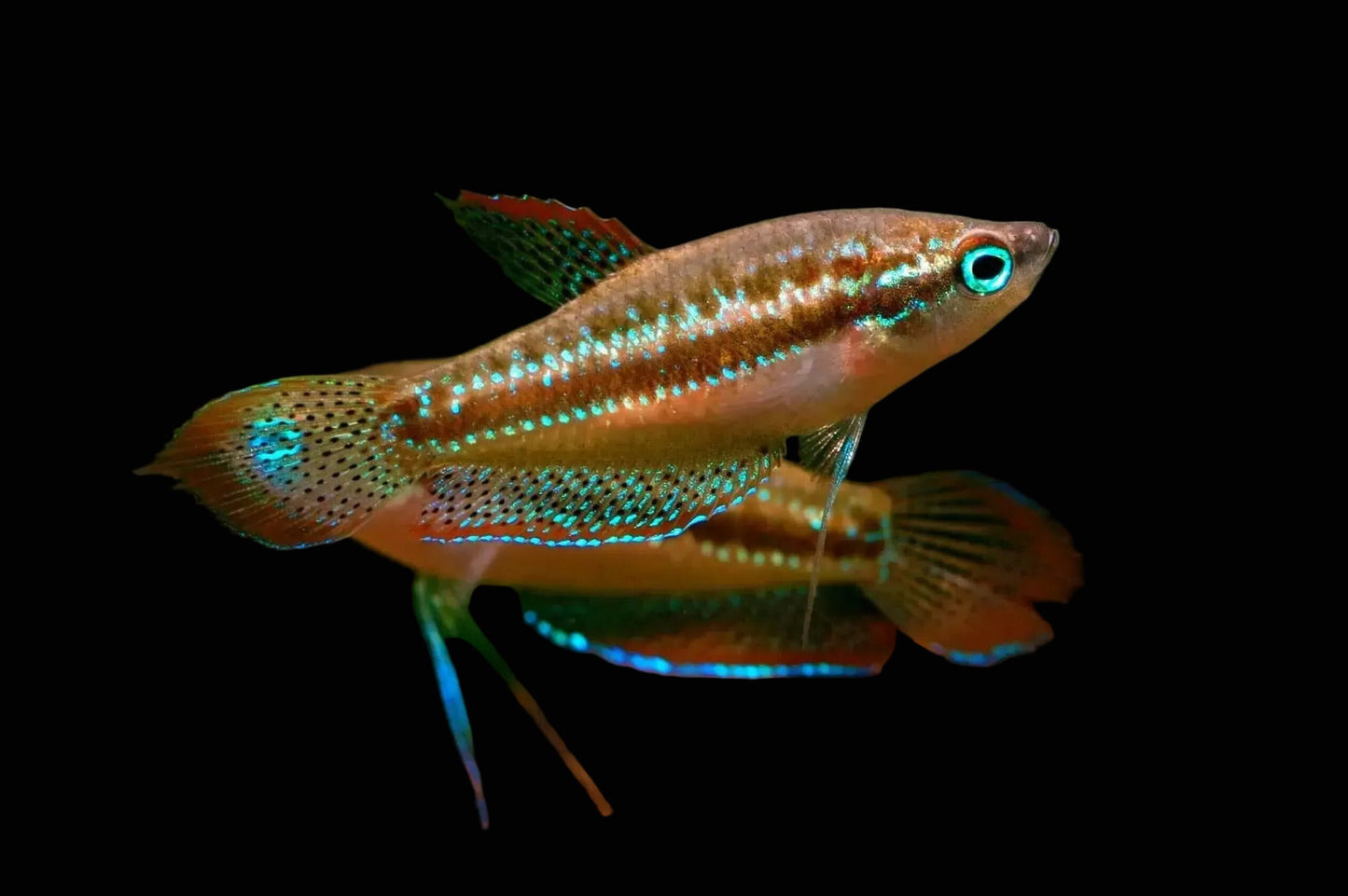
Sparkling Gourami (Pair)
Couldn't load pickup availability
Turn the filter off for a minute and put your ear near the glass. The Sparkling Gourami actually talks. Males produce a dry, clicking croak — a real, audible sound made by snapping modified tendons in the pectoral fins — when they display, court, or square up to a rival. There are barely a handful of aquarium fish that do this, and none of the others fit in a 20-litre tank.
Under tank light the body lights up in metallic blue-green speckling over a translucent bronze base, with red-and-blue edged fins and bright turquoise eyes. It is a labyrinth fish, a miniature relative of the Betta, and it behaves like one — deliberate, curious, and completely unbothered by low-flow, heavily planted, blackwater-style setups where most fish sulk.
Best kept as a group of 6 or more. A single pair is quiet and shy. A group establishes a loose pecking order, and that is when the croaking, flaring and colour actually start.
Care Snapshot
| Scientific name | Trichopsis pumila |
| Also known as | Pygmy Gourami, Croaking Gourami, Dwarf Croaking Gourami |
| Origin | Mekong basin — Thailand, Cambodia, Vietnam, southern Laos |
| Adult size | 3.5–4 cm |
| Lifespan | 4–5 years |
| Minimum tank | 20 litres for a pair · 45 litres+ for a group of 6 |
| Temperature | 22–28 °C |
| pH | 6.0–7.5 |
| Hardness | 2–15 dGH |
| Diet | Micropredator — small meaty foods, micro-granules |
| Temperament | Peaceful, shy; males mildly territorial with each other |
| Care level | Easy to moderate |
| Swimming zone | Middle and upper, among plants |
Setting Up For It
- Plant it heavily and cover the surface. Cryptocoryne, Java fern, Bucephalandra and a mat of floating plants — Salvinia, Frogbit, Red Root Floater. Cover is what makes this fish come out; a bare tank turns it into a permanent hider.
- Keep the flow low. A sponge filter is ideal. It breathes air at the surface, so a churning outlet works against it.
- Leave a warm air gap and use a tight lid. Labyrinth fish gulp air above the water. Cold, dry room air over an open tank causes respiratory damage — the gap between water and lid should stay warm and humid.
- Tannins help. Catappa leaves or a piece of driftwood soften the water, dim the light and deepen the iridescence. This is a blackwater fish by preference.
- Dark substrate. Colour is far stronger over dark sand or fine gravel than over light-coloured substrate.
Tank Mates
Good matches
Chili Rasbora and other Boraras, Espei/Harlequin Rasbora, Pygmy Corydoras, Otocinclus, Kuhli Loach, Ember Tetra, Neocaridina and Caridina shrimp (adults), Nerite snails.
Keep away from
Tiger Barbs and other nippers, Danios, Angelfish, larger gouramis including Dwarf and Pearl, Bettas, any cichlid. Fast or boisterous fish will out-compete it at feeding time.
Note: adult dwarf shrimp are safe, but shrimplets will be eaten. Plan accordingly if you are breeding shrimp in the same tank.
Feeding
The mouth is tiny — this is the single most common reason Sparkling Gouramis fail in a community tank. Standard flake and 1 mm pellets are simply too large, and the fish quietly starves while the owner assumes it is eating.
Feed small, sinking-to-mid-water particles twice a day, only what is cleared in two minutes. From the AQA range, use the finest-grade micro granule as the daily staple, alternating with a freeze-dried or frozen meaty food two or three times a week for colour and breeding condition.
Live and frozen foods it particularly favours: baby brine shrimp, daphnia, moina, cyclops, grindal worms, chopped bloodworm.
Sexing & Breeding
Males have longer, more pointed dorsal and anal fins with stronger red and blue edging, and croak far more often. Females are rounder in the body, shorter-finned and duller. Both sexes can vocalise. Holding a torch to the flank of a mature female shows the ovaries as a pale mass — the most reliable field method.
Breeding is achievable at home. The male builds a small bubble nest, usually beneath a broad leaf or inside a cave, spawns in an embrace, then takes over guarding and tending the eggs. Fry hatch in 2–3 days and are free-swimming by day 4–5. They are very small and need infusoria or liquid fry food before they can manage baby brine shrimp. Raise them in a shallow, well-covered tank with warm surface air.
Keeping It In Indian Conditions
- Across most of India this fish needs no heater for much of the year — room temperature sits comfortably in range. In Bengaluru, Pune and hill-station winters, a small heater set to 24 °C prevents the night-time dips that trigger fin clamping and ich.
- In peak summer, watch for temperatures above 30 °C. Warm water holds less oxygen; increase surface agitation slightly and keep the lid gap ventilated but still warm.
- Most Indian municipal supplies are moderately hard and alkaline, which this fish tolerates well once acclimatised. Colour and breeding response improve markedly with catappa leaves or a small share of RO water.
What You Receive
Juvenile to young adult specimens, approximately 2–3 cm, quarantined and conditioned at our Bengaluru facility before dispatch. Sex cannot be guaranteed on juveniles. Packed with oxygen and insulation for pan-India delivery.
Covered by the Best4Pets live arrival guarantee. Please film an unboxing video before opening the bag — it is required for any DOA claim.