- Product
- Sole fish 2inch - 4inch

Sole fish 2inch - 4inch
Couldn't load pickup availability
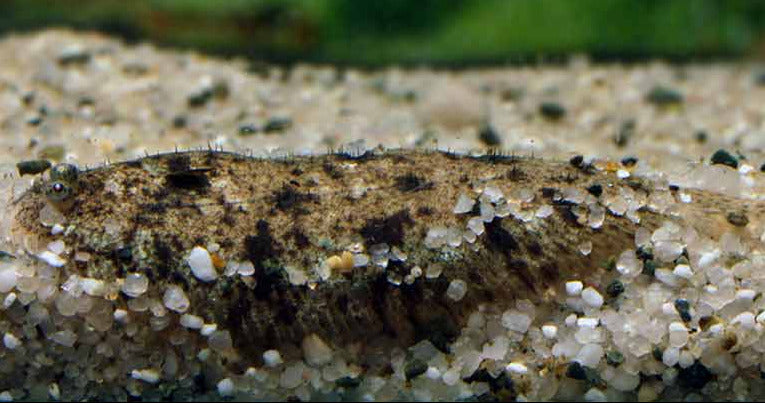
A flatfish. In a freshwater tank. It begins life as an ordinary upright larva with an eye on each side of the head, then one eye migrates across the skull, the body flattens onto its side, and the fish spends the rest of its life lying down. Almost every flatfish on earth is marine. A handful of soles made it into Southeast Asian rivers, and this is one you can actually keep.
Mottled brown and grey, disc-shaped, fringed all round with a continuous fin that ripples when it moves. It settles onto sand and flicks grains over its back until only the eyes are showing. Then, at night, it glides across the substrate with a motion nothing else in the tank has — less swimming than flowing. It is an extraordinary animal to watch, and it is also one of the more demanding fish in this catalogue.
The failure mode is starvation, and it is almost universal.
This is a slow, nocturnal, sight-and-touch hunter that takes small live and frozen invertebrates off the substrate. It will not eat flake or pellets, it will not compete with a community tank at feeding time, and it gives no visible sign of decline until it is very thin. Most specimens sold in the trade die within a few months for this reason alone. Buy it only if you are prepared to target-feed frozen and live foods after lights-out, most days, indefinitely.
"Freshwater flounder" covers several different fish
The name is applied loosely in the trade to Asian soles like this one and to South American Achirus, which genuinely need brackish water and do poorly without it. They look broadly similar and are frequently mislabelled. Care advice written for one will not reliably work for the other, so check the scientific name rather than the shop label.
Care Snapshot
| Scientific name | Euryglossa panoides |
| Also known as | Freshwater Sole, Freshwater Flounder; also placed in Brachirus |
| Family | Soleidae — true soles |
| Origin | Wild-collected — Southeast Asia |
| Habitat | Soft-bottomed lowland rivers and estuarine reaches |
| Minimum tank | 100 litres, 90 cm × 45 cm footprint — floor area, not height |
| Temperature | 24–28 °C |
| pH | 7.0–8.0 |
| Hardness | Medium to hard |
| Substrate | Fine soft sand only — non-negotiable |
| Flow | Gentle to moderate |
| Diet | Carnivore — live and frozen invertebrates, fed at night |
| Activity | Nocturnal; buried or motionless by day |
| Temperament | Peaceful and passive; easily out-competed |
| Care level | Advanced — feeding is the whole challenge |
Building The Right Tank
- Fine soft sand, 3–5 cm deep, and nothing else. This fish buries. Gravel of any grade makes that impossible and abrades the underside, which is where infections start. Play sand or fine river sand, rinsed thoroughly.
- Floor area is the real measurement. A flatfish uses the base of the tank and nothing above it. Two tanks of the same volume are not equivalent — pick the one with the larger footprint every time.
- Leave the sand open. Plant around the edges or use epiphytes on wood. A carpeted base removes the habitat entirely.
- Dim the lighting and give shade. Nocturnal and light-shy. Floating plants or a shaded end of the tank will bring it out earlier in the evening.
- Gentle flow, strong filtration. It cannot hold station in strong current, but it is a messy carnivore fed on frozen food. Filter through a sponge-guarded intake so a resting fish is never drawn against it.
- Keep the sand clean. Uneaten frozen food buried in a sand bed fouls quickly. Siphon the surface at every water change.
Tank Mates
Good matches
A species tank is the reliable answer. If you must combine, use quiet mid-water and surface fish that never touch the floor — rasboras, halfbeaks, hatchetfish, small peaceful barbs. Nothing that forages on sand.
Keep away from
Every bottom-feeder — Corydoras, loaches, plecos, shrimp. They are faster to food and will strip the substrate before this fish moves. Also avoid nippers, which will worry the fin fringe, and anything large or predatory. Small shrimp are prey.
Several soles can be kept together in a tank with enough floor area. They ignore one another almost entirely.
Feeding — Read This Twice
Nearly every freshwater sole sold in the aquarium trade dies of starvation. Not disease, not water quality — starvation, over weeks or months, in a tank the owner believes is well fed. The fish is slow, nocturnal, and locates food by scent and touch on the substrate. Anything eaten in the water column, or eaten within seconds of hitting the sand, is food it never sees.
Target-feed after lights-out, using a pipette or feeding tube placed next to the fish. Frozen bloodworm, blackworm, mysis, brine shrimp and chopped prawn are all taken. Live blackworm and grindal worm are the most reliable starters for a newly imported specimen, because movement triggers the feeding response.
Feed most days. Watch the fish actually eat — this is the only way to know. A sole that is thinning shows it as a sunken, concave outline behind the head when viewed from above.
Some long-settled specimens eventually accept a sinking carnivore pellet from the AQA range. Treat that as a convenience once established, never as the plan for a new fish.
Sexing & Breeding
There is no reliable way to sex this species visually in the aquarium, and no external differences are documented for the hobby.
Captive breeding has not been achieved in home aquaria. Soles in this group are understood to spawn in open water and produce planktonic larvae which undergo the eye-migration metamorphosis before settling — a cycle that cannot be reproduced in a tank. Every specimen in the trade is wild-caught.
A Note On Wild-Collected Stock
Every one of these fish came out of a wild river and none can be replaced by captive breeding. Freshwater soles are poorly studied, the taxonomy of the group is unsettled, and the soft-bottomed lowland and estuarine habitats they depend on are among the most heavily modified freshwater systems in Southeast Asia. Combined with the very high mortality this species suffers in the trade, that makes it a fish to buy deliberately or not at all. We would rather sell five to people who will keep them properly than fifty to people who will not.
Keeping It In Indian Conditions
- Temperature and water chemistry are the easy part. Room temperature across most of India sits inside the range for most of the year, and hard, alkaline municipal water suits this species. No heater in most months, no RO, no buffering.
- Your food supply is the constraint. Sort it out before the fish arrives. Frozen bloodworm and mysis are available in most Indian cities; live blackworm and grindal cultures are not, and are worth starting a few weeks ahead. A newly imported sole waiting on your logistics is a sole losing condition.
- Above 30 °C in peak summer, add surface agitation. Appetite drops in heat, which compounds the feeding problem — watch condition closely through April and May.
- Fine river sand is cheap and widely available across India. Rinse it until the water runs clear, and avoid the sharp crushed gravel sold as aquarium substrate in most local shops.
What You Receive
Wild-collected specimens, quarantined at our Bengaluru facility and feeding on frozen foods before dispatch. Size and markings vary between individuals and sex cannot be determined. Packed with oxygen and insulation for pan-India delivery.
Covered by the Best4Pets live arrival guarantee. Please film an unboxing video before opening the bag — it is required for any DOA claim. We recommend confirming your sand substrate is in place and your frozen or live food supply is sorted before ordering.