- Product
- Tiger shovelnose catfish 3inch

Tiger Shovelnose Catfish 3inch
Couldn't load pickup availability
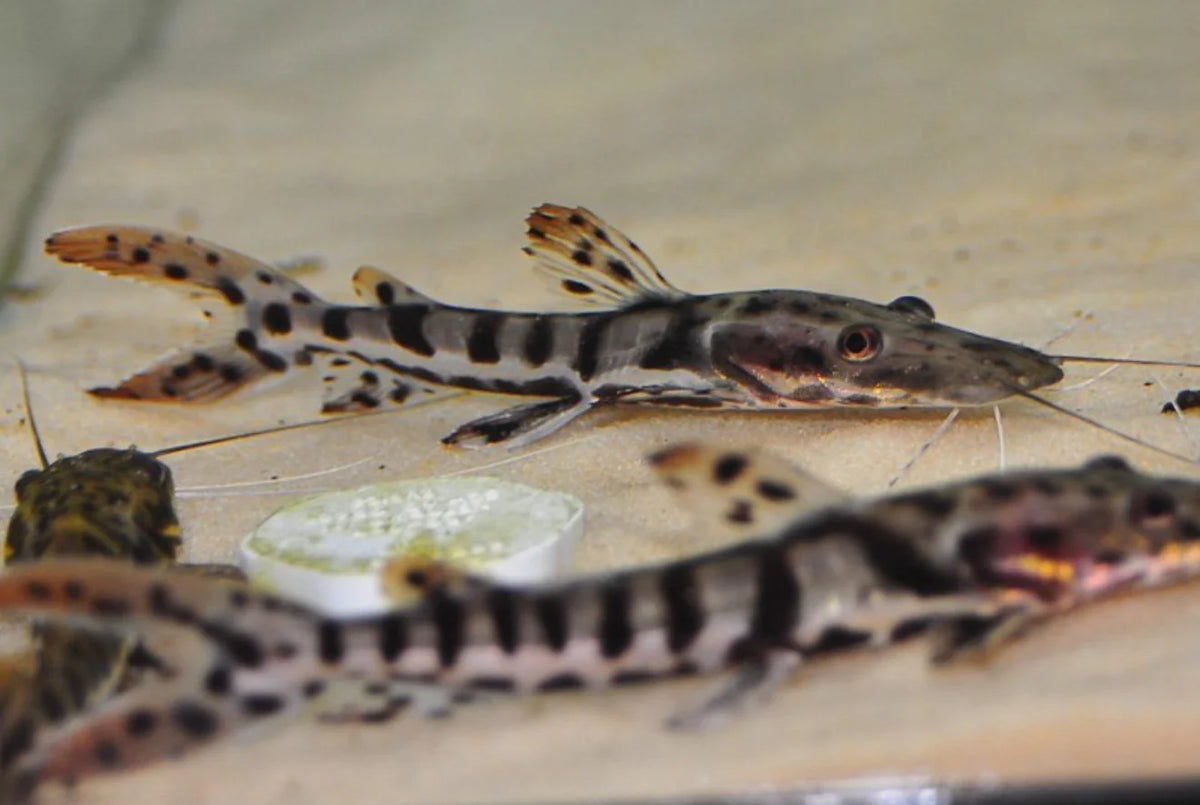
One of the great freshwater predators, and it knows it. The Tiger Shovelnose is built like something designed in a wind tunnel — a long flattened head, a broad spade of a snout, four sweeping barbels, and a silver body laid over with black bars and blotches that run back into the tail. It cruises the lower half of the tank with slow, deliberate authority, then moves faster than you can follow when it decides to.
For keepers with the space, this is one of the most rewarding fish in the hobby. They become genuinely responsive to their owner, take food from the hand, and live for fifteen to twenty-five years — this is a fish you keep for a substantial part of your life, not a season. They are also hardy, straightforward to feed once settled, and surprisingly peaceful toward anything too large to swallow.
Know what you are starting. This fish reaches about a metre.
You are buying a 7.5 cm juvenile that will outgrow a standard aquarium within its first year and will eventually need a tank or pond measured in thousands of litres. That is not a reason to avoid it — plenty of people keep them superbly — but it is a decision to make now rather than in eighteen months. Plan the adult housing before the fish arrives.
What Happens Over The Next Few Years
| On arrival | About 7.5 cm. A 200 litre grow-out tank is adequate for now. |
| Year 1 | Commonly 30–40 cm. Growth is rapid when well fed. Needs 500 litres plus. |
| Years 2–3 | 50–70 cm. This is the point at which most home aquariums run out. |
| Adult | 80–100 cm, occasionally more. Needs 1,800 litres or more, minimum 240 cm length and 75 cm depth, or an indoor pond. |
Growth rates vary with feeding and tank size, but the direction is not in doubt. Treat the first tank as a grow-out, not a home.
Care Snapshot
| Scientific name | Pseudoplatystoma fasciatum |
| Also known as | Tiger Shovelnose, Barred Sorubim, Tiger Sorubim |
| Family | Pimelodidae — long-whiskered catfishes |
| Origin | Amazon and Orinoco basins, South America |
| Adult size | 80–100 cm, occasionally larger |
| Size on arrival | Approx. 7.5 cm (3 inches) |
| Lifespan | 15–25 years |
| Adult tank | 1,800 litres+, minimum 240 × 75 cm footprint |
| Temperature | 23–28 °C |
| pH | 6.0–7.8 |
| Hardness | Soft to moderately hard |
| Substrate | Fine sand or bare bottom — nothing sharp |
| Diet | Piscivore — carnivore pellets, whole frozen fish and prawn |
| Temperament | Not aggressive, but predatory — eats anything it can swallow |
| Care level | Advanced — easy fish, demanding housing |
| Activity | Crepuscular and nocturnal; bottom and mid water |
Setting Up For It
- Keep the tank uncluttered. This is the detail people miss. A startled shovelnose bolts at speed, and in a tank full of rock and wood it injures its snout and spine against the hardscape. Smooth, open layout with a few large, rounded, immovable pieces — nothing sharp, nothing it can wedge into.
- Sand or bare bottom. Scaleless fish with a sensitive belly and barbels. Gravel abrades both.
- Heavy, secured lid. These are powerful jumpers, especially at night and when first settling. A lid that merely rests on the rim is not enough.
- Serious filtration, and a plan for water changes. A large predator eating whole fish produces a bioload to match. Oversize the filtration and expect weekly changes of 30–50% on the adult tank.
- Subdued lighting and shade. Nocturnal by nature. Under bright light they stay hidden; dim the tank and they come out and interact.
- Treat medications with care. Scaleless catfish are sensitive to many standard treatments, particularly copper and some anti-parasitics. Use half doses and watch closely, or choose scaleless-safe products.
Tank Mates
Good matches
Large, robust, similarly sized fish — Oscars and other large cichlids, Arowana, Datnoids, Pacu, large Plecos, Silver Dollars of adult size, other big catfish. Anything that is too large to fit in the mouth and tough enough to hold its own.
Keep away from
Anything it can swallow — and the mouth is far larger than it looks. A fish half the shovelnose's body length is still at risk. Also avoid aggressive fin-nippers, which target the long barbels, and delicate or slow species that cannot cope with a large active predator.
They are not territorial or aggressive in the usual sense — tank mates are eaten, not attacked. Size is the only thing that keeps a fish safe.
Feeding
Juveniles usually start on frozen bloodworm, chopped prawn and small pieces of fish, and should be weaned onto prepared food as soon as possible. A settled adult takes large sinking carnivore pellets readily, supplemented with whole frozen fish, prawn, mussel and squid. Feed juveniles daily; adults every two or three days is sufficient and better for long-term health.
From the AQA range, a large sinking carnivore pellet makes the practical staple — cheaper, cleaner and more complete than a frozen-only diet.
Do not use feeder goldfish or rosy barbs. They carry disease and parasites into the tank, and their tissue contains thiaminase, which over time causes vitamin B1 deficiency and serious health problems in predatory fish. It is one of the most common causes of early death in large catfish kept well in every other respect.
Sexing & Breeding
There is no reliable visual sexing method in the aquarium, and breeding is not achievable in home conditions — in the wild the species undertakes long spawning migrations that cannot be reproduced in a tank. Commercial production relies on hormone-induced spawning in aquaculture facilities.
Never Release It
Large predatory catfish released into Indian lakes, tanks and rivers is a real and documented problem, not a hypothetical one. A metre-long piscivore in a local water body eats native fish, and in warm Indian conditions it can survive indefinitely. Buy this fish only if you intend to house it for its full life, and decide now that releasing it is not an option you will ever consider.
Keeping It In Indian Conditions
- Temperature and water chemistry are easy here. Room temperature across most of India sits inside the range for most of the year, and ordinary tap water suits it. No heater needed except in northern and hill-station winters.
- Summer needs aeration, not cooling. Above 30 °C, oxygen falls while a large fish's demand rises. Strong surface agitation and a fan across the water through April and May.
- Plan the adult system now. Custom tanks and indoor ponds are both achievable in India and far cheaper to build here than imported equipment suggests. Talk to a fabricator before the fish is 30 cm, not after.
- Water changes are the real commitment. A 1,800 litre system needs a planned drain and fill route. Work that out as part of the build rather than carrying buckets.
What You Receive
Juveniles of approximately 7.5 cm, quarantined and conditioned at our Bengaluru facility before dispatch and feeding on prepared foods. Sex cannot be determined. Barring and body proportions change considerably as the fish grows. Packed with oxygen and insulation for pan-India delivery.
Covered by the Best4Pets live arrival guarantee. Please film an unboxing video before opening the bag — it is required for any DOA claim.