

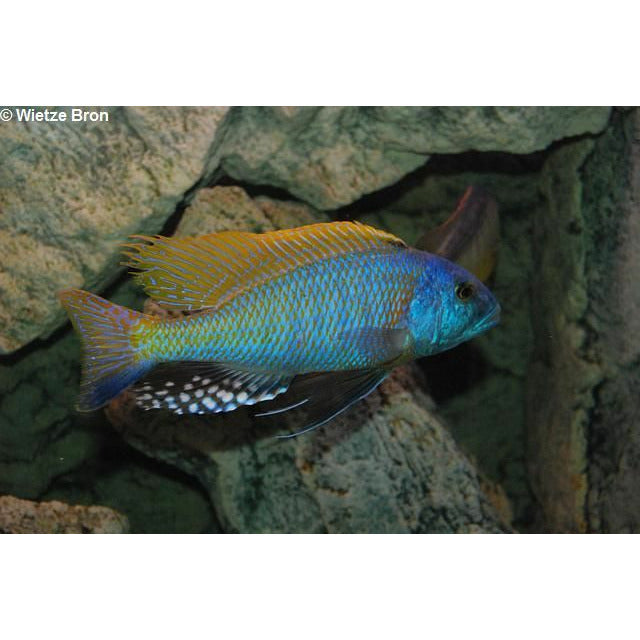
Buccochromis rhoadesii / Rhoad Cichlid 2inch
Couldn't load pickup availability
A big yellow hunter for big tanks. A mature male Buccochromis rhoadesii is a heavy-bodied, bright yellow fish with a deep blue to grey head and a large mouth built for catching other fish. It is one of the largest haps commonly offered in the trade, and a full-grown male cruising a big tank is a striking sight.
In Lake Malawi it hunts small fish over sandy areas. In the aquarium it is calm with tank mates too large to swallow, but eats anything that fits. It also grows big and fast — a small juvenile can reach 20 cm within a couple of years and keep going. This is a fish for owners of very large tanks who want a centrepiece hap.
Buy only if you have the tank for a 30 cm fish.
Adults commonly reach 25–35 cm. A tank of 600 litres and around 180–200 cm in length is the realistic minimum. Kept in less, it is stunted, stressed and dangerous to its tank mates.
Care Snapshot
| Scientific name | Buccochromis rhoadesii |
| Also known as | Rhoad Cichlid, Yellow Lepturus |
| Family | Cichlidae — Lake Malawi haplochromines (haps) |
| Origin | Farm-bred; wild form from sandy areas of Lake Malawi |
| Adult size | 25–35 cm (males larger) |
| Arrival size | about 2 inch |
| Lifespan | 10–15 years |
| Minimum tank | 600 litres, minimum 180–200 cm length |
| Temperature | 24–28 °C |
| pH | 7.5–8.6 |
| Hardness | 10–20 dGH — hard and alkaline |
| Diet | Piscivore — large sinking pellets and frozen foods |
| Temperament | Predatory; calm with large tank mates |
| Care level | Advanced — space is the main challenge |
| Swimming zone | Middle and lower water |
Setting Up For It
- The largest tank you can manage. Length and front-to-back depth matter most. 180–200 cm long is the starting point for adults.
- Open sand and swimming space. Keep rock to the back and ends; most of the tank should be open water over sand.
- Hard, alkaline water. pH 7.8–8.4 with good carbonate hardness.
- Heavy-duty filtration. A sump or large canisters rated well above tank volume, plus 30–40% weekly water changes.
- Heavy, secure lid. Large fish lunge and can jump when startled.
Tank Mates
Good matches
Other large haps of similar size: Venustus, Livingstonii, Fossorochromis rostratus, Blue Dolphin, Malawi Hawk, large Placidochromis, and big Synodontis.
Keep away from
Mbuna, peacocks and any fish small enough to swallow. Community fish, shrimp and anything slow or delicate.
Introduce tank mates at a size the Rhoad cannot eat and grow them up together.
Feeding — Meaty And Sinking — No Feeder Fish
This is a true predator, but farm-bred fish take prepared foods easily. Live feeders are the commonest way disease gets into a big cichlid tank and are not needed.
Feed a large sinking carnivore or cichlid pellet once a day. From the AQA range, a sinking cichlid pellet makes a sound staple, with frozen foods several times a week. Avoid beef heart and other mammal meat.
Foods it takes well: frozen krill, silversides, whole prawns, mussel, chopped fish fillet and earthworms.
Sexing & Breeding
Juveniles are silvery and cannot be sexed. Mature males become bright yellow with a blue-grey head and egg-spots on the anal fin. Females remain silvery or pale with dark markings.
A maternal mouthbrooder rarely bred at home because of the space required. The female carries the eggs and fry for around three weeks.
Keeping It In Indian Conditions
- Indian hard water suits it. Hard, alkaline tap or borewell water is close to what Malawi haps want.
- Summer oxygen is the risk. Above 28 °C, large fish need extra aeration and a surface fan.
- Power backup is essential. A 600-litre tank of big predators can run short of oxygen fast in a power cut.
- Frozen foods are widely sold across Indian cities, so live feeder fish are never necessary.
What You Receive
Farm-bred juveniles, supplied at about 2 inch, quarantined and conditioned at our Bengaluru facility before dispatch. Sex cannot be determined at this size. Juveniles are silvery and look nothing like the yellow adult males yet; colour develops over a year or more. Packed with oxygen and insulation for pan-India delivery.
Covered by the Best4Pets live arrival guarantee. Please film an unboxing video before opening the bag — it is required for any DOA claim.
