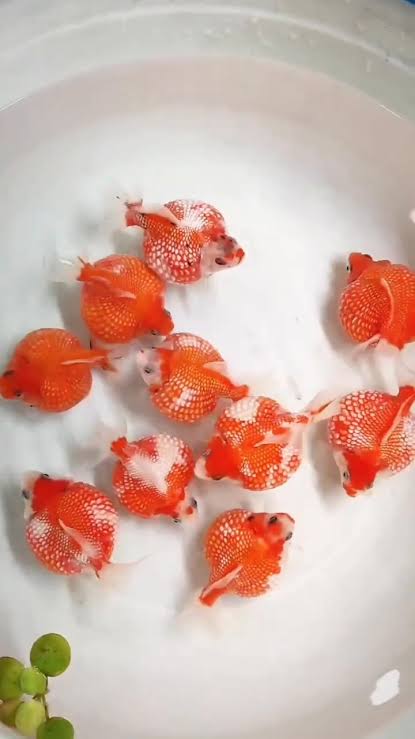
Red White PingPong Pearlscale (Import) 4"+
Couldn't load pickup availability
A goldfish the shape of a ping-pong ball. The ping-pong is the most extreme form of the pearlscale: a near-spherical body, a short tail, and every scale raised into a hard, domed bead. A good one in red and white looks less like a fish and more like a little ornament that has learned to swim.
It is a line-bred refinement of the Chinese pearlscale, selected for an even more compact, globe-shaped body. That shape is the whole point — and the whole difficulty. The organs are tightly packed, the swim bladder is compressed, and these fish are the most buoyancy-prone of all goldfish. They are also slow and easily out-competed. In the right tank, with the right food, they are charming and surprisingly long-lived; in a mixed tank with fast fish and floating flakes, they struggle.
Keep them only with slow, round fish — and feed sinking food.
Ping-pongs cannot compete for food and cannot cope with strong current. Kept with ryukins, comets or busy orandas they go hungry, and fed dry floating food they develop swim-bladder trouble. A dedicated tank of ping-pongs, pearlscales or ranchus, gentle flow and sinking or pre-soaked food is what makes them work.
Care Snapshot
| Scientific name | Carassius auratus |
| Also known as | Ping Pong Goldfish, Golf Ball Pearlscale; a line-bred, globe-bodied form of the pearlscale |
| Family | Cyprinidae — carps and minnows |
| Origin | Line-bred variety developed in China; farm-bred and imported |
| Adult size | 8–12 cm including the tail |
| Arrival size | about 4 inch |
| Lifespan | 8–12 years with good care, sometimes longer |
| Minimum tank | 100 litres for one, plus about 40 litres for each additional fish |
| Temperature | 18–24 °C ideal; stressed above about 28 °C |
| pH | 7.0–8.0 |
| Hardness | 8–20 dGH — moderately hard to hard |
| Diet | Omnivore — sinking foods, plenty of vegetables |
| Temperament | Peaceful and very slow; cannot compete |
| Care level | Demanding — the most swim-bladder-prone goldfish |
| Swimming zone | Lower and middle |
Setting Up For It
- Very gentle flow. Sponge filters or a spray bar aimed at the glass. If a ping-pong is drifting with the current, the flow is too strong.
- Plenty of filter capacity regardless. Goldfish waste is goldfish waste. Generous sponge or canister media and 40–50% weekly water changes.
- Nothing abrasive. Lost pearl scales tend to regrow flat. Smooth stones, rounded wood, soft plants or a bare tank.
- Shallower water. A broad tank with 30–40 cm of water depth makes life easier for a fish that labours to change level.
- Bare bottom or fine sand. Keeps the tank easy to clean and safe for sifting.
Tank Mates
Good matches
Other ping-pongs and pearlscales; ranchus and lionheads of similar size and pace.
Keep away from
Comets, sarasas and shubunkins absolutely. Ryukins, fantails and active orandas, which take all the food. All tropical fish, plecos and suckermouth grazers, and anything boisterous.
A single-variety ping-pong tank is the safest arrangement.
Feeding — Small Meals, Sinking, Plenty Of Peas
Feeding is how ping-pongs are kept well or lost. Floating dry food swallowed with air at the surface is the commonest trigger for floating or tipping. Use sinking pellets or gel food, or soak floating food first, and keep portions small.
Two small meals a day and a fast day each week. From the AQA range, a small sinking goldfish pellet works as the staple; add blanched, shelled peas and soft greens several times a week, and frozen foods for protein.
Foods they take eagerly: small sinking pellets, gel food, frozen bloodworm, brine shrimp and daphnia, crushed blanched peas, spinach and courgette.
Sexing & Breeding
Sexing is difficult in such a round fish. In season males show white breeding tubercles on the gill covers and pectoral rays and chase; females become fuller and softer in the belly.
Ping-pongs can spawn like other goldfish, but the extreme body shape makes them less reliable breeders, and only a small proportion of fry develop the true globe shape. Most breeding of this form is done on specialist farms.
Keeping It In Indian Conditions
- Summer heat is the biggest risk. Tanks in many Indian cities exceed 30 °C in April and May, and a compact, slow fish has the least reserve of any goldfish. Coolest room, no direct sun, a fan across the water, constant aeration.
- Plan for power cuts. A warm goldfish tank runs short of oxygen fast during monsoon outages. A battery air pump or inverter backup is essential.
- Tap water is fine. India's hard, alkaline tap and borewell water suits goldfish once dechlorinated.
- Their size tempts people toward bowls. Do not. A small, round, swim-bladder-prone goldfish in a bowl is the worst possible combination.
What You Receive
Imported, farm-bred ping-pong pearlscales in red and white, supplied at about 4 inch, quarantined and conditioned at our Bengaluru facility before dispatch. Each fish is patterned differently, and red-white patterns can shift with age. Sex cannot be guaranteed. Packed with oxygen and insulation for pan-India delivery.
Covered by the Best4Pets live arrival guarantee. Please film an unboxing video before opening the bag — it is required for any DOA claim.