- Product
- Red tail penguin tetra (pair)


Red Tail Penguin Tetra (Pair)
Couldn't load pickup availability
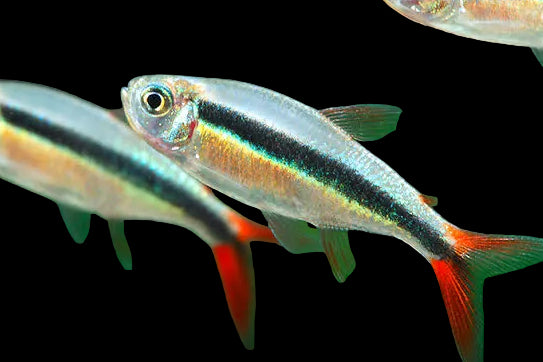
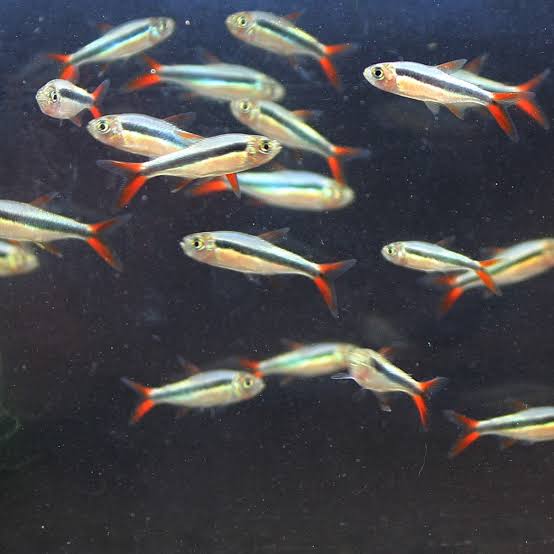
A penguin tetra with a red flash at the tail. Picture the classic tilted, tail-down posture and the black stripe that bends into the lower tail lobe — then add warm red in the fins and tail. A school hovering at its typical angle in mid-water gives you the penguin silhouette everyone recognises, with a splash of colour the common form never had.
This is an undescribed penguin tetra, traded as Thayeria sp. 'Redfin Teles Pires' after the Rio Teles Pires in the upper Tapajós basin of Mato Grosso, Brazil. Because it has no formal scientific description yet, published data on it is thin, so its care here is based on the well-known Thayeria boehlkei with deliberately broad, forgiving ranges. In practice it behaves like its familiar cousin: an active, peaceful mid- to upper-water schooler for a planted community tank.
Numbers make the fish — plan for a school.
Penguin tetras are schooling fish through and through. A lone pair stays skittish, pale and inclined to hide, and the red in the fins never really shows. Treat each pair as a building block towards a group of eight or more; that is when the tilted school and the colour both come together.
Care Snapshot
| Scientific name | Thayeria sp. 'Redfin Teles Pires' (undescribed) |
| Also known as | Red Tail Penguin Tetra, Red Fin Penguin Tetra, Redfin Hockeystick Tetra |
| Family | Characidae — American tetras |
| Origin | Rio Teles Pires, upper Tapajós basin, Mato Grosso, Brazil |
| Adult size | around 5–6 cm |
| Lifespan | 3–5 years with good care |
| Minimum tank | 80 litres, minimum 75 cm length for a school of 8+ |
| Temperature | 23–27 °C |
| pH | 6.0–7.5 |
| Hardness | 2–12 dGH — soft to moderately hard |
| Diet | Omnivore — small dry, frozen and live foods |
| Temperament | Peaceful; schooling, keep 8+ |
| Care level | Easy to moderate — hardy once acclimatised |
| Swimming zone | Upper and middle |
Setting Up For It
- Leave the top half open. These fish hover and cruise in mid and upper water at their characteristic angle; tall clutter right to the surface cramps the school.
- A tight-fitting lid is non-negotiable. Penguin tetras are confident jumpers, and new arrivals are at their most jumpy.
- Plants around the edges. Background and side planting gives the school a retreat and noticeably calms new fish.
- Clear, flowing water. As a fish from a large, clear-water river system, it appreciates good oxygenation and a moderate current from a well-maintained filter.
- Darker décor brings out the red. A dark substrate and background sharpen both the black stripe and the warm fin colour.
- Regular water changes. Weekly 25–30% changes keep the water stable and the school active.
Tank Mates
Good matches
Rummynose, Lemon, Emperor and other similar-sized peaceful tetras, Pencilfish, Rasboras, Corydoras, Otocinclus, Bristlenose Pleco, Rams, Dwarf Gouramis, Kuhli Loach.
Keep away from
Slow, long-finned fish such as Bettas or fancy guppies if the school is kept small, large cichlids, and anything big enough to swallow a 5 cm fish.
In a proper school they keep themselves busy and rarely bother tank mates.
Feeding — Feeds High In The Water
Like other penguin tetras, this fish takes most of its food at the surface and as it drifts down through mid-water, and seldom forages on the substrate. Choose foods that float or sink slowly, so the school gets its share before bottom-dwellers clear it up.
Feed small amounts once or twice a day. From the AQA range, a fine community flake or slow-sinking micro granule works well as the staple, with frozen foods several times a week to bring up the red in the fins.
Foods they relish: frozen bloodworm, brine shrimp, daphnia, mosquito larvae, cyclops.
Sexing & Breeding
As with other Thayeria, mature females are generally deeper and rounder in the belly, while males are slimmer. Differences are slight in young fish, and specific breeding reports for this undescribed form are scarce.
Penguin tetras are free-spawning egg scatterers. If a group spawns, a separate tank with fine-leaved plants or a spawning mop, soft slightly acidic water and prompt removal of the adults gives the eggs the best chance; the fry need infusoria first.
Keeping It In Indian Conditions
- Comfortable at room temperature in most of India for much of the year; use a heater in northern and hill-station winters.
- Watch the summer peak. Keep the tank below about 28 °C in April and May with extra aeration and a fan across the water — a river fish like this suffers most when warm water is also low in oxygen.
- Tap water is usually workable if it is moderately hard; blend very hard borewell water with RO or rainwater.
- A rare import — acclimatise slowly. Drip-acclimatise over 30–45 minutes rather than tipping the bag, and keep the lights low for the first day.
- Power cuts: a battery-backed air pump protects an active, oxygen-loving school during outages.
What You Receive
Juveniles and young adults, quarantined and conditioned at our Bengaluru facility before dispatch. A pair here means two fish; sex cannot be guaranteed at this size. The red in the fins and tail is often faint after travel and builds up as the fish settle and mature. Packed with oxygen and insulation for pan-India delivery.
Covered by the Best4Pets live arrival guarantee. Please film an unboxing video before opening the bag — it is required for any DOA claim.