
- Product
- Red cheek tropheops albino 2inch
Red Cheek Tropheops Albino 2inch
Couldn't load pickup availability
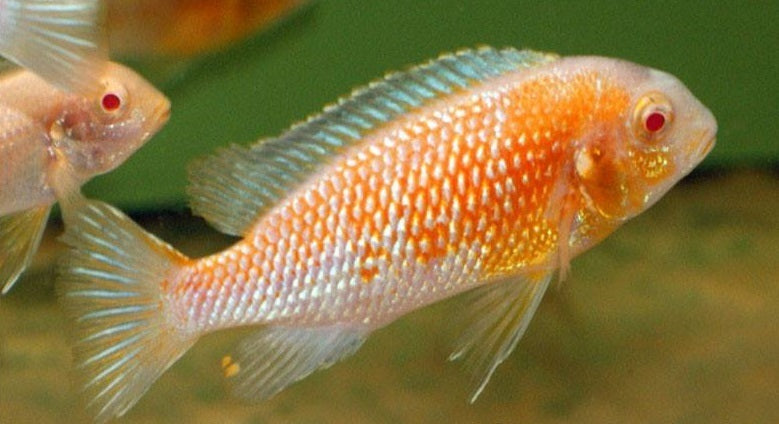
The cheek stays red when everything else goes white. Albinism strips out black and dark pigment, but leaves the reds and yellows untouched. In the albino Red Cheek Tropheops that means a pale, cream-to-pink fish with red eyes — and the warm orange-red flush on the cheek that gives the wild fish its name still sitting right where it should.
Tropheops are a distinctive group of mbuna, recognisable by a steeply sloping forehead and an underslung mouth built for biting algae off rock and tearing it free with a twist of the body. They are tough, active and territorial. This albino is a farm-produced colour form, not something found in the lake, and its exact lineage is not documented — keep that in mind if you plan to breed it.
It is still a Tropheops — stock it as a tough mbuna.
The pale colour makes this fish look delicate. It is not. Males are territorial and can be pushy, so it needs a rock-filled, densely stocked mbuna tank with a harem ratio of one male to three or more females. The only concession to albinism is lighting and making sure it gets food against faster tank mates.
Care Snapshot
| Scientific name | Tropheops sp. 'Red Cheek' (albino form) |
| Also known as | Albino Red Cheek, Albino Tropheops; formerly sold under Pseudotropheus; albino is a farm-bred colour form |
| Family | Cichlidae — Lake Malawi mbuna (rock-dwelling cichlids) |
| Origin | Farm-bred albino; wild form endemic to Lake Malawi, East Africa |
| Adult size | 11–13 cm |
| Arrival size | about 2 inch |
| Lifespan | 6–10 years |
| Minimum tank | 250 litres, minimum 120 cm length |
| Temperature | 24–28 °C |
| pH | 7.6–8.6 |
| Hardness | 8–20 dGH — hard |
| Diet | Herbivore — algae grazer, vegetable-based foods |
| Temperament | Moderately aggressive; males territorial |
| Care level | Moderate — straightforward in a proper mbuna setup |
| Swimming zone | Lower and middle, around rockwork |
Setting Up For It
- Lots of rock with algae on it. Tropheops graze the algae film on rocks all day. Stack plenty of rock on the base glass and let algae grow on the back and side surfaces.
- Moderate light. Albino eyes lack protective pigment. Avoid very harsh lighting; shaded caves let the fish settle and come forward.
- Hard, alkaline water. pH 7.6–8.6, hard. Crushed coral or aragonite in the filter if your water is soft.
- Heavy filtration. Densely stocked mbuna tanks need filtration rated at three to four times tank volume per hour and 30–40% weekly water changes.
- Sand floor. Fine sand or aragonite. Rock must sit on the glass, not on sand, or digging will bring it down.
Tank Mates
Good matches
Robust mbuna of different colour and shape: Yellow Lab (Labidochromis caeruleus), Acei (Pseudotropheus sp. 'Acei'), Red Zebra (Maylandia estherae), Cynotilapia, Labeotropheus in larger tanks, Rift Lake Synodontis.
Keep away from
Normally coloured Red Cheek Tropheops and other Tropheops, with which it will interbreed. Peacocks and haps on a protein-led diet. Small, timid mbuna that it can push around.
Albinos see less well; check at feeding times that it is actually getting food.
Feeding — Grazer — Protein Kept Low
In the wild Tropheops live almost entirely on algae and the tiny animals living in it. A rich, meaty diet is the commonest route to Malawi bloat — swelling, refusal to eat and white stringy faeces, often fatal by the time it is spotted.
Feed a spirulina-based flake or pellet twice a day in small amounts. From the AQA range, choose the most vegetable-heavy cichlid food as the staple. Keep meaty frozen food to an occasional treat and fast one day a week.
Good additions: blanched spinach, peas and cucumber, spirulina wafers, nori on a rock clip, and rare small feeds of frozen brine shrimp.
Sexing & Breeding
In the wild form, males are blue-grey with the red cheek and females are yellow-orange. In the albino the male's dark pigment is gone, so the sexes look more alike: females usually stay a richer yellow-orange, while males tend to be paler with the red cheek and egg spots on the anal fin. Juveniles cannot be sexed reliably.
A maternal mouthbrooder; the female holds eggs and fry for around three weeks. Because this is a man-made colour form with undocumented ancestry, keep it as its own line and do not cross it with normally coloured Tropheops or other pure species.
Keeping It In Indian Conditions
- Hard borewell water is an advantage. Bengaluru's and much of South India's borewell water is naturally hard and alkaline — ideal for Malawi cichlids. Dechlorinate and test before buffering.
- Summer heat. Keep the tank below about 29 °C with surface agitation and a fan through April and May.
- Power cuts. A crowded mbuna tank needs a battery air pump or an inverter line for the filter.
- Spirulina foods are widely available. Spirulina flakes and pellets are easy to buy in India, and blanched vegetables from the kitchen complete the diet.
What You Receive
Farm-bred albino juveniles, supplied at about 2 inch, quarantined and conditioned at our Bengaluru facility before dispatch. Sex is not guaranteed — juveniles are hard to sex, and the albino form hides much of the colour difference between males and females. Expect a pale, red-eyed young fish; the cheek colour and yellow-orange tones build as it matures. Packed with oxygen and insulation for pan-India delivery.
Covered by the Best4Pets live arrival guarantee. Please film an unboxing video before opening the bag — it is required for any DOA claim.
