
- Product
- Piano snails (algae eater)

Piano Snails (Algae Eater)
Couldn't load pickup availability
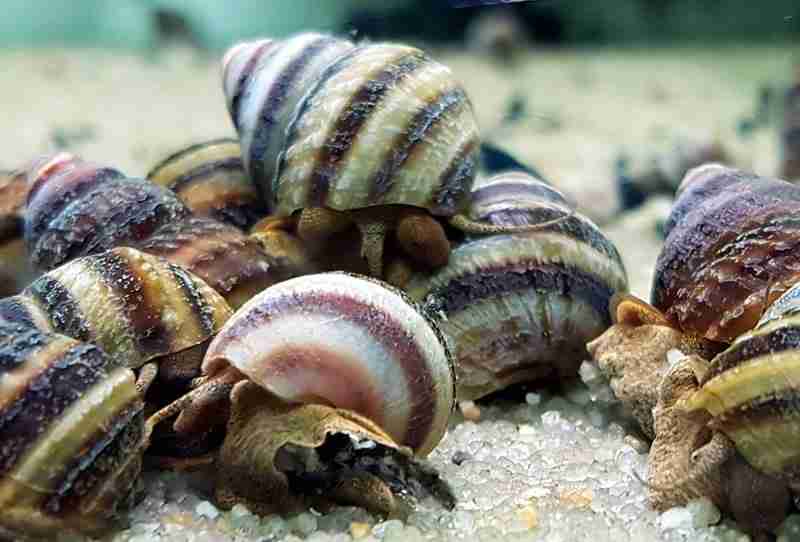
The piano snail (Taia naticoides) originates from Southeast Asia, more precisely from Burma, Vietnam and India, and belongs to the Vorderkiemern (Prosobranchia). Striking about these animals is their brown-yellow striped, nubby shell, which can reach up to 4 cm in diameter. Males and females of this separately sexual snail can be distinguished very well, because the right antenna of the male is thickened. It serves as a mating organ. In females both antennae are equally thick.
The piano snail is viviparous. Females release a single live young every few weeks, mainly at night, which has previously developed from an egg in their brood pouch. A population explosion is not to be expected even under the best husbandry conditions.
In their native habitat piano snails live in sediment-rich waters, they also like to burrow in the aquarium. They are grateful for a sand corner in the aquarium. This species can be kept from 50 liters at a temperature between 22 and 28 °C, a pH-value from 7,5, a total hardness between 6 and 22 °dGH and a carbonate hardness between 3 and 15 dKH.
The piano snail is a filter feeder and is therefore dependent on the daily administration of dust food. They also like to scrape off algae growth and biofilm, and after a period of acclimation they will also go for fish food remains. Brown autumn leaves should be as in no invertebrate aquarium missing, the microorganism film on it is eaten very gladly, later also the leaf itself.
The piano snail is not a very assertive snail, it should therefore not be kept together with other large snails, because the food competitors would sooner or later displace them. A species tank is preferable, but you can alsosocialize them very well with mussels or other dust feeders like fan shrimp , but then you should also pay attention to low flow areas in the aquarium. Dwarf shrimps may be possible as additional stock, as long as their numbers are kept within limits and the animals do not become too dominant. Peaceful, herbivorous fish are also good aquarium partners.