- Product
- Parkinsoni rainbow (pair)

Parkinsoni Rainbow (Pair)
Couldn't load pickup availability
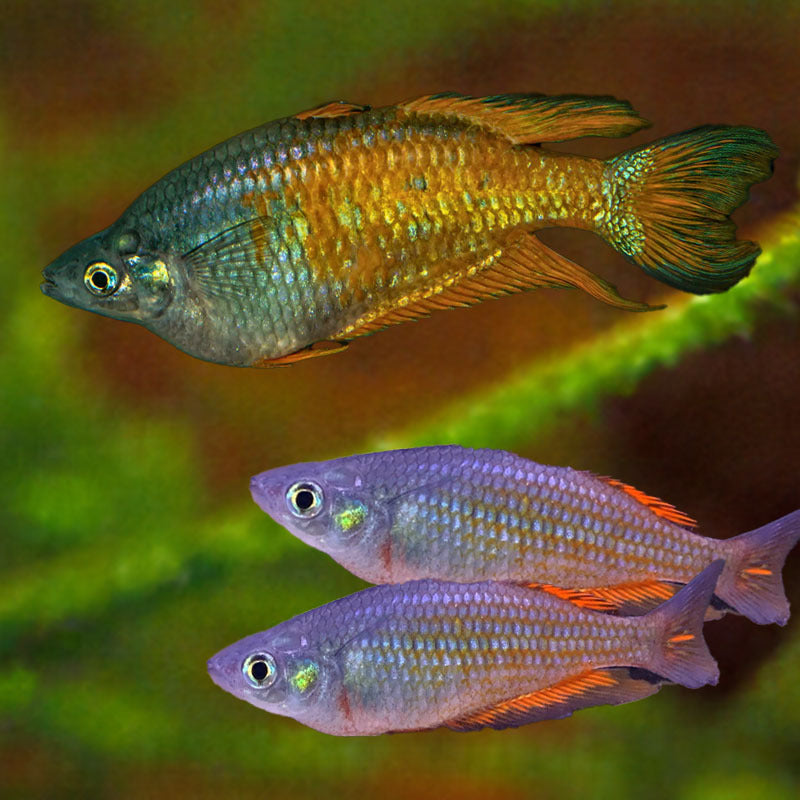
Two fish in one body. The front half of a mature male Parkinson's Rainbowfish is cool greenish-silver. The back half erupts into blotched yellow and hot orange, split along the flank by dark bars. The transition is abrupt, and it looks less like a colour gradient than like someone painted the rear of the fish and stopped halfway.
It gets better in motion. Rainbowfish display constantly — males flare at each other through the day, and when they do, the orange saturates and a pale stripe flashes along the forehead, then fades again within seconds. This is one of the larger Melanotaenia, a strong open-water swimmer from the rivers of southeastern Papua New Guinea, and in a long tank a group of them is about as much movement and colour as freshwater offers.
Colour is a display behaviour, not a paint job. Males produce it to compete with other males and impress females. Keep one alone and it will stay a silver fish for life. Keep six or more with several males and you get the full performance daily. This is the single most misunderstood thing about rainbowfish.
Care Snapshot
| Scientific name | Melanotaenia parkinsoni |
| Also known as | Parkinson's Rainbow, Spotted Rainbowfish |
| Origin | Tank-bred; native to southeastern Papua New Guinea |
| Adult size | 10–12 cm typical in aquaria; up to 15 cm |
| Size on arrival | Approx. 4–5 cm, beginning to colour |
| Lifespan | 5–8 years |
| Minimum tank | 200 litres, minimum 120 cm length |
| Temperature | 24–30 °C |
| pH | 7.0–8.0 — alkaline preferred |
| Hardness | 8–20 dGH — moderately hard to hard |
| Diet | Omnivore — dry, frozen and live foods |
| Temperament | Peaceful, active, shoaling; keep 6+ |
| Care level | Easy — hardy, but needs space |
| Swimming zone | Middle and upper |
Setting Up For It
- Length is not negotiable. These fish swim hard, all day, in straight lines. 120 cm is the working minimum and 150 cm is better. Volume alone does not substitute — a tall 200-litre tank is the wrong shape for this species.
- Plant heavily at the back and sides, leave the front open. Vallisneria and other tall stems suit them, and the open lane is where the displaying happens.
- Give them current. Unlike most tropical community fish, rainbowfish want moderate to strong flow and will swim into it. A decent canister return or an extra circulation pump is a benefit, not a stressor.
- Morning sun on the tank is worth arranging. Rainbowfish display hardest in the first hours of light. A tank that catches early indirect daylight puts on a noticeably better show.
- Heavy lid. Powerful jumpers with the size to clear a gap. Any opening around a filter pipe should be closed off.
Tank Mates
Good matches
Other medium and large rainbowfish — Boesemani, Turquoise, Red Rainbow — plus Denison Barb, Congo Tetra, larger Corydoras, Bristlenose and Sailfin Pleco, Synodontis, loaches, and Bolivian Ram or other peaceful cichlids on the floor below them.
Keep away from
Small nano fish and dwarf shrimp — a 12 cm rainbowfish is not malicious, but it is fast, greedy and large enough to swallow them. Also avoid long-finned slow fish such as Bettas and fancy Guppies, which cannot compete at feeding time, and aggressive cichlids.
Note: males chase and spar constantly. It looks dramatic and is almost never damaging, provided the group is large enough and the tank is long enough for a loser to leave.
Feeding
Enthusiastic, fast, upward-facing feeders with small mouths for their body size. They will eat almost anything offered at or near the surface — which also means they will strip a community tank before slower fish get a look in. Feed the bottom-dwellers separately.
From the AQA range, use a colour-enhancing flake or small floating pellet as the daily staple, twice a day, with frozen or freeze-dried meaty foods two or three times a week. Carotenoid-rich foods make a visible difference to the orange, so this is not a species to run on a plain staple if colour is the point.
Foods it responds to particularly well: frozen brine shrimp, daphnia, mysis, bloodworm, and live blackworm. Some vegetable matter — spirulina flake or blanched greens — supports long-term condition.
Sexing & Breeding
Males grow larger and considerably deeper-bodied, develop the yellow-orange rear half and dark flank blotching, and carry longer, more angular fins. Females stay slimmer, shallower and mostly silver with only faint yellow. The difference is unmistakable by around 6 cm and near-invisible before that. Aim for two or three males to every female where you can — the competition is what drives the colour.
Breeding is straightforward. Rainbowfish are continuous spawners: a conditioned group scatters a few eggs daily among fine-leaved plants or a wool mop, each egg anchored by adhesive threads. Lift the mop every few days into a separate rearing container. Eggs hatch in 7–10 days depending on temperature, and the fry are very small — infusoria or liquid fry food first, then baby brine shrimp. Growth is slow and colour takes 12–18 months, which is why adult rainbowfish are expensive everywhere.
Keeping It In Indian Conditions
- Indian tap water is close to ideal for this fish. Rainbowfish want hard, alkaline water — the same conditions that make South American blackwater species difficult here. No RO, no buffering, no catappa. For most of the country this is a species you can keep straight out of the tap.
- Summer heat is a non-issue. The comfortable range runs to 30 °C, so peak Indian summers cause no trouble provided aeration is adequate. Very few colourful community fish can say that.
- A heater is needed only in northern and hill-station winters. Set it to 25 °C to prevent sharp night-time drops.
- The real constraint is tank size. A 120 cm tank is a serious piece of furniture and needs a proper stand and a planned water-change routine. Buy the tank before you buy the fish.
What You Receive
Tank-bred sub-adults, approximately 4–5 cm, quarantined and conditioned at our Bengaluru facility before dispatch. These are beginning to colour but are not yet at full adult colour, which develops over the following months and cannot be guaranteed by sex at this size. Packed with oxygen and insulation for pan-India delivery.
Covered by the Best4Pets live arrival guarantee. Please film an unboxing video before opening the bag — it is required for any DOA claim.