- Product
- Papuan red goby

Papuan Red Goby
Couldn't load pickup availability
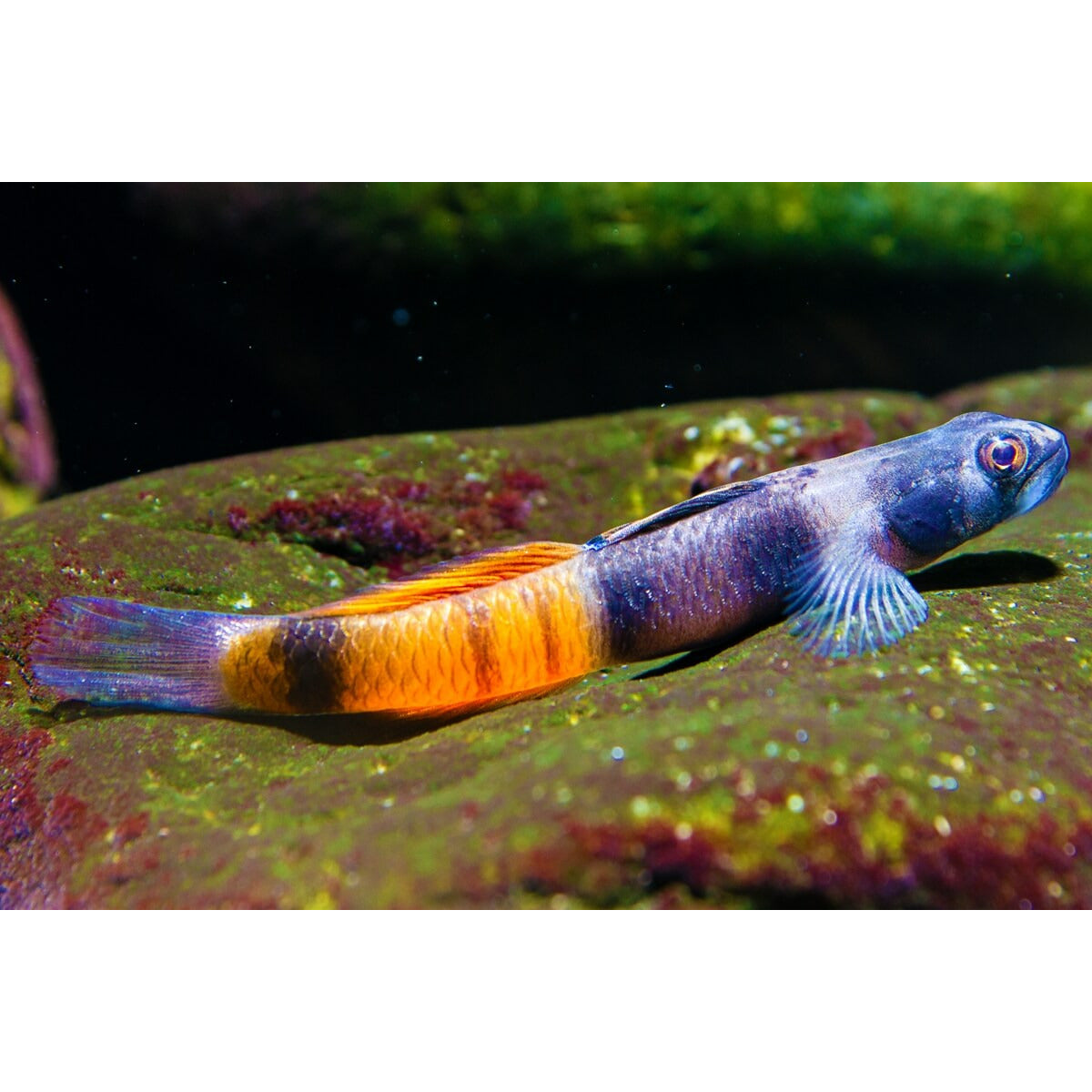
A five-centimetre fish that climbs waterfalls. Lentipes gobies live in the fast, cold, rock-strewn headwater streams of West Papua, gripping the substrate with a suction disc formed from fused pelvic fins. They graze biofilm off stone, hold small territories among the rocks, and males flare at one another in deep crimson, black and white — colours that would look excessive on a marine fish, let alone a freshwater one.
Almost nothing else in the freshwater hobby occupies this niche. It is not a community fish, it will not eat your flake, and it does not want a warm planted tank. What it wants is cool, hard-running, oxygen-saturated water over algae-covered rock — a river tank, built for it. Set up properly, it is one of the most rewarding species you can keep.
Read this before adding to cart — this is a specialist fish.
It is wild-collected, cannot be bred in home aquaria, is a dedicated biofilm grazer that frequently starves on standard foods, and needs water held at 23–26 °C — cooler than most of India runs without a chiller. In a normal tropical community tank it will die, and it will die slowly. We would rather lose the sale than have that happen. If you cannot commit to a dedicated river tank with cooling, please choose something else.
Care Snapshot
| Scientific name | Lentipes sp. |
| Family | Oxudercidae, subfamily Sicydiinae — rock-climbing gobies |
| Origin | Wild-collected — West Papua, Indonesia |
| Habitat | Fast, rocky headwater streams |
| Adult size | Up to 5 cm |
| Minimum tank | 60 litres, minimum 60 cm length, river-tank layout |
| Temperature | 23–26 °C — cooler than most tropicals |
| pH | 6.8–7.5 |
| Water quality | Ammonia 0 · Nitrite 0 · Nitrate under 30 ppm |
| Flow | Strong, high oxygen — essential |
| Diet | Grazer — algae and biofilm; gel and vegetable sinking foods |
| Temperament | Peaceful; males hold small territories |
| Care level | Advanced — specialist setup required |
Building The Right Tank
- A river tank, not a planted tank. Smooth rounded river stones and cobbles over sand or fine gravel, arranged into ledges and gaps. Plants are optional and largely irrelevant to the fish; the rock surface is the habitat.
- Serious flow. Aim for turnover in the range of 15–20× tank volume per hour, delivered as directed current along the length of the tank rather than random turbulence. A powerhead or circulation pump in addition to the filter is the usual approach.
- Oxygen above all. These fish come from cold, churning, oxygen-saturated water. Strong surface agitation is not optional, and it becomes critical as temperature rises.
- Mature the tank first — six months, not six weeks. The fish grazes established biofilm and algae. Adding it to a clean new setup removes its food source entirely. Let rocks green up under strong light before the fish arrives.
- Bright light is a feature here. Unusually for a shy fish, you want algae growth on the hardscape. Run the light hard and resist the urge to scrub the rocks.
- Cover every gap. These are climbers. In the wild they scale wet rock faces beside waterfalls. They will leave an open tank, and they can climb glass.
Tank Mates
Good matches
Best kept in a species tank, or with other hillstream specialists on the same regime — Sewellia and Gastromyzon hillstream loaches, Stiphodon gobies, Rhinogobius, and small fast-water danionins. Nerite snails work well and share the grazing habit.
Keep away from
Standard tropical community fish — not through aggression, but because they need warmer, slower water and will out-compete a slow, deliberate grazer at every feeding. Also avoid other bottom-dwellers that occupy the same rock surfaces, and any algae-eater efficient enough to strip the biofilm this fish depends on.
Keep either a single male, or a group in a tank long enough for several territories. Two males in a small tank means one is permanently displaced.
Feeding — The Part That Decides Everything
Starvation, not disease, is what kills these gobies in captivity. They are aufwuchs grazers with a specialised feeding action — scraping film off stone — and they do not recognise floating flake or chase food in the water column. A fish that appears to be "settling in quietly" for three weeks is usually a fish that is slowly running out of reserves.
Gel diets are the reliable answer. An algae or spirulina-based gel food smeared thinly onto a flat stone reproduces the natural feeding action and can be seen being grazed. Supplement with sinking algae wafers, blanched spinach or courgette, and from the AQA range a vegetable-based sinking tablet. Feed daily on a stone placed in a low-flow pocket where it will not simply wash away.
Occasional small frozen foods — cyclops, baby brine shrimp, daphnia — are accepted and useful for condition, but they are a supplement. The bulk of the diet must be plant and biofilm based.
Sexing & Breeding
Males carry the red, black and white colour and display it in bursts when flaring at rivals or courting. Females are smaller and plain brown-grey with dark mottling. Male colour is highly changeable — the same fish can look drab one hour and spectacular the next depending on mood and rivals present.
Captive breeding is not achievable in a home aquarium. Lentipes is amphidromous: adults spawn in freshwater streams, the newly hatched larvae are swept downriver to the sea, develop in saltwater for weeks or months, and the juveniles then migrate back upriver, climbing rock faces to reach the headwaters. Reproducing that cycle in captivity is beyond current hobby practice, which is why every specimen in the trade is wild-collected.
A Note On Wild-Collected Stock
Every one of these fish was taken from a wild stream, and none can be replaced by captive breeding. The genus is poorly documented, several species remain undescribed, and the headwater habitats they depend on are vulnerable to mining, logging and barriers to migration. We think that is worth stating plainly on the listing rather than leaving in the small print. Buy this fish if you intend to give it the setup it needs and keep it for its full life — not to try it and see.
Keeping It In Indian Conditions
- Temperature is the deciding factor, and for most of India it means a chiller. The working range tops out around 26 °C. Across the plains and the coast, an unmanaged tank will sit well above that for months at a time. This is not a species that quietly tolerates 30 °C — heat plus low oxygen is precisely the combination it is least equipped for.
- Bengaluru, Pune, and hill-station keepers have the easiest run of it, and even there a fan across the surface plus a cool room will be needed through April and May. Elsewhere, plan for a chiller from the outset and budget for it alongside the tank.
- Because the tank must run cool and heavily oxygenated, this species does not combine with a standard tropical community. Treat it as a dedicated build.
- Indian tap water is generally within the pH range required and needs no adjustment. Nitrate control is the ongoing job — these are clean-water fish and 30 ppm is a ceiling, not a target.
What You Receive
Wild-collected specimens from West Papua, quarantined and conditioned onto prepared foods at our Bengaluru facility before dispatch. Sex and colour intensity vary between individuals and cannot be guaranteed. Packed with oxygen and insulation for pan-India delivery.
Covered by the Best4Pets live arrival guarantee. Please film an unboxing video before opening the bag — it is required for any DOA claim. We recommend confirming your tank is mature, cool and running strong flow before ordering.