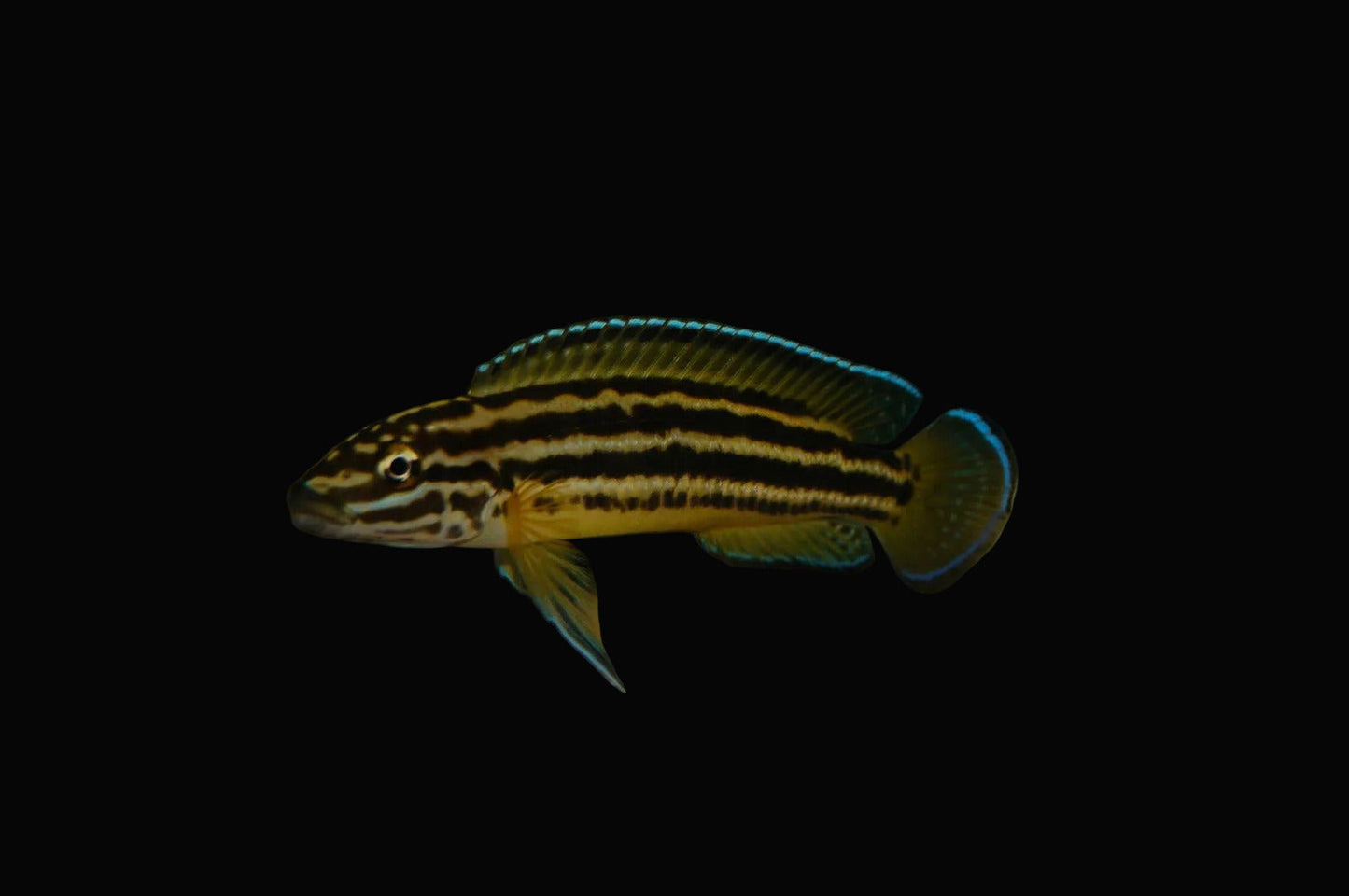
Julidochromis regani 1.5inch (Pair)
Couldn't load pickup availability
The big Julie, with racing stripes. Regan's Julie is the largest of the familiar Julies: a long, torpedo-shaped cichlid in warm sand-yellow, run through with four dark horizontal stripes and edged in pale blue on the fins. Where the smaller Julies dart, this one cruises — confidently, and always within reach of its crevice.
It lives along rocky and rubble shorelines throughout much of Lake Tanganyika, and that adaptability shows in the aquarium: it is hardy, tolerant of a range of hard water conditions and one of the easiest Tanganyikans to breed. The trade-off is size and attitude. A breeding pair of Regan's Julies will hold a sizeable territory and defend it against fish much larger than themselves.
One pair per tank, and buy them as juveniles.
Julies form strong pair bonds and do not tolerate rival pairs nearby. Raise five or six young fish, let a pair choose itself, and rehome the rest. Adding a new, unrelated adult to an established pair almost always ends badly.
Care Snapshot
| Scientific name | Julidochromis regani |
| Also known as | Regan's Julie, Striped Julie |
| Family | Cichlidae — Lake Tanganyika lamprologine cichlids |
| Origin | Endemic to Lake Tanganyika |
| Adult size | 10–13 cm (females usually larger) |
| Arrival size | about 1.5 inch |
| Lifespan | 8–10 years |
| Minimum tank | 150 litres for a pair, minimum 100 cm length |
| Temperature | 24–27 °C |
| pH | 7.8–9.0 |
| Hardness | 10–20 dGH — hard and alkaline |
| Diet | Micropredator — small crustaceans and insect larvae |
| Temperament | Calm outside breeding; very aggressive when guarding fry |
| Care level | Easy — one of the hardiest Tanganyikans |
| Swimming zone | Around rock at all levels |
Setting Up For It
- Rock is the habitat. Build tall, stable stacks of rock on the base glass with plenty of narrow cracks and fissures. Julies live on vertical and overhanging surfaces, often upside down, and the more crevices you provide the calmer they are.
- Give each pair a territory. A pair will claim one rock pile. In tanks under about 150 litres, keep Regan's as the only rock-dwelling cichlid; in larger tanks, build two separate piles so a second species has its own ground.
- Fine sand between the stones. They dig small pits beneath rocks before spawning. Coral sand or aragonite also helps buffer the water.
- Moderate flow, high oxygen. A good canister or sump plus an air stone. Strong biological filtration matters more than current.
- Small, matched water changes. 15–25% weekly with water matched for temperature and pH. Big, sudden changes upset Tanganyikans far more than slightly ageing water.
Tank Mates
Good matches
Cyprichromis shoals in the open water above, Calvus and Compressiceps, a Synodontis group, and shell dwellers on a separate sand bed in large tanks. Species that keep away from the Julies' rock.
Keep away from
Other Julidochromis — they can hybridise. Mbuna, Tropheus and Frontosa, which either bully or eat them. Small community fish.
Once a pair is breeding, tank mates may need to be moved if the colony grows to fill the tank.
Feeding — Small Meaty Foods
Regan's Julies pick tiny crustaceans and insect larvae off the algae-covered rock in the wild. They are not heavy eaters and do best on several small feeds rather than one large one. Overfeeding mostly feeds the filter and fouls the water in a rock-packed tank.
From the AQA range, a small sinking cichlid granule or quality flake works well as the daily staple, with frozen foods several times a week. Include a little spirulina-based food occasionally for balance, but this is a micropredator, not a grazer.
Foods they take eagerly: frozen mysis, brine shrimp, cyclops, daphnia, finely chopped prawn, and small sinking pellets and granules.
Sexing & Breeding
Females are usually larger and more robust; males are slimmer, sometimes with a slightly more pointed head. It is a size difference, not a colour one, and it only shows reliably in adults.
A cave and crevice spawner that forms long-term pairs. Eggs are laid on the ceiling of a crack or cave and guarded by both parents, and in a settled tank older fry often stay on and help defend newer broods, so a single pair can grow into a family colony. That colony becomes very aggressive while breeding and will expand its territory steadily, so plan for it.
Keeping It In Indian Conditions
- Hard borewell water is an advantage, but Tanganyikans care more about stability than about any single number. If your supply is soft municipal water, buffer it with coral sand or aragonite, and match pH and temperature on every change.
- Summer means oxygen. These fish come from cool, oxygen-saturated water. Above 28 °C, run an air stone and a fan across the surface through April and May.
- Keep a battery air pump for power cuts. A rock-heavy tank holds little open water, and a breeding pair guarding fry is the last thing you want gasping during an outage.
- Quality food shows in the stripes. Cheap, filler-heavy flake leaves Julies pale and thin. Frozen mysis and brine shrimp are widely available in Indian cities and keep the yellow warm and the stripes sharp.
What You Receive
Juveniles, supplied at about 1.5 inch, quarantined and conditioned at our Bengaluru facility before dispatch. Sex cannot be confirmed at this size, including on listings sold as a pair — at this age a "pair" is two fish chosen to give you the best chance, not a bonded couple. Packed with oxygen and insulation for pan-India delivery.
Covered by the Best4Pets live arrival guarantee. Please film an unboxing video before opening the bag — it is required for any DOA claim.