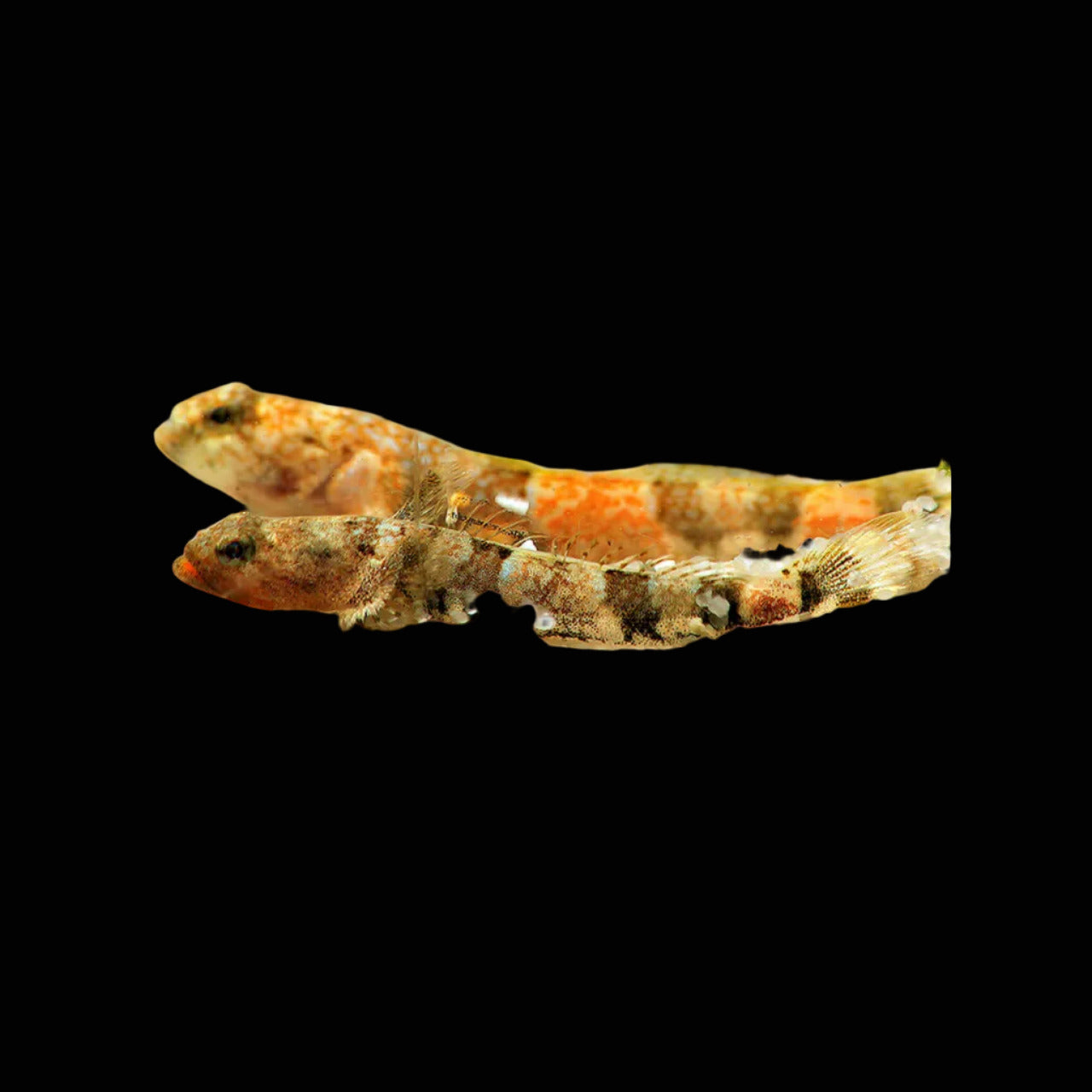
Indonesian Dragon Micro Goby *Rare*
Couldn't load pickup availability
You will lose it against the gravel, and that is the point. Schismatogobius are scaleless stream gobies that sit motionless on clean substrate between stones, broken up by bold dark saddles into something that reads as shadow and pebble rather than fish. Then one shifts position, and a set of banded pectoral fins fans open like a pair of painted hands.
Barely three centimetres long, wholly benthic, and utterly unlike anything else you can put in a tank. It hops rather than swims, settles into a depression it has cleared, and darts out to snatch small prey passing on the current. Males confront each other by gaping — a wide open-mouthed display that shows the inside of the jaw — before one retreats. In a small, clean, fast-water tank this is one of the most quietly absorbing fish in the hobby.
Specialist species — please read before ordering.
Wild-collected, not breedable in home aquaria, and a strict micropredator that will not eat flake or pellets. It needs cool, clean, well-oxygenated flowing water over open sand or fine gravel, and a regular supply of small frozen or live foods. In a warm, slow, planted community tank it will hide and slowly starve. If live and frozen feeding is not part of your routine, please choose something else.
Not a Bumblebee Goby
Banded stream gobies are often sold loosely as "bumblebee gobies". True Bumblebee Gobies are Brachygobius — chunkier, yellow-and-black, from slow brackish and blackwater habitats, and requiring almost the opposite conditions. Schismatogobius is a slim, scaleless, pure freshwater fast-water fish. Care advice written for one will not work for the other.
Care Snapshot
| Scientific name | Schismatogobius risdawatiae |
| Family | Oxudercidae — scaleless stream gobies |
| Origin | Wild-collected — Indonesian stream systems |
| Habitat | Clear, fast streams over sand, gravel and cobble |
| Life history | Amphidromous — marine larval stage, freshwater adult |
| Minimum tank | 45 litres, minimum 60 cm length |
| Temperature | 22–26 °C — cooler than most tropicals |
| pH | 6.5–7.5 |
| Water quality | Ammonia 0 · Nitrite 0 · Nitrate under 20 ppm |
| Flow | Moderate to strong, high oxygen |
| Diet | Carnivorous micropredator — small live and frozen foods |
| Temperament | Peaceful and shy; males display at each other harmlessly |
| Care level | Advanced — feeding is the challenge |
Building The Right Tank
- Open substrate is the habitat. Fine sand and small rounded gravel with scattered cobbles, and plenty of clear floor left exposed. This fish sits on and settles into the substrate — carpeting the base with plants removes its living space.
- Scaleless, so substrate must be smooth. No sharp crushed gravel and no coarse aquarium chips. There are no scales protecting the belly, and abrasion leads directly to infection.
- Good flow, but leave shelter pockets. These are fast-water fish that nonetheless station themselves behind stones in the current shadow. Directional flow along the tank with cobbles breaking it up gives exactly that.
- High oxygen, low nitrate. Clear headwater fish with little tolerance for accumulated waste. Weekly water changes and strong surface movement.
- Give each fish its own patch. Territories are small but real. Several cobble clusters spread along the tank prevents constant low-level displacement.
- Lid on, gaps closed. Small, cryptic and quick to leave a tank if startled.
Tank Mates
Good matches
A species tank is by far the best outcome. Otherwise only small, fast-water companions that stay in the water column — small danionins, Microdevario, hillstream loaches such as Sewellia and Gastromyzon, and Stiphodon gobies which graze rock rather than competing for the floor.
Keep away from
Anything that feeds quickly at the bottom — Corydoras, loaches, larger shrimp — will strip food before this fish commits to moving. Also avoid warm-water community fish, which need the wrong conditions, and any species large enough to see a 3 cm goby as prey.
Note: dwarf shrimp adults are usually left alone, but a settled goby will take shrimplets passing within range.
Feeding — This Is What Decides Success
Unlike the algae-grazing stream gobies it is often sold alongside, this is a carnivore. It hunts small invertebrates from a stationary position and responds to movement. Dry food is generally refused outright, and a keeper who assumes otherwise will lose the fish over several weeks with no obvious symptom beyond a thinning body.
Feed small frozen and live foods daily: frozen bloodworm (chopped), baby brine shrimp, daphnia, cyclops, mysis, and live blackworm or grindal worm where you can get them. Target-feed with a pipette near the fish's station rather than broadcasting food into the current, and feed once the tank lights dim if the fish is still settling in.
Some individuals eventually accept a sinking carnivore granule from the AQA range once well settled. Treat that as a bonus, not a plan — the frozen and live routine must be in place regardless.
Sexing & Breeding
Males are the more strongly marked, with bolder banding, larger and more elaborately patterned pectoral fins, and a broader head. They perform the open-mouthed gaping display at rivals. Females are plainer and fuller-bodied when in condition. Differences are subtle and best judged with several fish side by side.
Captive breeding is not achievable in a home aquarium. Like the other stream gobies in this group, the species is amphidromous: eggs are laid in freshwater, the minute larvae are carried downstream to the sea to develop in marine plankton, and juveniles later migrate back up the river. Adults may pair and spawn in a tank, but the larvae cannot be raised. Every specimen in the trade is wild-collected.
A Note On Wild-Collected Stock
This is a recently described species from a genus that is still being worked out — several close relatives remain undescribed, and distribution data for most of them is thin. Amphidromous fish are unusually exposed: they need an unbroken corridor from headwater to sea, so one weir or culvert low in a catchment can eliminate everything above it, and small island streams can hold populations found nowhere else. None of it can be offset by captive breeding. We put this on the listing rather than in the small print because it should shape the decision. Buy this fish to keep it properly, not to find out whether you can.
Keeping It In Indian Conditions
- Temperature is the constraint. The working ceiling is around 26 °C. Across the plains and the coast, summer tank temperatures run well past that, and heat combined with falling oxygen is the worst case for a fast-water fish. Plan for a chiller, or restrict this species to a cool room.
- Bengaluru, Pune and hill-station keepers manage most of the year on a surface fan and good circulation alone, with April and May the pinch point.
- Sort out the food supply before you order the fish. Frozen bloodworm and brine shrimp are widely available in Indian cities; live blackworm and grindal cultures are not, and are worth starting a few weeks in advance. A goby waiting on your food logistics is a goby losing condition.
- Indian tap water generally sits within the required pH range and needs no adjustment. Nitrate control and oxygenation are the ongoing work.
What You Receive
Wild-collected specimens, quarantined at our Bengaluru facility and feeding on frozen foods before dispatch. Sex, size and marking intensity vary between individuals and cannot be guaranteed. Packed with oxygen and insulation for pan-India delivery.
Covered by the Best4Pets live arrival guarantee. Please film an unboxing video before opening the bag — it is required for any DOA claim. We recommend confirming your tank is cool, mature and running clean flow, and that your frozen food supply is in place, before ordering.