- Product
- Import crowntail betta


Import Crowntail Betta
Couldn't load pickup availability
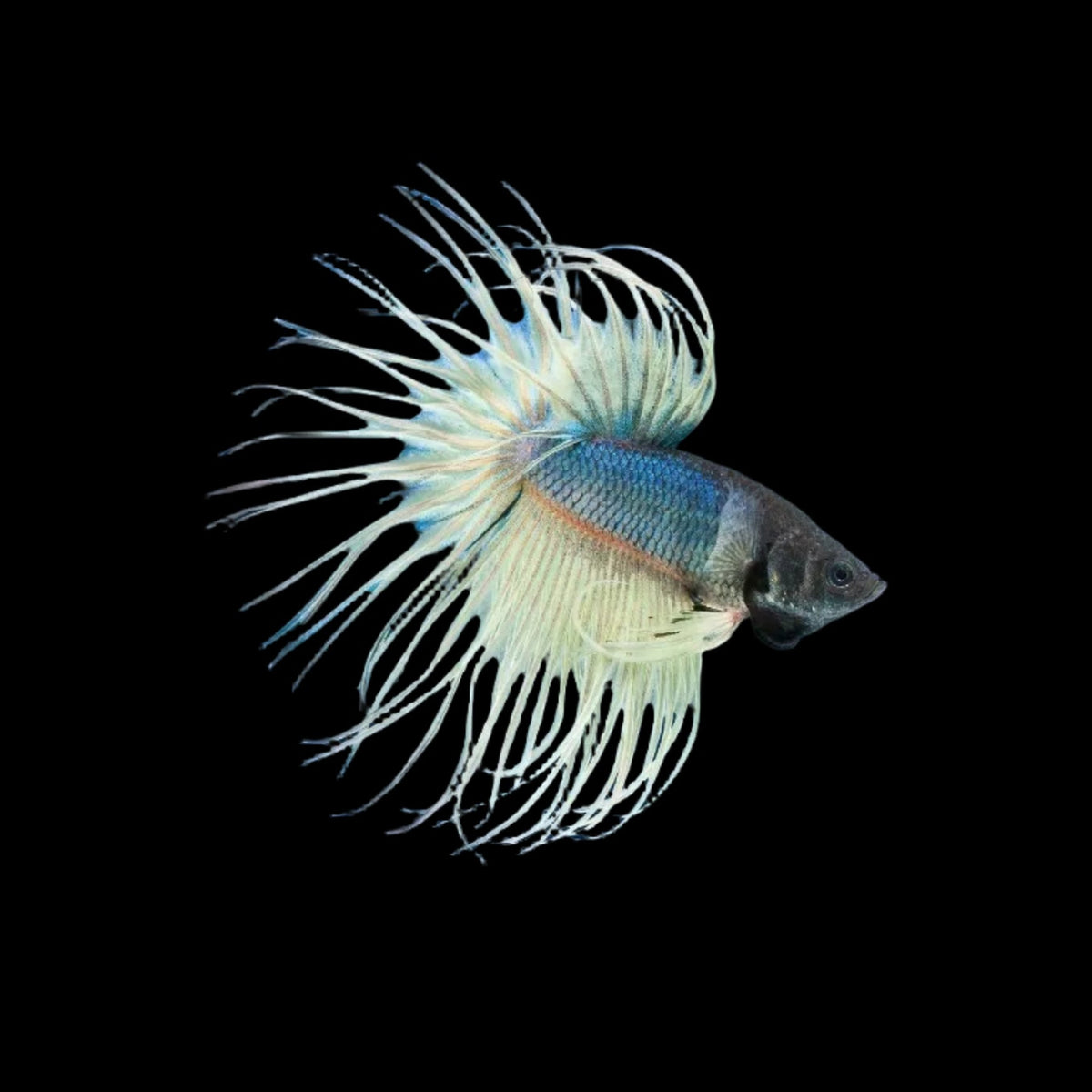
Spiked like a crown, swept like a flame. On a crowntail, the fin rays run well past the webbing between them, so every fin ends in a fringe of fine spikes. When the male flares, the tail, dorsal and anal fins fan out into a spiky halo that looks more like a firework than a fish.
The form was developed in Indonesia in the late 1990s and spread through the hobby almost overnight. Crowntails are lighter in the fin than halfmoons, which makes them better swimmers, but the reduced webbing has its own weakness: the exposed rays are brittle and can curl, kink or fuse when water quality slips. Clean, soft-ish water keeps the crown sharp.
Clean water keeps the rays straight.
Curled ray tips and webbing that creeps back up the rays are the usual signs that a crowntail is living in tired water. Weekly partial changes, a mature filter and no overfeeding are what keep the spikes long and separate. Medication cannot fix rays that have already bent.
Care Snapshot
| Scientific name | Betta splendens |
| Also known as | CT Betta, Siamese Fighting Fish; a finnage form of Betta splendens |
| Family | Osphronemidae — gouramis and fighting fish |
| Origin | Form developed in Indonesia; our stock is farm-bred and imported |
| Adult size | 5–6.5 cm body |
| Lifespan | 2–4 years |
| Minimum tank | 20 litres, heated and gently filtered |
| Temperature | 26–28 °C |
| pH | 6.0–7.5 |
| Hardness | 3–12 dGH — soft to moderate |
| Diet | Carnivore — small floating and frozen foods |
| Temperament | Aggressive to other males; tolerant of quiet bottom fish |
| Care level | Easy to moderate |
| Swimming zone | Upper and middle |
Setting Up For It
- Mature the filter first. Cycle the tank for three or four weeks before the crowntail goes in. The first ammonia spike in a new tank is exactly what curls ray tips.
- Soften the water a little. Crowntail rays hold their shape best in soft to moderately hard water. A few Indian almond leaves or a piece of driftwood bring pH and hardness down gently and stain the water a pleasant tea colour.
- Low flow, still surface. Crowntails swim better than halfmoons but still dislike current. A sponge filter or a baffled outlet keeps the surface calm enough for a bubble nest.
- Snag-free planting. The spiky fin edges catch easily. Choose live plants with soft leaves — Java fern, Anubias, Amazon frogbit — and skip spiky plastics.
- Lid with an air gap. Crowntails are confident jumpers, and they need warm moist air above the water for surface breathing.
Tank Mates
Good matches
In 40 litres or more: Pygmy and Panda Corydoras, Otocinclus, Kuhli Loaches, Harlequin Rasboras, Nerite and Mystery snails. Quiet species that do not compete at the surface.
Keep away from
Another male betta, fin-nipping barbs and tetras, guppies and fancy-tail livebearers, and dwarf gouramis. Also be cautious with shrimp, which many crowntails hunt.
A crowntail that starts biting its own tail is usually bored or stressed; more plants, less light and a slightly lower temperature often stop it.
Feeding — Short Meals, Long Rays
Leftover food breaks down into ammonia, and ammonia is what ruins crowntail rays. Feed two small meals a day, only what is eaten within a minute, and miss one day a week.
From the AQA range, a betta-sized floating pellet is the daily staple. Frozen daphnia, brine shrimp and bloodworm two or three times a week add variety and help digestion.
Readily eaten: floating betta pellets, frozen daphnia, brine shrimp, bloodworm, live mosquito larvae.
Sexing & Breeding
Males have long crowned fins with obvious ray extensions and a thick beard. Females are shorter-finned with only slight cresting at the fin edges, and show a white egg spot under the belly.
Crowntail breeders usually pair crowntail to crowntail; crossing with other forms tends to give fish with irregular, half-crowned edges. The male builds a large nest and does all the egg care. Remove the female after spawning, and the male a few days after the fry become free-swimming.
Keeping It In Indian Conditions
- A heater through the cooler months. Bengaluru nights from November to February dip below 24 °C, and a crowntail kept cold quickly loses fin condition. Set a thermostat heater to 27 °C.
- Hard tap water needs softening. Many Bengaluru borewell supplies run hard. Catappa leaves, driftwood or blending in some RO water helps keep the crown rays sharp.
- Peak summer: shade and water changes. Room temperatures above 30 °C are survivable for a betta, but faster bacterial growth means fin problems if maintenance slips.
- Leave the bowl in the cupboard. Plenty of crowntails in India live in bowls. Their rays are the first casualty. Twenty filtered, heated litres is the minimum.
What You Receive
One male crowntail betta, imported, quarantined at our Bengaluru facility before dispatch. Colour is chosen from the batch and will not exactly match the photograph; young crowntails often lengthen their rays over the first few months. Packed with oxygen and insulation for pan-India delivery.
Covered by the Best4Pets live arrival guarantee. Please film an unboxing video before opening the bag — it is required for any DOA claim.