- Product
- Hockeystick tetra (pair)

Hockeystick Tetra (Pair)
Couldn't load pickup availability
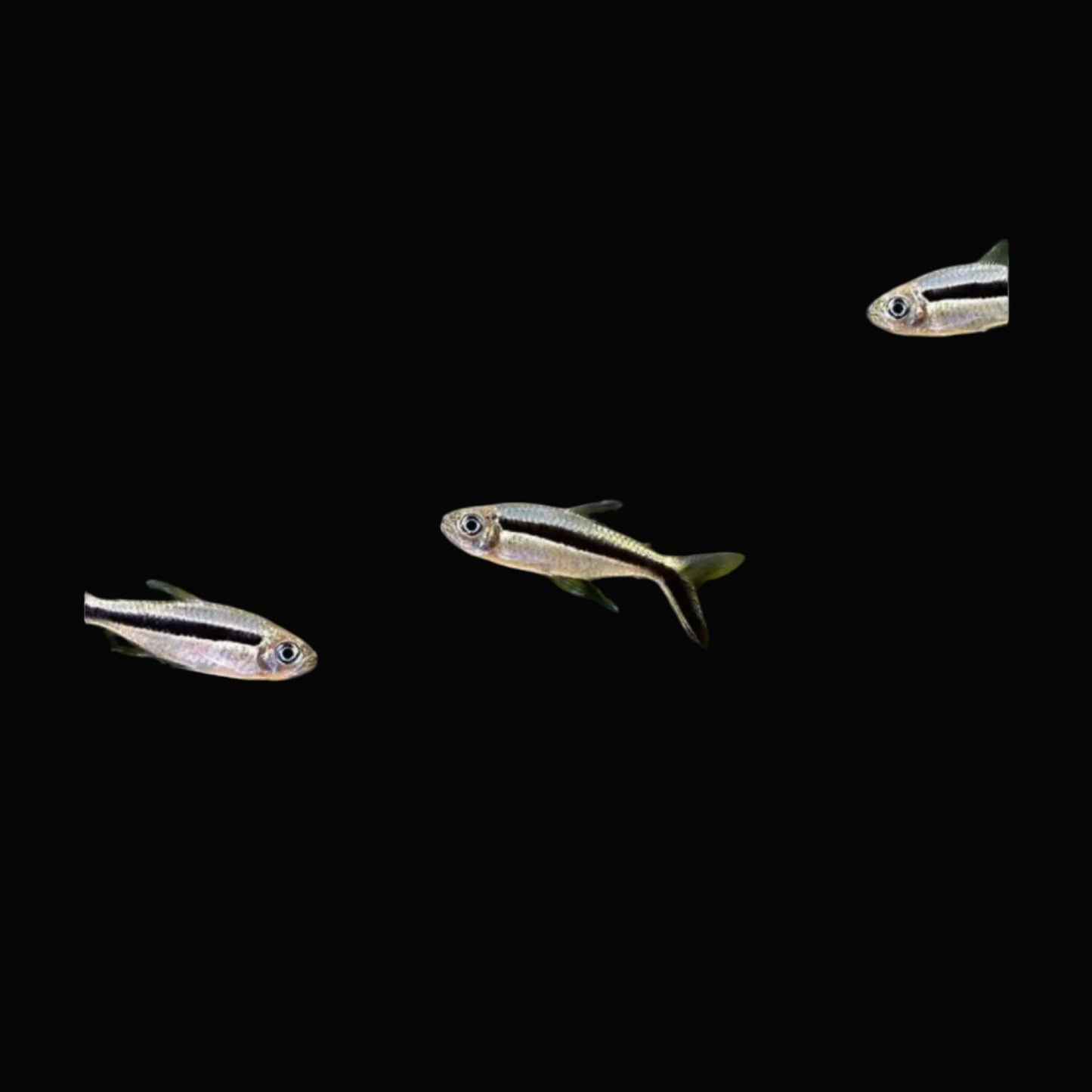
It swims at an angle, and that is the point. A bold black stripe runs along the body and bends down into the lower tail lobe like a hockey stick. The fish holds itself tail-down at a slight angle, so a school looks like a set of tilted arrows hovering in mid-water — unlike anything else in a community tank.
Also known as the Penguin Tetra, this is a hardy, active, peaceful schooler that suits almost any community. It tolerates a wide range of water conditions, eats readily and lives for years. The striking stripe and unusual posture make it a good choice for anyone wanting something a little different from the usual neon.
Keep a group and a lid.
Hockeysticks need a school of eight or more to feel secure; in small numbers they become skittish and can nip. They are also capable jumpers, so a well-fitted lid is essential.
Care Snapshot
| Scientific name | Thayeria boehlkei |
| Also known as | Penguin Tetra, Hockeystick Tetra, Blackline Penguinfish |
| Family | Characidae — American tetras |
| Origin | Native to the Amazon basin, Brazil and Peru |
| Adult size | 5–6 cm |
| Lifespan | 4–6 years |
| Minimum tank | 80 litres, minimum 75 cm length for a group of 8+ |
| Temperature | 22–28 °C |
| pH | 6.0–7.5 |
| Hardness | 2–15 dGH |
| Diet | Omnivore — small dry, frozen and live foods |
| Temperament | Peaceful; schooling, keep 8+ |
| Care level | Easy |
| Swimming zone | Upper and middle |
Setting Up For It
- Open swimming space. They hover in mid- and upper water, so keep the top half of the tank clear.
- Tight lid. They jump readily.
- Planted edges. Cover around the back and sides helps them settle.
- Moderate flow. A standard filter suits them.
- Weekly water changes. 25–30% keeps them healthy and active.
Tank Mates
Good matches
Rummynose, Lemon, Serpae and Black Widow Tetras, Corydoras, Plecos, Rams, Dwarf Gouramis, Platies, Rasboras.
Keep away from
Long-finned fish in small groups of hockeysticks, large cichlids and anything able to swallow a 5 cm fish.
Kept in a proper group, they rarely bother other fish.
Feeding — Surface And Mid-Water Feeders
They take food mainly from the surface and as it falls, rather than from the bottom.
Feed once or twice daily. From the AQA range, a community flake or slow-sinking granule makes a good staple, with frozen foods several times a week.
Foods they relish: frozen bloodworm, brine shrimp, mosquito larvae, daphnia.
Sexing & Breeding
Females are larger and rounder; males are slimmer. A group usually includes both.
They are egg scatterers and prolific spawners in the right conditions. Use a separate tank with fine-leaved plants or a mop and remove the adults after spawning.
Keeping It In Indian Conditions
- Handles Indian tap water. Moderately hard municipal water works well for this hardy species.
- Summer: above 29 °C, add aeration and run a fan through April–May.
- Winter heater. Keep 25 °C overnight in cooler cities.
- Power cuts: a battery air pump protects a busy community tank during outages.
What You Receive
Juveniles and young adults, quarantined and conditioned at our Bengaluru facility before dispatch. Sex is not guaranteed. The black stripe may look faint after travel and sharpens once settled. Packed with oxygen and insulation for pan-India delivery.
Covered by the Best4Pets live arrival guarantee. Please film an unboxing video before opening the bag — it is required for any DOA claim.