- Product
- Green terror cichlid 4" (pair)

Green Terror Cichlid 4" (Pair)
Couldn't load pickup availability
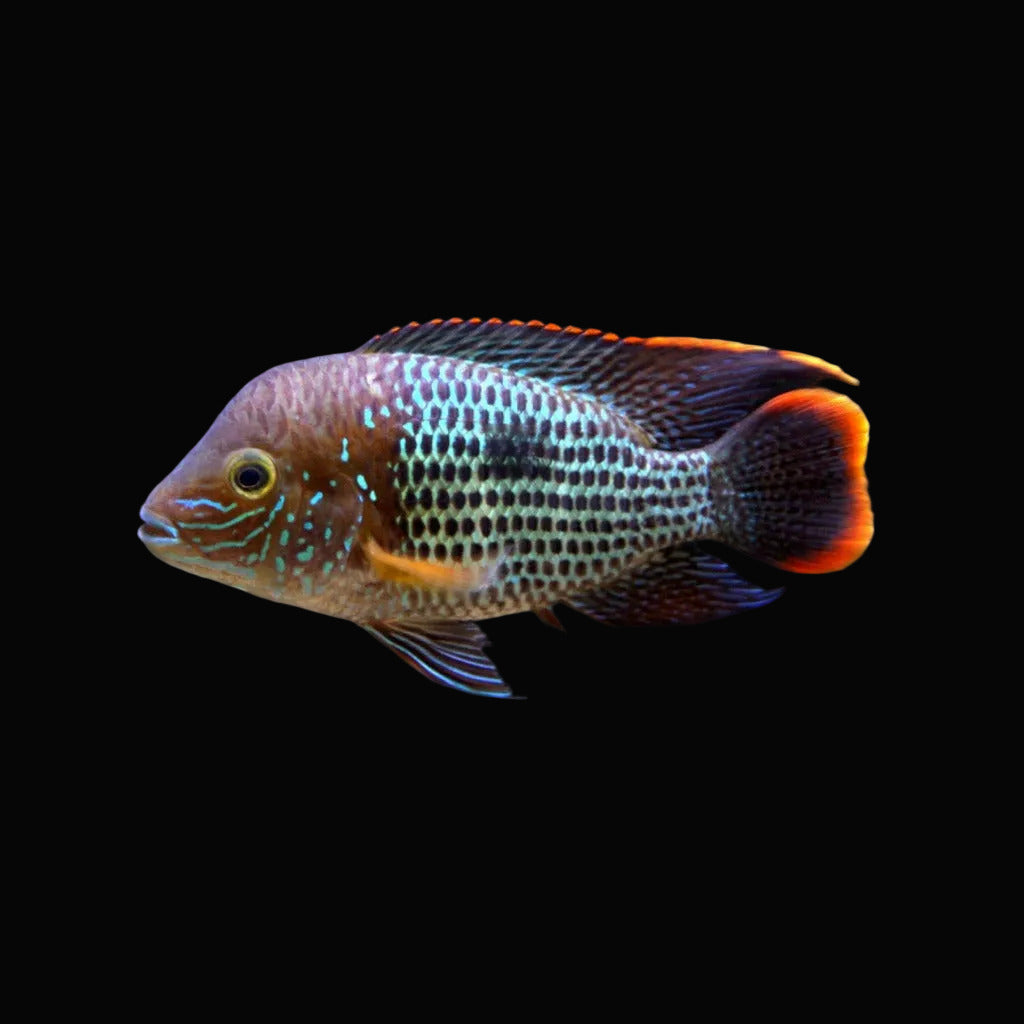
The name is earned. A mature Green Terror is a thick-set, metallic fish with turquoise scales sparkling over olive-green, a face scribbled with electric blue lines and, in the best fish, a bright orange-white band edging the dorsal fin and tail. It is also one of the most confident, territorial cichlids South America has to offer — and it will tell you so the day it settles in.
This is a fish with presence. It learns its owner, begs at the glass, rearranges the décor and defends its patch of floor with total conviction. Males develop a prominent forehead hump with age and grow considerably larger than females. Juveniles are deceptively plain and well behaved; the colour and the attitude both arrive together somewhere around 8–10 cm. Bought with that in mind, it is a hardy, long-lived and genuinely rewarding centrepiece fish for a large cichlid tank.
Choose its tank mates before you choose the fish.
A Green Terror will not share a tank with peaceful South Americans, and a breeding pair will clear a 300-litre tank of nearly anything. It belongs either on its own as a pair, or among robust cichlids of equal size that can hold their ground. Decide which of those you are building first — everything else about this species is easy.
Care Snapshot
| Scientific name | Andinoacara rivulatus |
| Also known as | Green Terror Cichlid, Gold Saum, Silver Saum; formerly Aequidens rivulatus |
| Family | Cichlidae — South American acara-type cichlids |
| Origin | Tank-bred; wild form native to Pacific-slope rivers of Ecuador and northern Peru |
| Adult size | 15–25 cm (males larger, often 20 cm+; females 12–15 cm) |
| Arrival size | about 4 inch |
| Lifespan | 8–10 years, often longer |
| Minimum tank | 250 litres for one adult, 350 litres+ for a pair or a mixed cichlid tank, minimum 120 cm length |
| Temperature | 22–28 °C |
| pH | 6.5–8.0 |
| Hardness | 5–20 dGH — adaptable |
| Diet | Omnivore with a strong appetite for meaty foods |
| Temperament | Aggressive and territorial, worse when breeding |
| Care level | Easy — hardy, but needs space and planning |
| Swimming zone | Bottom and middle |
Setting Up For It
- Sand or fine gravel floor. Green Terrors dig constantly, especially before spawning. A smooth substrate lets them excavate without damaging the mouth or gills.
- Heavy, stable rockwork. Set large stones directly on the base glass. A digging adult will undermine anything balanced on sand, and a falling rock can crack a tank.
- Break the sightlines. Rocks and wood that divide the tank into separate zones give tank mates somewhere to be out of view, which takes most of the heat out of the aggression.
- Strong filtration and big water changes. A large, meat-eating cichlid produces heavy waste. Run a canister or sump rated well beyond the tank volume and change 30–40% weekly.
- Forget delicate planting. Rooted plants will be dug out. Anubias and Java fern on wood are the realistic choices.
- Secure lid and heater guard. Big cichlids can jump, and they will push a bare heater around until it breaks.
Tank Mates
Good matches
Other robust cichlids of similar size: Jack Dempsey, Convict (in very large tanks), Firemouth, Severums only in large and well-broken tanks, Oscars, Silver Dollars as dither fish, large Plecos such as Common or Sailfin Pleco, large Synodontis.
Keep away from
Peaceful South Americans such as Angelfish, Discus, Uaru, Geophagus and Apistogramma. Small tetras, rasboras, livebearers and shrimp — they will be eaten. Anything much smaller than the Green Terror at any stage of its growth.
Adding all the cichlids at the same small size, and growing them up together, gives the best chance of a peaceful mixed tank. A spawning pair may still need to be separated.
Feeding — A Big Appetite To Manage
Green Terrors eat anything offered and will always ask for more. The danger is not underfeeding but overfeeding: a large cichlid stuffed daily in warm water fouls the tank, gets fat and becomes prone to bloat and head-and-lateral-line erosion.
Feed a quality sinking or slow-sinking cichlid pellet sized to the fish once or twice a day, only what is eaten in two or three minutes. From the AQA range, a cichlid pellet makes a sound daily staple, with frozen meaty foods two or three times a week and a vegetable component for balance. Skip feeder fish — they are the commonest way disease enters a cichlid tank.
Foods it takes eagerly: frozen bloodworm, mysis and krill, chopped prawn, earthworms, and blanched peas as an occasional vegetable feed.
Sexing & Breeding
Males grow much larger, develop a pronounced forehead hump and usually carry the brightest orange edging on the dorsal fin and tail. Females are smaller, with a rounder profile and often darker pigment in the dorsal fin. Juveniles under about 8 cm cannot be reliably sexed.
Green Terrors are open substrate spawners. A bonded pair cleans a flat stone, lays several hundred eggs and guards them and the free-swimming fry fiercely for weeks. Breeding in a community tank almost always ends with tank mates being chased into corners or injured, so be ready with a divider or a second tank. Fry grow quickly on baby brine shrimp and crushed pellets.
Keeping It In Indian Conditions
- Comfortable in Indian room temperatures. This species comes from the Pacific side of the Andes, not the Amazon, and is happy anywhere from 22 to 28 °C. Most of the year a heater is just a safety net; in Bengaluru and northern winters, keep one set to 25 °C.
- Watch the top end in April and May. Above about 30 °C a heavily fed cichlid tank runs short of oxygen. Increase surface agitation, run a fan and feed less during heatwaves.
- Hard borewell water is no problem. Green Terrors tolerate moderately hard, slightly alkaline water well — dechlorinate, match the temperature and use it as it comes.
- Back up the filter. A large cichlid tank stocked with heavy fish can turn dangerous within a couple of hours of a power cut. A battery-backed air pump or an inverter line is cheap insurance.
What You Receive
Tank-bred juveniles and young adults, supplied at about 4 inch, quarantined and conditioned at our Bengaluru facility before dispatch. Fish under about 8 cm cannot be sexed and show only a hint of the adult colour; the orange fin edging and facial blue lines develop as they grow. Where a listing is sold as a pair, juveniles are two unsexed fish; listings sold as a breeding pair contain an adult male and female, though whether any two fish bond is always up to them. Packed with oxygen and insulation for pan-India delivery.
Covered by the Best4Pets live arrival guarantee. Please film an unboxing video before opening the bag — it is required for any DOA claim.