- Product
- Fire ant tetra (pair)


Fire Ant Tetra (Pair)
Couldn't load pickup availability
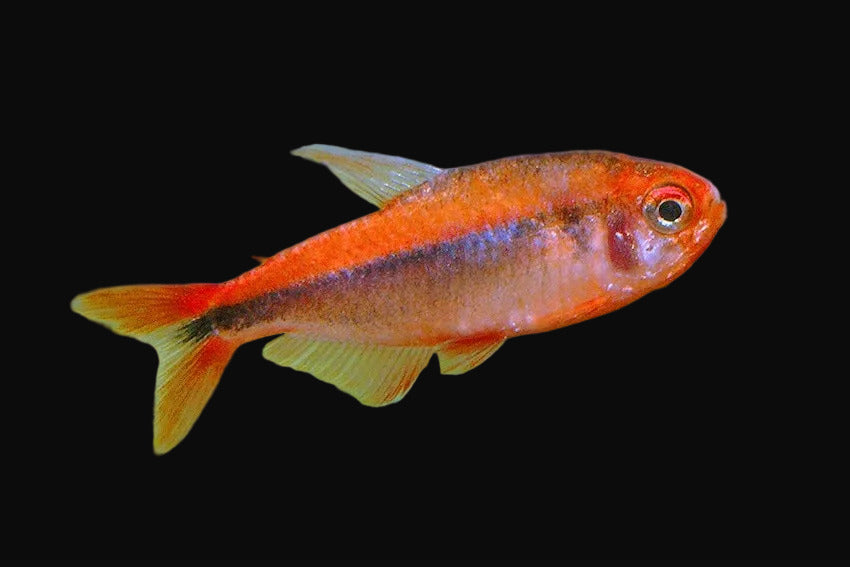
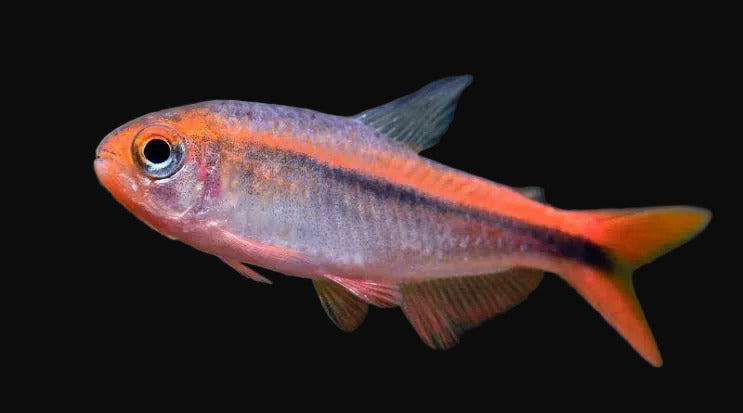
Small fish, big red attitude. The Fire Ant Tetra is a true dwarf, barely three centimetres grown, but a dominant male turns a saturated red that holds its own against fish twice its size. Males that win their small daily contests colour the hardest, so a busy group puts on the best show.
It is a recent arrival in the hobby from the Tapajós region of Brazil, and published information is still limited. What keepers report so far is encouraging: a peaceful, active little shoaler that takes prepared foods and settles well in a mature planted tank. It suits a nano or small community set-up where it is not competing with anything larger or faster.
Buy enough males to keep the red switched on.
The strongest colour belongs to dominant males, and dominance only means something in a group. A pair or trio gives you pleasant but muted fish. A group of ten or more, with several males sparring, is what produces the red the species is named for.
Care Snapshot
| Scientific name | Hyphessobrycon myrmex |
| Also known as | Fire Ant Tetra; a recent introduction to the hobby |
| Family | Characidae — American tetras |
| Origin | Native to the upper Rio Tapajós basin, Brazil |
| Adult size | 2.5–3 cm |
| Lifespan | Not well documented — likely 3–5 years |
| Minimum tank | 45 litres, minimum 45 cm length for a group of 10+ |
| Temperature | 23–28 °C |
| pH | 6.0–7.2 |
| Hardness | 2–10 dGH — soft to moderately soft |
| Diet | Micropredator — small dry, frozen and live foods |
| Temperament | Peaceful; shoaling, keep 10+ |
| Care level | Moderate — easy once settled, delicate on arrival |
| Swimming zone | Middle and lower |
Setting Up For It
- Sand and a little rock. This is a clear-water fish from sandy, stony streams. A fine sand bottom with pebbles and a few stones looks right and suits its habit of working the lower water.
- Planting for cover and sightlines. Dense planting at the back and sides lets subordinate males retreat and breaks up line of sight, which keeps the sparring harmless.
- Gentle flow. A sponge filter or a small, baffled outlet. Tiny fish tire quickly in strong current.
- Mature tank only. Very small fish have very little reserve. Add them to a tank that has been stable for at least two months.
- Moderate light. Red shows best under clear, moderate light over a darker sand. Floating plants over part of the surface help them settle.
Tank Mates
Good matches
Other tiny, peaceful species: Chili Rasbora and other Boraras, Ember Tetra, Pygmy and Habrosus Corydoras, Otocinclus, pencilfish, Sparkling Gourami, and adult Neocaridina or Caridina shrimp with Nerite snails.
Keep away from
Anything large enough to eat a 3 cm fish, including Angelfish once grown, and fast, greedy feeders such as barbs and larger danios that will take all the food. Avoid fin-nippers and any cichlid larger than a dwarf.
Shrimplets may occasionally be taken, but adult shrimp are safe.
Feeding — Think Small
A dwarf fish with a dwarf mouth. Standard flake and pellets are often too large, and in a mixed tank they can be outcompeted easily. Make sure food reaches the middle and lower water where they feed.
Feed small amounts two or three times a day. From the AQA range, the finest micro granule or crushed flake makes a good daily staple, rotated with small live and frozen foods for colour and condition.
Foods they take readily: baby brine shrimp, cyclops, moina, daphnia, microworm and finely chopped frozen bloodworm.
Sexing & Breeding
Males become intensely red when dominant and show brighter fins; females are paler, rounder and less colourful. Young fish often all look similar until they mature and a hierarchy forms.
Detailed breeding reports are still scarce. The usual approach for small egg-scattering tetras is a sensible starting point: soft, slightly acidic water, a small dim tank with fine-leaved plants or moss, and removing adults after spawning. Fry would be very small and need infusoria at first.
Keeping It In Indian Conditions
- Summer ceiling matters for a dwarf. Keep the tank below 28 °C through April and May with a fan and surface agitation; tiny fish lose condition quickly in heat.
- Winter heater for cooler regions. In Bengaluru winters and further north, hold the tank at around 25–26 °C overnight.
- Soften borewell water. Very hard borewell water is not suitable on its own. Blend with RO, and use driftwood or catappa leaves.
- Monsoon and power cuts: keep water changes small and matched, and have a battery-backed air pump for long outages — a small tank warms and loses oxygen quickly.
- Line up micro foods first. Frozen cyclops and baby brine shrimp are easy to find in Indian cities; get them before the fish arrive.
What You Receive
Juveniles and young adults, quarantined and conditioned at our Bengaluru facility before dispatch. Sex is not guaranteed, and young fish usually look pale orange rather than red — the full colour develops in dominant males once a settled group forms. Packed with oxygen and insulation for pan-India delivery.
Covered by the Best4Pets live arrival guarantee. Please film an unboxing video before opening the bag — it is required for any DOA claim.