- Product
- Echinodorus vesuvius

Echinodorus Vesuvius
Couldn't load pickup availability
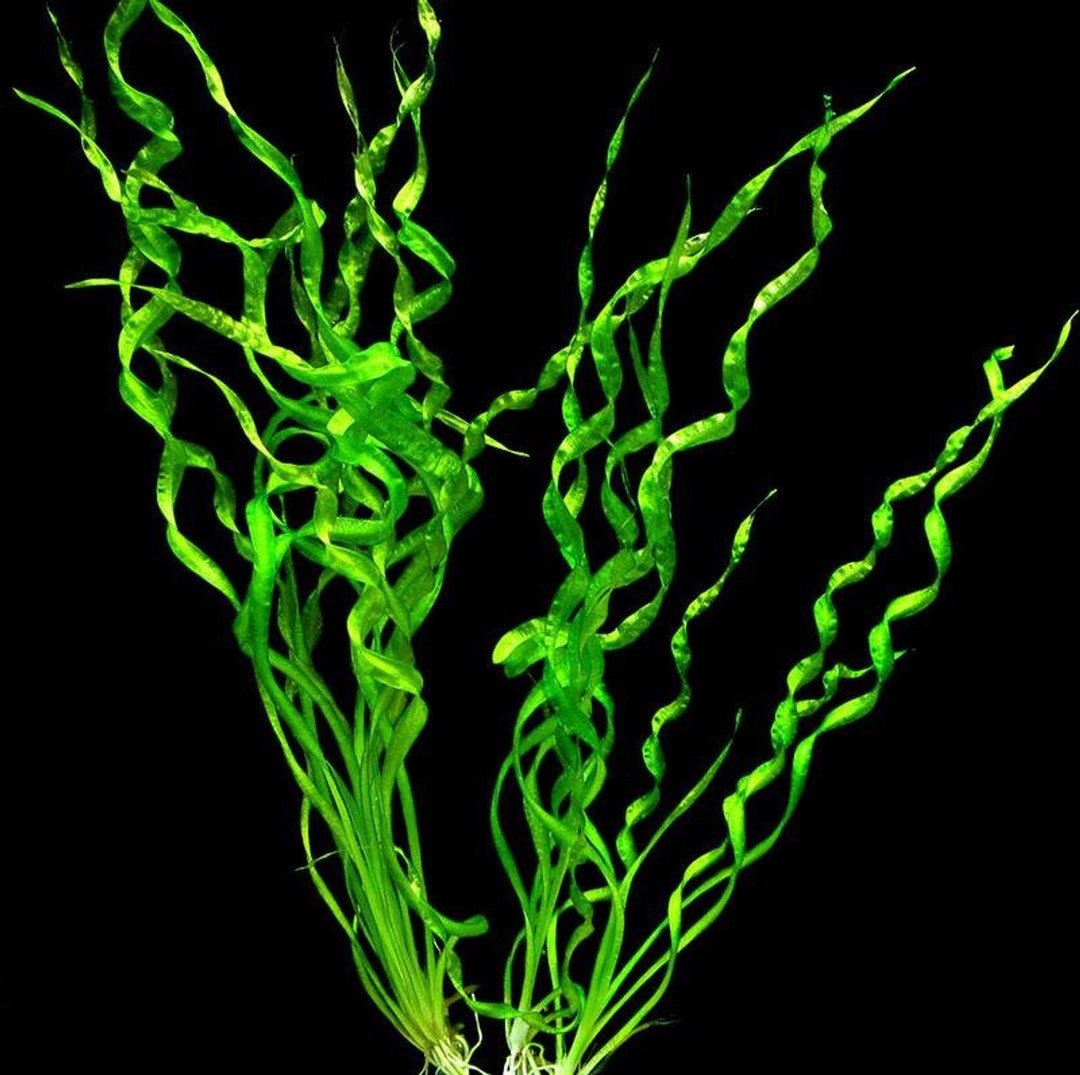
Every leaf is a corkscrew. 'Vesuvius' is a cultivated form of the narrow-leaf sword in which each blade twists into a tight spiral as it grows, so a mature plant looks like a green firework frozen mid-burst. Nothing else in the planted tank has this shape, and it holds the eye in a way that a normal rosette plant simply does not.
The useful part is that it is a sword. Underneath the unusual foliage sits an ordinary, tough Echinodorus root system — which means no CO2, moderate light, complete indifference to hard alkaline water, and the heat tolerance that makes swords work in Indian tanks. You get a genuinely distinctive specimen plant without taking on a high-tech setup to keep it alive.
Feed the roots, not the water.
Swords are heavy root feeders. In plain sand or gravel with no root tabs, this plant will slowly pale, thin out and stop producing new leaves, and no amount of liquid fertiliser will fix it. Give it at least 5 cm of substrate and push a root tab in beside it every few months. That single habit is the difference between a specimen plant and a disappointment.
Care Snapshot
| Scientific name | Echinodorus angustifolius 'Vesuvius' |
| Also known as | Vesuvius Sword, Corkscrew Sword, Twisted Sword |
| Family | Alismataceae |
| Origin | Nursery cultivar; the genus is South American |
| Plant type | Rosette, heavy root system |
| Placement | Mid-ground specimen; background in small tanks |
| Size | Roughly 15–25 cm tall, 10–15 cm across |
| Growth rate | Slow to moderate |
| Lighting | Medium; tolerates low, tighter spirals under more |
| CO2 | Not required; grows faster with it |
| Temperature | 22–29 °C |
| pH | 6.0–8.0 — wide tolerance |
| Hardness | Soft to hard — handles Indian tap water well |
| Substrate | Fine sand or gravel, 5 cm+ deep |
| Fertilisation | Root tabs essential in inert substrate |
| Difficulty | Easy — beginner-suitable with root feeding |
Planting It
- Bury the roots, keep the crown clear. The point where leaves emerge must sit at the substrate surface. A buried crown rots — the one planting mistake that actually kills a sword.
- Depth over area. At least 5 cm of substrate, more if you can. This plant puts far more mass below the surface than above it.
- Plant it where it can be seen from the front. The spiral structure is the entire reason to own it. Tucked behind taller plants it reads as an ordinary clump of grass.
- Use it as a single specimen or a group of three. One plant as a focal point works; three staggered at slightly different heights works better. A straight row of them does not.
- Leave it alone once planted. Swords resent being lifted and will sulk for weeks afterwards. Decide the position before you plant.
- Emersed-grown stock will change. Nursery plants raised out of water drop their original leaves and regrow submersed ones with tighter spirals. Expect a transition period rather than instant results.
Getting The Best Spirals
The twist is a stable trait of the cultivar, but how pronounced it is depends on conditions. Under moderate to strong light with a well-fed root zone, leaves stay short, dense and tightly coiled. Under weak light the plant stretches toward the surface and the spirals open out into something closer to a wavy ribbon. Neither harms the plant, but if you bought it for the corkscrew look, more light and root feeding is how you get there. New growth that does not match the leaves it arrived with is normal — the new leaves were grown for your tank.
Propagation
Swords propagate by throwing a long runner or flower stalk on which daughter plantlets develop, complete with their own leaves and roots, while still attached to the parent. Leave them in place until each plantlet has four or five leaves and a visible root system, then cut it free and plant it with the crown clear of the substrate. A well-fed plant will do this on its own without any encouragement. Mature specimens may also be divided at the rhizome, but that sets the parent back considerably and is best avoided unless you need to.
What It Pairs With
Shrimp-safe and snail-safe, with tough leaves that stand up to Corydoras, loaches and most community fish working around the base. The fine twisted foliage contrasts well against broad-leaved Cryptocoryne, Anubias and Bucephalandra — pairing it with those gives a low-tech tank real textural variety without a single stem plant or any CO2. Goldfish and large cichlids will uproot or eat it; almost nothing else will bother it.
Growing It In Indian Conditions
- Hard, alkaline tap water suits it. No RO, no buffering, no CO2. Swords are among the small group of genuinely attractive plants that will simply grow in an ordinary Indian tank.
- Summer is survivable. Comfortable to around 29 °C, where fine-leaved stem plants are already failing. Growth slows in peak heat but the plant holds its form rather than collapsing.
- No heater needed anywhere in India for most of the year.
- Root tabs are the one thing you must buy alongside it. Most Indian tanks run plain river sand or gravel with no nutrient substrate, and that is exactly the situation in which a sword slowly starves. Budget for tabs from the start, not after the plant declines.
What You Receive
Nursery-propagated plants held and conditioned at our Bengaluru facility. No wild-collected stock. Leaf length and spiral tightness vary with growing conditions and will change to match your tank over the following weeks. Some of the existing leaves may be shed after planting as the plant converts to submersed growth — this is normal and is not a fault.
Covered by the Best4Pets live arrival guarantee. Please film an unboxing video before opening the bag — it is required for any DOA claim.