- Product
- Dragon blood cichlid 3"inch

Dragon Blood Cichlid 3"inch
Couldn't load pickup availability
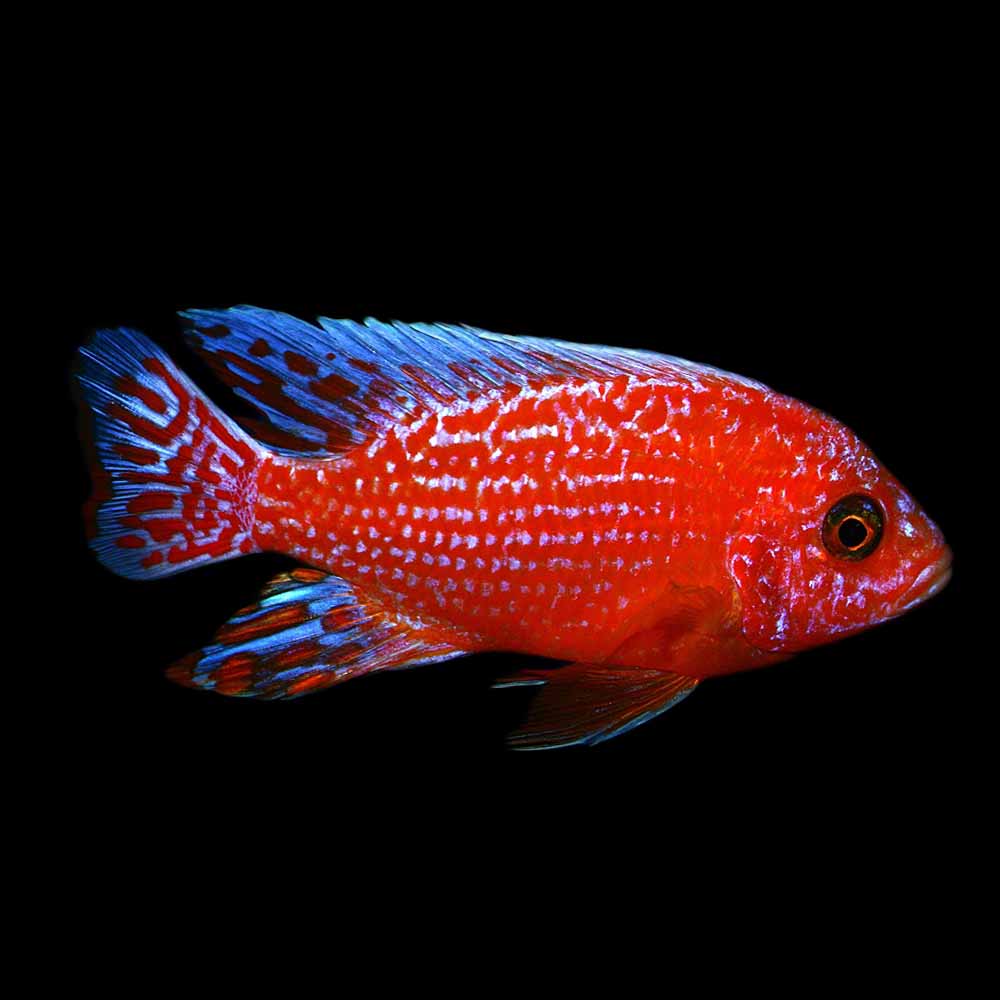
Pink, orange and red — and made entirely by fish farmers. The Dragon Blood is a man-made hybrid, bred on fish farms for an intense wash of pink, peach, orange and red, sometimes with dark speckling. There is no wild population and no single species behind it, and we would rather say so up front than dress it up with a scientific name.
What you get is a peacock-type cichlid in looks and behaviour: a sturdy, active fish of around 12–15 cm that swims in open water and gets along well with other peacocks and calm haps. Colour varies a great deal from fish to fish and changes with age — some go deep red-orange, some stay pink-cream, some develop spotting. It is a fun, colourful, hardy fish for an all-male peacock display tank.
A hybrid — keep it apart from pure species when breeding.
Dragon Bloods will cross with peacocks and haps. That is fine in a mixed display of males, but if you keep or breed pure Malawi species, keep females of the Dragon Blood away from them, and never sell or pass on its fry as anything other than hybrids.
Care Snapshot
| Scientific name | Hybrid — no single species name (Aulonocara-type peacock cross) |
| Also known as | Dragon Blood Cichlid, Dragon's Blood Peacock, Fire Fish |
| Family | Cichlidae — Lake Malawi peacock-type hybrid |
| Origin | Farm-bred hybrid strain; not found in the wild |
| Adult size | 12–15 cm |
| Arrival size | about 3 inch |
| Lifespan | 8–10 years |
| Minimum tank | 300 litres, minimum 120–150 cm length |
| Temperature | 24–28 °C |
| pH | 7.6–8.6 |
| Hardness | 8–20 dGH — hard and alkaline |
| Diet | Omnivore — peacock-style diet of pellets with meaty extras |
| Temperament | Moderately aggressive; best in an all-male peacock tank |
| Care level | Easy — hardy and adaptable |
| Swimming zone | Middle and lower open water |
Setting Up For It
- Open sand floor. Peacock-type fish feed and display over open sand. Keep rock to caves at the back and ends.
- 120–150 cm length. Gives males space to display and spread out without constant clashes.
- Heavy filtration. Turnover of five to eight times the volume per hour and 30–40% weekly water changes.
- Light background, neutral light. The pink-orange colour shows well against blue or dark backgrounds under neutral white light.
- All-male or one-male groups. An all-male display tank of peacocks and haps gives the best colour; mixed-sex groups mean breeding behaviour and hybrid fry.
- Rock caves for refuge. A few caves give lower-ranked fish somewhere to go.
Tank Mates
Good matches
Peacocks (Aulonocara), Electric Blue Ahli, Blue Dolphin, Copadichromis, Otopharynx and other calm haps of similar size, large synodontis catfish.
Keep away from
Aggressive mbuna, which harass peacock-type fish. Large predatory haps once the Dragon Bloods are small. Community fish and shrimp. Females of pure peacock species if you want to avoid further hybridisation.
Buy at similar sizes to the rest of the tank so no fish is easily dominated.
Feeding — Peacock Diet, Not Mbuna Diet
Like peacocks, Dragon Bloods sift sand for small invertebrates and take more protein than mbuna. Overfeeding is still the main danger: bloat and fatty liver come from too much food, not just the wrong food.
Feed once or twice a day, only what is gone in a couple of minutes. From the AQA range, a quality cichlid pellet works well as the staple, with frozen mysis, brine shrimp or krill two or three times a week. Colour-enhancing foods help but cannot change the fish's underlying genetics.
Foods it takes readily: cichlid pellets and flake, frozen mysis, brine shrimp, krill and a little spirulina.
Sexing & Breeding
Males usually colour more strongly, grow larger and develop longer, pointed dorsal and anal fins. Females are often paler but, unusually, can also be quite colourful in this strain. Fish under about 10 cm (4 inch) often show little colour, and sexing juveniles is unreliable.
They breed as maternal mouthbrooders and will do so readily. Fry are hybrids and colour unpredictably. Please do not cross them with pure Malawi species, and do not sell offspring as anything but hybrids.
Keeping It In Indian Conditions
- Hard alkaline water is on your side. Borewell and much southern municipal water is already hard and alkaline — exactly what Malawi cichlids need. Dechlorinate, match the temperature and use it without softening.
- Summer heat means oxygen. Above about 29 °C, a tank of large cichlids starts to run short. Through April and May add an air stone, run a fan across the surface and feed lighter.
- Back up the filter. Large Malawi fish in a stocked tank can be in trouble within an hour of a power cut. A battery air pump or inverter line for the filter is the cheapest insurance you will buy.
- Hardy in Indian conditions. Farm-bred hybrids are generally robust and adapt well, but they still need a heater in cold northern and Bengaluru winter nights, set to 25 °C.
What You Receive
Farm-bred hybrid juveniles and young adults, supplied at about 3 inch, quarantined and conditioned at our Bengaluru facility before dispatch. Colour and pattern vary between individuals and change with age — smaller fish often show little colour until they settle and grow. Sex cannot be guaranteed. Packed with oxygen and insulation for pan-India delivery.
Covered by the Best4Pets live arrival guarantee. Please film an unboxing video before opening the bag — it is required for any DOA claim.