- Product
- Didiplis diandra


Didiplis Diandra
Couldn't load pickup availability
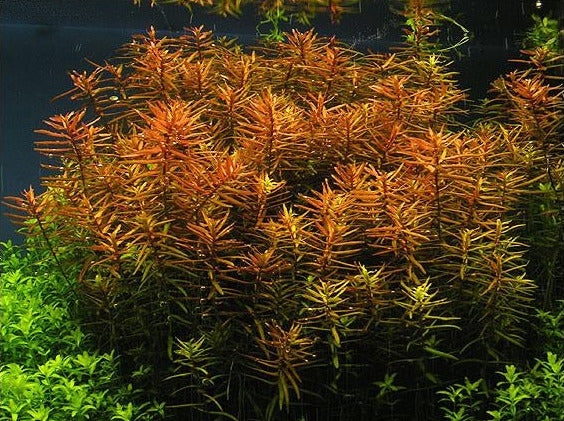
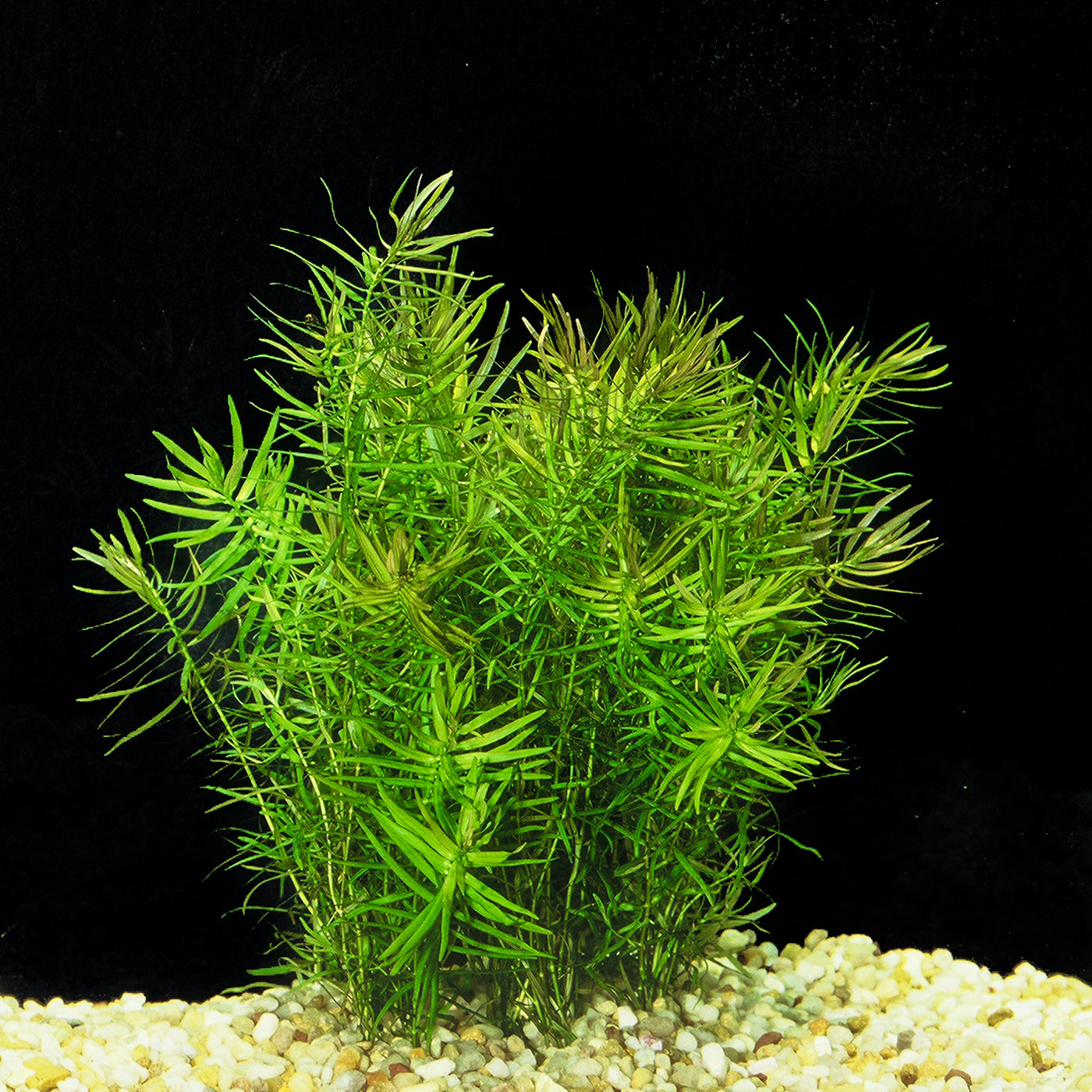
Fine needle foliage that burns orange at the tips. Didiplis diandra carries narrow, almost grass-like leaves in tight opposite pairs along a slender stem, and under strong light the growing tips shift from green through amber to a clear orange-red while the lower stem stays green. The effect is a gradient within a single plant, which is why aquascapers keep reaching for it despite everything else about it.
Planted in a dense group it makes a soft, textured hedge — the common name is accurate — and it sits beautifully against broad-leaved plants like Cryptocoryne or Anubias. It is a North American species from cooler, softer waters than most aquarium plants, and that history shapes everything about how it behaves in a tank here.
This plant punishes instability more than it punishes neglect.
It is not especially difficult to grow — it is difficult to grow consistently. A swing in CO2, a week of missed dosing, nitrate hitting zero, or a jump in temperature will stunt the growing tips, and stunted tips on this species do not recover. You cut them off and grow new ones. If your tank runs on a steady routine it will reward you; if your dosing is occasional, it will look ragged no matter how good the light is.
Care Snapshot
| Scientific name | Didiplis diandra |
| Also known as | Water Hedge, Blood Stargrass; also placed in Peplis |
| Family | Lythraceae |
| Origin | Eastern and central North America |
| Plant type | Rooted stem plant |
| Placement | Mid-ground, planted in dense groups |
| Height | Roughly 10–30 cm, kept lower by trimming |
| Growth rate | Moderate |
| Lighting | High — required for the orange tips and compact form |
| CO2 | Strongly recommended; stable levels matter more than high ones |
| Temperature | 20–26 °C — prefers the cooler end |
| pH | 5.5–7.2 |
| Hardness | Soft to moderately soft, low KH preferred |
| Substrate | Fine, nutrient-rich; aquasoil preferred |
| Fertilisation | Regular water-column dosing; do not let nitrate reach zero |
| Flow | Gentle but even — good distribution matters |
| Difficulty | Moderate to advanced |
Planting It
- Plant stems individually, close together. Separate every stem from the bunch and set them 1–2 cm apart. The hedge effect comes from density; scattered stems just look thin.
- Strip the lowest leaves and bury 2–3 cm of bare stem. Foliage buried in substrate rots and takes the stem with it.
- Put it under the strongest part of the light. The orange tips are a light response. In shade the plant stays entirely green and stretches.
- Keep nitrogen available. This is the one to watch. Running nitrate to zero to chase colour, a common trick with red plants, stunts this species instead and the damage is permanent to that tip.
- Dose micros consistently rather than heavily. Iron and trace elements support the colour, but steadiness is what keeps the growing point healthy.
- Be patient for the first month. It establishes slowly and often sulks before it takes off. Do not keep replanting it in the meantime.
What Usually Goes Wrong
The tips stunt. The characteristic failure — growth stops, the top whorls stay tiny and twisted, and the stem goes nowhere. Almost always CO2 instability or a nutrient gap, frequently nitrogen. Fix the cause, then cut below the damage and replant the healthy section. A stunted tip will not resume.
It stays green. Not enough light reaching the plant. Colour here is intensity-driven, not something the plant arrives with permanently.
Algae in the fine foliage. Like all needle-leaved plants it traps filament algae and cannot be cleaned by shrimp or otocinclus. Address the cause upstream and restart from clean cuttings rather than trying to rescue an affected stand.
Trimming & Propagation
Cut a healthy stem, strip the lowest leaves from the cutting and replant it beside the parent. The parent branches below the cut, so regular trimming thickens the group — this is how a hedge is built rather than bought. Trim little and often rather than hard and occasionally; heavy cutting stresses the plant and can trigger the same stunting as a nutrient crash. Retire old bottom stalks periodically and keep the stand going from fresh tops.
Disposing Of Surplus
This is a non-native species in India, and stem plants establish readily from fragments in warm water. Never tip trimmings into a drain, pond, canal or storm water line. Dry cuttings out completely or bag them for household waste, or pass surplus stems to another aquarist. It takes ten seconds.
Growing It In Indian Conditions
- Temperature is the main obstacle, not water chemistry. This is a temperate North American plant that prefers the cooler end of its range. Through April and May across the plains and the coast, tank temperatures push past what it handles well — growth slows, tips stunt, and algae takes advantage. Expect to lose ground in summer and replant fresh tops afterwards.
- Bengaluru, Pune and hill-station tanks hold it far more reliably year-round, and are where it is genuinely worth attempting.
- Hard alkaline tap water works against it. It prefers soft, low-KH water. It can be grown harder with strong light and stable CO2, but form and colour suffer. An RO blend and an aquasoil substrate make a visible difference.
- Consider what it is for. If you want fine-textured contrast in an ordinary Indian tank without CO2, this is not the plant — a group of Cryptocoryne or a stand of Water Sprite will serve you better and cost less. This is for a stable, high-light, injected tank where you are chasing a specific look.
What You Receive
Healthy stems grown and held at our Bengaluru facility. Stem length and colour intensity vary naturally, and colour will adjust to your own lighting and dosing within a few weeks. Separate the stems before planting. Some transition adjustment in the first fortnight is normal and is not a fault.
Covered by the Best4Pets live arrival guarantee. Please film an unboxing video before opening the bag — it is required for any DOA claim.