- Product
- Dario dario / red badis (pair)


Dario dario / Red Badis (Pair)
Couldn't load pickup availability
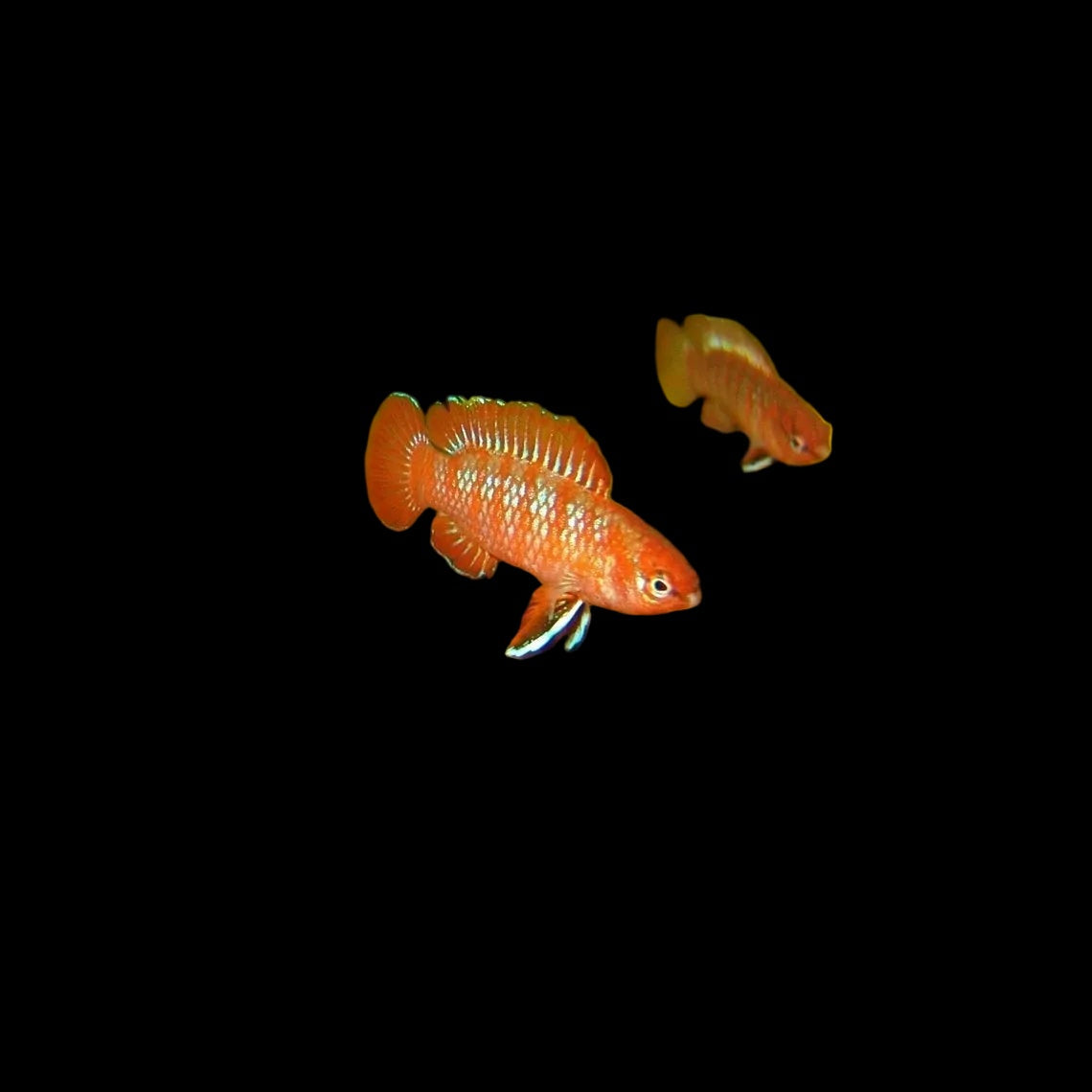
Two centimetres of pure attitude. A mature male Scarlet Badis is barely the length of a fingernail, yet he is barred in vivid scarlet and electric blue, with white-edged pelvic fins he flares like a cockerel at any rival. Watching two males square up over a clump of moss is one of the great small pleasures of fishkeeping.
Females are a different fish to look at: plain silvery-grey and shy. This is a micro-predator from the slow, weedy margins of streams in West Bengal and Assam, and it lives a quiet, deliberate life — hovering, inspecting, then snapping up a tiny crustacean. It is not a community fish in any real sense. Kept in its own small planted tank, it is fascinating, long-lived for its size and breeds readily.
It eats live and frozen food. Plan that before you buy.
Most Scarlet Badis refuse flake and pellets outright, and the few that take them do not stay in good condition on them. If you cannot supply frozen or live foods several times a week — baby brine shrimp, daphnia, cyclops, grindal — this is not the fish for you. Get the food sorted and everything else is easy.
Care Snapshot
| Scientific name | Dario dario |
| Also known as | Scarlet Badis, Red Badis, Dario Dario; formerly Badis bengalensis |
| Family | Badidae — chameleon fishes and badis |
| Origin | Northern and north-eastern India — West Bengal, Assam and neighbouring regions |
| Adult size | 1.5–2 cm |
| Lifespan | 3–4 years |
| Minimum tank | 30 litres for a male and two or three females; species tank strongly preferred |
| Temperature | 20–26 °C |
| pH | 6.5–7.8 |
| Hardness | 4–15 dGH |
| Diet | Micropredator — live and frozen foods |
| Temperament | Males territorial with each other; timid with other species |
| Care level | Moderate — easy if fed correctly |
| Swimming zone | Bottom and lower middle |
Setting Up For It
- A small, dense planted tank. Java moss, Cryptocoryne, stem plants and leaf litter give territories and cover. Males need line-of-sight breaks so subordinate males can escape.
- Gentle filtration. A sponge filter is ideal — it moves water without blowing these tiny fish around, and it grows the microfauna they graze between feeds.
- Fine, dark substrate. Dark sand or fine gravel brings out the scarlet. Leaf litter adds hunting ground.
- Caves for spawning. Small coconut-shell halves, short pipe sections or gaps under stones. Males spawn in these.
- Mature tank. A tank with established biofilm and copepods gives them something to hunt between meals and buffers the dips in condition.
Tank Mates
Good matches
Best on their own. In a larger planted tank: Chili Rasbora and other Boraras, Pygmy Corydoras, Otocinclus, Neocaridina shrimp (adults), Nerite snails.
Keep away from
Anything quick and greedy that out-competes them at feeding time — danios, barbs, most tetras, guppies. Any fish large enough to eat them. Other Badis species, which may hybridise or fight.
One male per 30–40 litres, with two or three females each. Shrimplets will be eaten.
Feeding — Small, Live, Often
Feed small amounts of live or frozen food once or twice a day: newly hatched brine shrimp, daphnia, cyclops, moina, microworm and finely chopped bloodworm. Frozen foods should be thawed and fed sparingly so leftovers do not foul a small tank.
Some individuals can be weaned onto a very fine sinking granule, such as the finest grade in the AQA range, by mixing it with frozen food over several weeks. Treat this as an occasional extra, never the staple.
Foods they hunt eagerly: baby brine shrimp, daphnia, cyclops, moina, grindal worm, microworm, chopped bloodworm.
Sexing & Breeding
Males are unmistakable once mature: bright red-orange vertical bars, blue sheen, and long white-edged pelvic fins. Females are smaller, plain greyish-beige and lack the bars. Juveniles of both sexes look like females.
Spawns readily in a planted species tank. The male courts a female into his cave or a dense patch of moss, and the eggs hatch in two to three days. Unlike some badis, the male provides little care. Adults will eat fry, so either keep the tank heavily planted so some survive, or move the moss to a rearing container. Fry need infusoria first, then microworm and baby brine shrimp.
Keeping It In Indian Conditions
- A native of Bengal's weedy streams and ponds. In the wild it breeds as monsoon waters rise and vegetation thickens, which is why a well-planted tank with cooler water changes brings it into condition.
- Indian temperatures suit it for most of the year. Keep the tank below 27 °C in summer with a fan and surface agitation; in the north, a small heater keeps winter water above 20 °C.
- Local tap water is fine. Moderately hard, neutral to slightly alkaline water suits it; no softening needed.
- Food supply is the real challenge. Frozen daphnia and brine shrimp are available in most Indian cities. Setting up a brine shrimp hatchery or a microworm culture before the fish arrive makes this an easy species.
What You Receive
One pair, quarantined and conditioned at our Bengaluru facility before dispatch. We select a coloured male and a plain female where they can be told apart; young males may still be developing their full scarlet bars. Colours fade in transit and return within days in a planted tank. Packed with oxygen and insulation for pan-India delivery.
Covered by the Best4Pets live arrival guarantee. Please film an unboxing video before opening the bag — it is required for any DOA claim.