- Product
- Cryptcoryne wendetii "green"

Cryptcoryne Wendetii "Green"
Couldn't load pickup availability
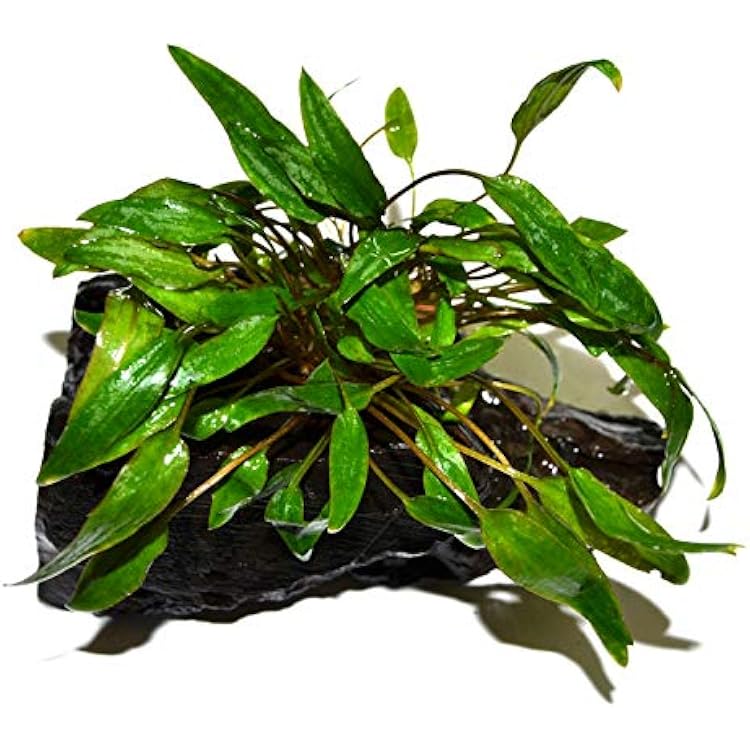
If you are only going to buy one plant, buy this one. Cryptocoryne wendtii 'Green' is the workhorse of the planted tank: fresh green, slightly rippled, lance-shaped leaves in a low rosette that asks for no CO2, tolerates low light, grows perfectly well in hard Indian tap water, and spreads into a dense bed on its own over a season.
The species is endemic to Sri Lanka, where it grows along shaded stream margins that flood and dry with the seasons — which is exactly why it is so hard to kill in an aquarium. The green form is the most vigorous and the fastest-spreading of the wendtii cultivars, and it takes stronger light better than the bronze forms without losing colour. It is the plant to put down first and build a layout around.
It will probably melt. Do not throw it away.
Cryptocorynes routinely shed their entire leaf set after planting or after any significant change in water conditions. Within a week or two you may be looking at bare stalks and a pile of dissolving leaves. This is normal, it is well known, and the plant is not dead — the rhizome and roots are intact and will push new leaves within a few weeks, grown for your conditions rather than the nursery's. Remove the rotting leaves, leave the plant exactly where it is, and change nothing.
Care Snapshot
| Scientific name | Cryptocoryne wendtii 'Green' |
| Also known as | Green Crypt, Wendt's Water Trumpet |
| Family | Araceae |
| Origin | Nursery-propagated cultivar; species endemic to Sri Lanka |
| Plant type | Rosette, rhizome and root system |
| Placement | Mid-ground; foreground in larger tanks |
| Size | Roughly 10–20 cm tall, spreading wider by runners |
| Growth rate | Slow to moderate — the most vigorous wendtii form |
| Lighting | Low to medium-high; shade-tolerant |
| CO2 | Not required |
| Temperature | 22–29 °C |
| pH | 6.0–8.0 — wide tolerance |
| Hardness | Soft to hard — handles Indian tap water well |
| Substrate | Fine sand or gravel, 5 cm+ deep — it is a root feeder |
| Fertilisation | Root tabs or nutrient substrate; liquid dosing is secondary |
| Difficulty | Easy — among the most forgiving plants available |
'Green' Or 'Tropica'?
'Green' — this plant
Fresh green, taller and more upright, the most vigorous spreader of the group. Handles brighter light without bleaching. Use it to fill space and build a base layer. The better choice if you want plant coverage quickly and cheaply.
'Tropica' — the bronze form
Shorter, more compact, olive-brown to red with heavily hammered leaf texture. Slower and less prolific. Use it as a colour and texture accent rather than a filler.
They grow well together and the contrast between them is one of the easiest ways to make a low-tech tank look deliberate.
Planting It
- Bury the roots, keep the crown clear. The point where the leaves emerge must sit at the substrate surface. Buried crowns rot; this is the one planting error that actually kills a Cryptocoryne.
- Give it depth. At least 5 cm of substrate. It builds a substantial root system and feeds through it far more than through the water column.
- Use root tabs. In plain sand or gravel, push a tab in beside each plant every few months. This matters more than any liquid fertiliser.
- Decide where it lives and leave it there. Every move triggers another melt and sets the plant back months. Plan the layout first.
- Space plants 10–15 cm apart. This form spreads faster than the bronze cultivars and will close the gaps itself within a season.
- Tissue-cultured stock needs its gel washed off and the clump divided into small portions before planting. Emersed-grown stock will drop its existing leaves and regrow submersed ones — expect it.
How It Will Actually Look
Leaf shape in Cryptocoryne wendtii varies so widely with conditions that the same cultivar can look like two different plants in two different tanks. Low light and rich substrate give longer, broader, smoother leaves and a taller plant. Stronger light keeps it shorter and more compact with more pronounced rippling along the leaf edge. Do not be alarmed if new growth does not resemble what arrived — the new leaves are the ones grown for your tank, and they are the ones that count.
Propagation
It spreads by underground runners, sending up new plantlets a few centimetres from the parent. Leave them alone and a single plant becomes a dense bed over a year or two — this form does it faster than any other wendtii cultivar, and it is the best and cheapest way to plant a tank. To move a plantlet, wait until it has four or five leaves of its own, cut the runner and lift it with as much root as you can. Expect the transplant to melt and regrow. Frequent division keeps the plant permanently unsettled, so do it sparingly.
What It Pairs With
Shrimp-safe, snail-safe, and tough enough to sit in a tank with Corydoras or loaches working the substrate around it. The low foliage gives shy fish and shrimp cover, and it thrives in exactly the shaded, low-tech, tannin-stained setups that suit Sparkling Gouramis, Boraras, bettas and dwarf cichlids. Goldfish and large cichlids will uproot or eat it; almost nothing else will bother it.
Growing It In Indian Conditions
- Hard, alkaline tap water suits it. No RO, no buffering, no CO2, no aquasoil. This is one of the small number of attractive plants that will simply grow in an ordinary Indian tank.
- It handles summer better than almost anything else planted. Comfortable to around 29 °C, where Cabomba and Rotala are already failing. If April and May usually wreck your aquascape, this is what is still standing afterwards.
- No heater needed anywhere in India for most of the year.
- Buy several and let them spread rather than buying a lot at once. Because this form propagates readily by runner, five plants in a low-tech Indian tank will cover more ground in a year than twenty stems of anything that needs CO2 — and cost you nothing further.
What You Receive
Nursery-propagated plants held and conditioned at our Bengaluru facility. No wild-collected stock. Leaf size and shape vary with growing conditions and will change to match your tank over the following weeks. Some or all of the existing leaves may be shed after planting — this is normal for Cryptocorynes and is not a fault.
Covered by the Best4Pets live arrival guarantee. Please film an unboxing video before opening the bag — it is required for any DOA claim.