- Product
- Costae tetra (pair)

Costae Tetra (Pair)
Couldn't load pickup availability
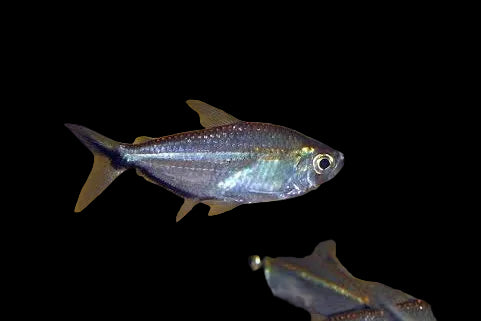
Watch the eye and the tail. The Costae Tetra is a silver fish with two flashes of detail that make it: a ring of red-gold across the top of the eye, and a black tail spot neatly framed in bright white. In a moving school those white-edged tails flick in unison, and the effect is crisp and graphic rather than gaudy.
It is a hardy, active, uncomplicated tetra from the São Francisco basin of eastern Brazil — a fish for people who like a clean, tight-looking school and do not want to fight their tap water to keep it. It is less known than its relatives, which is a shame: it holds together well as a group and adapts to a wide range of conditions.
A proper school, and a long swimming lane.
Costae Tetras are active mid-water swimmers. Kept as a pair they are restless and forgettable; kept as eight to twelve in a tank with open water along the front, they move as a group and the white tail marks become the point of the tank.
Care Snapshot
| Scientific name | Moenkhausia costae |
| Also known as | Costae Tetra, White-spot Tetra |
| Family | Characidae — American tetras |
| Origin | Native to the Rio São Francisco basin, Brazil |
| Adult size | 4–5 cm |
| Lifespan | 3–5 years |
| Minimum tank | 80 litres, minimum 75 cm length for a school |
| Temperature | 22–28 °C |
| pH | 6.0–7.8 |
| Hardness | 3–15 dGH |
| Diet | Omnivore — small dry, frozen and live foods |
| Temperament | Peaceful, active; keep 8+ |
| Care level | Easy |
| Swimming zone | Middle |
Setting Up For It
- Open water along the front. Plant the back and sides and leave a long lane for the school.
- Dark background. The white tail flashes and red eye stand out sharply against a dark backdrop and substrate.
- Moderate flow. They are comfortable with a light current, which keeps them schooling.
- Regular water changes. Easy-going, but colour and activity are best in clean, well-oxygenated water.
Tank Mates
Good matches
Other active tetras, Harlequin Rasbora, Rosy Barbs, Platies and Mollies, Corydoras, Bristlenose Pleco, Kribensis, Rams and Dwarf Gourami.
Keep away from
Large predatory fish and aggressive cichlids. With very slow, long-finned fish such as Bettas, watch for occasional nipping.
A busy, fast fish — very shy nano species may be crowded off food.
Feeding — Easy And Eager
Not fussy in the slightest. They take food in mid-water as it falls and compete well with other community fish.
Feed twice a day, only what is eaten in two minutes. From the AQA range, a small community granule or flake as the staple, with frozen foods a couple of times a week.
Foods they take well: frozen bloodworm, brine shrimp, daphnia and mosquito larvae.
Sexing & Breeding
Females are deeper and rounder in the body when mature. Males are slimmer. Hard to tell apart as juveniles.
An egg-scatterer that spawns among fine-leaved plants. Adults eat eggs, so breed in a separate tank with a mesh base or spawning mop and remove the adults afterwards. Fry take infusoria, then baby brine shrimp.
Keeping It In Indian Conditions
- Very tolerant of Indian tap water. Moderately hard, alkaline municipal water is within range after dechlorination.
- Summer: comfortable to about 28 °C. In April–May heat, add surface agitation and a fan.
- Cool-tolerant in winter. Holds up down to about 22 °C, so most of southern India needs no heater; the north and hill stations do.
- Monsoon: keep water changes regular but moderate while municipal supply quality fluctuates.
What You Receive
Juveniles and young adults, quarantined and conditioned at our Bengaluru facility before dispatch. Sex is not guaranteed. The red eye and white tail markings brighten within a few days of settling. Packed with oxygen and insulation for pan-India delivery.
Covered by the Best4Pets live arrival guarantee. Please film an unboxing video before opening the bag — it is required for any DOA claim.