- Product
- Corydoras wotroi (rare)

Corydoras wotroi (RARE)
Couldn't load pickup availability
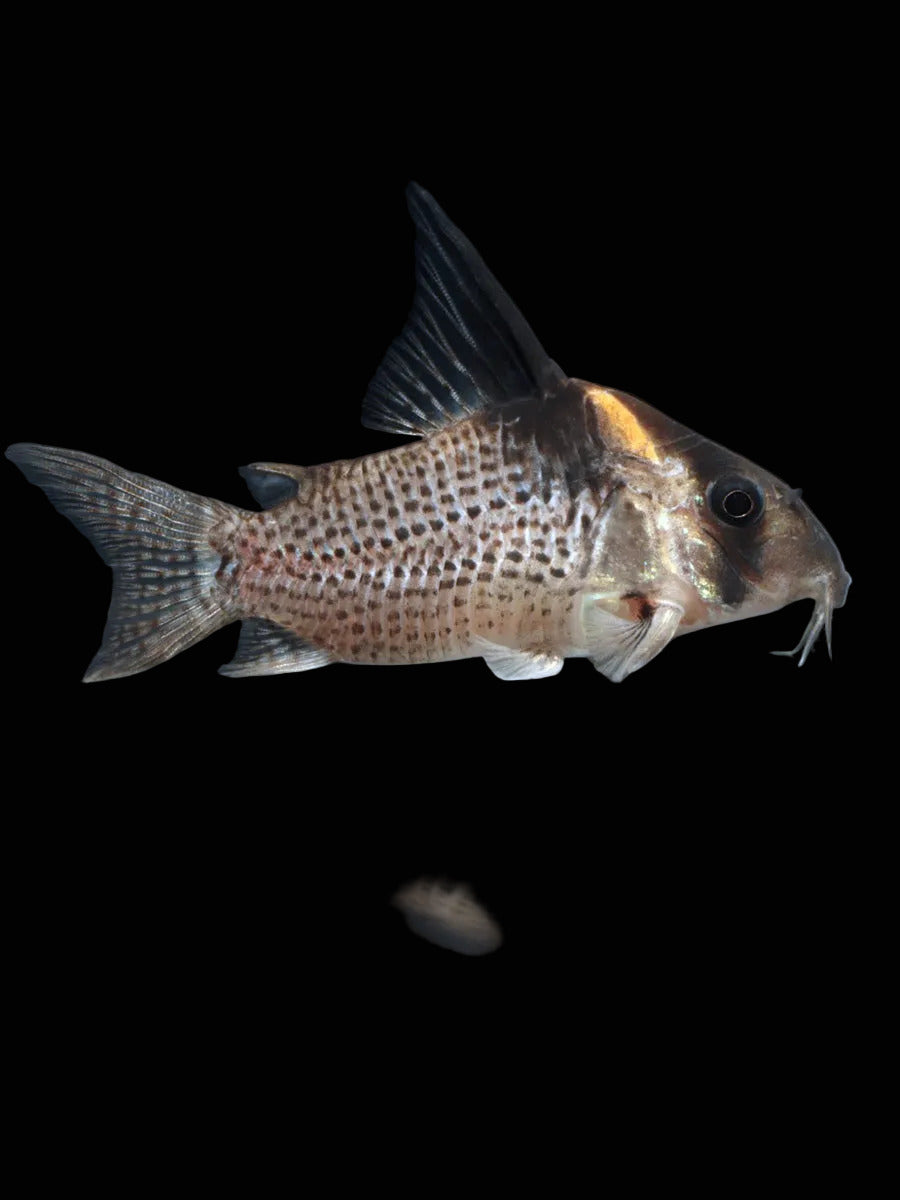
One for people who already keep corydoras. Corydoras wotroi is a super rare South American species that rarely reaches the aquarium trade, described in 1979 and named after the Dutch research foundation that funded the expedition work behind it. If you have a tank of Bronze, Emerald and Peppered corys and want something your local shop will never have, this is that fish.
black dorsal fin with a line/mark running through the eye and a light yellowish mark just above the gill with small spots/peppering across the body
Behaviour is pure corydoras: peaceful, sociable, busy all day, and happiest in a group working its way across open sand. They rest in loose piles under wood, forage constantly, and dash to the surface periodically for a gulp of air. Nothing about the care is exotic — what is uncommon is the fish, not the requirements.
Sand, not gravel. This is the one that matters.
These fish feed by pushing their barbels and snout through the substrate. On sharp gravel the barbels wear down, then become infected, and a cory with no barbels cannot find food properly for the rest of its life. It is the most common injury in the hobby and it is entirely caused by substrate choice. Fine, smooth sand — and keep it clean, because bacteria in dirty substrate does the same damage.
Care Snapshot
| Scientific name | Corydoras wotroi |
| Family | Callichthyidae — armoured catfishes |
| Origin | [[tank-bred / wild-collected]] — South America |
| Adult size | [[adult size]] cm |
| Size on arrival | [[arrival size]] cm |
| Lifespan | 5–8 years |
| Minimum tank | 75 litres, minimum 60 cm length — floor area matters |
| Temperature | 22–27 °C |
| pH | 6.0–7.5 |
| Hardness | 2–15 dGH — soft to moderately hard preferred |
| Substrate | Fine smooth sand — non-negotiable |
| Diet | Omnivore — sinking foods, fed directly |
| Temperament | Peaceful, shoaling; keep 6+ |
| Care level | Easy to moderate — given sand and proper feeding |
| Swimming zone | Bottom; surfaces periodically to gulp air |
Setting Up For It
- Open sand, and plenty of it. Floor area is what counts for a bottom-dwelling shoal, not water volume. Leave broad clear stretches rather than carpeting the whole base with plants.
- Keep the surface accessible. Corydoras breathe atmospheric air through the gut and must be able to reach the surface. Dashing up and back down is normal behaviour, not distress.
- Shade, wood and leaf litter. Uncommon species settle in faster with cover and a dimmer light. Catappa leaves and driftwood also soften the water slightly, which suits this group.
- Siphon the sand at every water change. Food and waste settle exactly where these fish feed. Dirty substrate is the second route to barbel damage after sharp gravel.
- Gentle to moderate flow, with good oxygenation. Not strong swimmers, but they want clean, well-moved water.
- Keep six or more, and consider a species tank. Rarely traded corydoras are worth keeping as a single-species group rather than scattered through a community — easier to feed properly, easier to observe, and the only realistic way to attempt breeding.
Tank Mates
Good matches
Tetras, rasboras, Boraras, Hockey Stick Tetra, Bolivian Ram, Honey and Sparkling Gourami, Otocinclus, Bristlenose Pleco. Quiet mid and upper water fish that leave the substrate alone.
Keep away from
Aggressive or territorial cichlids, large predatory fish, and anything that claims the substrate — including other corydoras species if you intend to breed a clean line. Avoid fast surface feeders unless you will feed the bottom separately.
Adult dwarf shrimp are generally safe alongside them, though shrimplets on open sand may be taken.
Feeding — They Are Not A Cleanup Crew
The most persistent myth about corydoras is that they live on leftovers. They do not. A group fed only on what drifts past the tetras will decline slowly over months, and because they are hardy fish it takes a long time to become obvious. Feed them deliberately, every day, with food that reaches the bottom.
From the AQA range, use a sinking wafer or small granule as the daily staple, with frozen bloodworm, brine shrimp or daphnia two or three times a week. Feed after the tank lights go off if faster fish are clearing everything first — these catfish are perfectly happy feeding in the dark.
Watch body condition from above. A healthy cory is rounded across the shoulders; a thinning one narrows noticeably behind the head.
Sexing & Breeding
Females are larger and distinctly broader when viewed from above, particularly when in condition. Males are smaller and slimmer with a more pointed outline. The difference is clear only in mature fish and is best judged looking down into the tank rather than through the glass.
Breeding follows the corydoras pattern — condition heavily on live and frozen food, then trigger spawning with a large water change using cooler water. Eggs are pressed onto glass, filter surfaces or broad leaves and must be separated from the adults. Rarely traded species like this one are worth the attempt: captive-bred stock of uncommon corydoras is genuinely scarce, and a hobbyist who establishes a breeding group is adding something the trade does not otherwise have.
Keeping It In Indian Conditions
- Room temperature works across most of India for most of the year, so a heater is needed only for northern and hill-station winters.
- Watch the summer ceiling. Above 27 °C, oxygen falls and these are bottom fish in the least oxygenated part of the tank. Increase surface agitation and run a fan across the water through April and May.
- Softer water suits this group. Hard alkaline tap water is workable, but catappa leaves and driftwood bring conditions closer to what the species comes from, and help a newly imported group settle.
- Substrate is the thing to get right locally. Most Indian aquarium shops sell sharp crushed gravel, which is precisely what damages barbels. Fine river sand is cheap and widely available — rinse it thoroughly until the water runs clear.
What You Receive
tank-bred specimens, approximately [[arrival size]] cm, quarantined and conditioned at our Bengaluru facility before dispatch. Sex cannot be determined at this size, and markings sharpen as the fish mature. Packed with oxygen and insulation for pan-India delivery.
Covered by the Best4Pets live arrival guarantee. Please film an unboxing video before opening the bag — it is required for any DOA claim.