- Product
- Rust cory (corydoras rabauti)

Rust Cory (Corydoras rabauti)
Couldn't load pickup availability
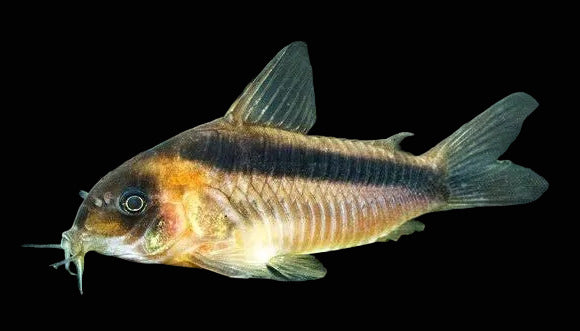
The juveniles and the adults look like two different fish. Young Corydoras rabauti carry a bold black zigzag band angling down the flank — striking, graphic, and completely unlike the adult. As they mature the pattern dissolves into a warm rust-orange body crossed by a single dark stripe running from behind the head to the tail. Buy them small and you get both fish for the price of one.
Beyond the colour change it is a compact, hardy, thoroughly likeable corydoras — smaller than a Bronze or Emerald, busy all day, and happiest in a group working across open sand. The rust tone is unusual in the genus and shows up far better against dark substrate than the silver and grey species most people end up with.
Sand, not gravel. This is the one that matters.
These fish feed by pushing their barbels and snout through the substrate. On sharp gravel the barbels wear down, then become infected, and a cory with no barbels cannot find food properly for the rest of its life. It is the most common injury in the hobby and it is entirely caused by substrate choice. Fine, smooth sand — and keep it clean, because bacteria in dirty substrate does the same damage.
What you receive will not look like the adult photo
Juveniles show the black diagonal banding and are sometimes mistaken for an entirely different species. The adult rust-and-stripe colouring develops gradually over several months as the fish grows. This is normal development, not a mislabelled fish — and watching the change is one of the better reasons to keep this species.
Care Snapshot
| Scientific name | Corydoras rabauti |
| Also known as | Rust Cory, Rabaut's Cory, Dwarf Rusty Corydoras |
| Family | Callichthyidae — armoured catfishes |
| Origin | Tank-bred; native to the upper Amazon basin |
| Adult size | 4–5 cm |
| Lifespan | 5–8 years |
| Minimum tank | 75 litres, minimum 60 cm length — floor area matters |
| Temperature | 22–27 °C |
| pH | 6.0–7.5 |
| Hardness | 2–15 dGH — tolerates hard water once acclimatised |
| Substrate | Fine smooth sand — non-negotiable |
| Diet | Omnivore — sinking foods, fed directly |
| Temperament | Peaceful, shoaling; keep 6+ |
| Care level | Easy — given sand and proper feeding |
| Swimming zone | Bottom; surfaces periodically to gulp air |
Setting Up For It
- Open sand, and plenty of it. Floor area is what counts for a bottom-dwelling shoal, not water volume. Leave broad clear stretches rather than carpeting the whole base with plants.
- Dark substrate brings out the rust. Over pale sand this species looks washed out; over dark sand the orange and the black stripe both read properly. Worth the choice on this one specifically.
- Keep the surface accessible. Corydoras breathe atmospheric air through the gut and must be able to reach the surface. Dashing up and back down is normal behaviour, not distress.
- Shade and shelter. Driftwood, broad-leaved plants and a dimmer light bring them out during the day. In a bright bare tank they hide until the lights go off.
- Siphon the sand at every water change. Food and waste settle exactly where these fish feed. Dirty substrate is the second route to barbel damage after sharp gravel.
- Keep six or more. Fewer than that and they stay hidden and inactive. A group is where the constant foraging behaviour comes from.
Tank Mates
Good matches
Tetras, rasboras, Boraras, Harlequins, Hockey Stick Tetra, Bolivian Ram, Honey Gourami, Sparkling Gourami, Otocinclus, Bristlenose Pleco. Almost any peaceful mid or upper water fish — they occupy a level nothing else competes for.
Keep away from
Aggressive or territorial cichlids, large predatory fish, and anything that claims the substrate. Also avoid very fast surface feeders unless you are prepared to feed the bottom separately — a cory left on scraps is a cory slowly starving.
Adult dwarf shrimp are generally safe alongside them, though shrimplets on open sand may be taken.
Feeding — They Are Not A Cleanup Crew
The most persistent myth about corydoras is that they live on leftovers. They do not. A group fed only on what drifts past the tetras will decline slowly over months, and because they are hardy fish it takes a long time to become obvious. Feed them deliberately, every day, with food that reaches the bottom.
From the AQA range, use a sinking wafer or small granule as the daily staple, with frozen bloodworm, brine shrimp or daphnia two or three times a week. Feed after the tank lights go off if faster fish are clearing everything first — these catfish are perfectly happy feeding in the dark.
Watch body condition from above. A healthy cory is rounded across the shoulders; a thinning one narrows noticeably behind the head.
Sexing & Breeding
Females are larger and distinctly broader when viewed from above, particularly when in condition. Males are smaller and slimmer with a more pointed outline. The difference is clear only in mature fish and is best judged looking down into the tank rather than through the glass.
Breeding follows the corydoras pattern and is well within reach at home. Condition the group heavily on live and frozen food, then trigger spawning with a large water change using cooler water, imitating the onset of the rains. The female carries eggs in a pouch formed by her pelvic fins and presses them onto glass, filter surfaces or broad leaves. Remove the eggs or the adults, as they will eat them. Fry hatch in three to five days and take baby brine shrimp and powdered food.
Keeping It In Indian Conditions
- Hard, alkaline tap water is fine for tank-bred stock. No RO or buffering needed. Room temperature across most of India sits inside the range for most of the year, so a heater is needed only for northern and hill-station winters.
- Watch the summer ceiling. This species runs a little cooler than the Bronze and Emerald corys and is less comfortable above 27 °C. Warm water also holds less oxygen, and these are bottom fish in the least oxygenated part of the tank. Increase surface agitation and run a fan across the water through April and May.
- Substrate is the thing to get right locally. Most Indian aquarium shops sell sharp crushed gravel, which is precisely what damages barbels. Fine river sand is cheap and widely available — rinse it thoroughly until the water runs clear.
- A large cool water change is a reliable spawning trigger, and in India the first heavy rains often set a group off on their own.
What You Receive
Tank-bred juveniles, quarantined and conditioned at our Bengaluru facility before dispatch. At this size they carry the juvenile black banding rather than the adult rust colouring, and sex cannot be determined. Packed with oxygen and insulation for pan-India delivery.
Covered by the Best4Pets live arrival guarantee. Please film an unboxing video before opening the bag — it is required for any DOA claim.