- Product
- Cambomba carolina

Cambomba carolina
Couldn't load pickup availability
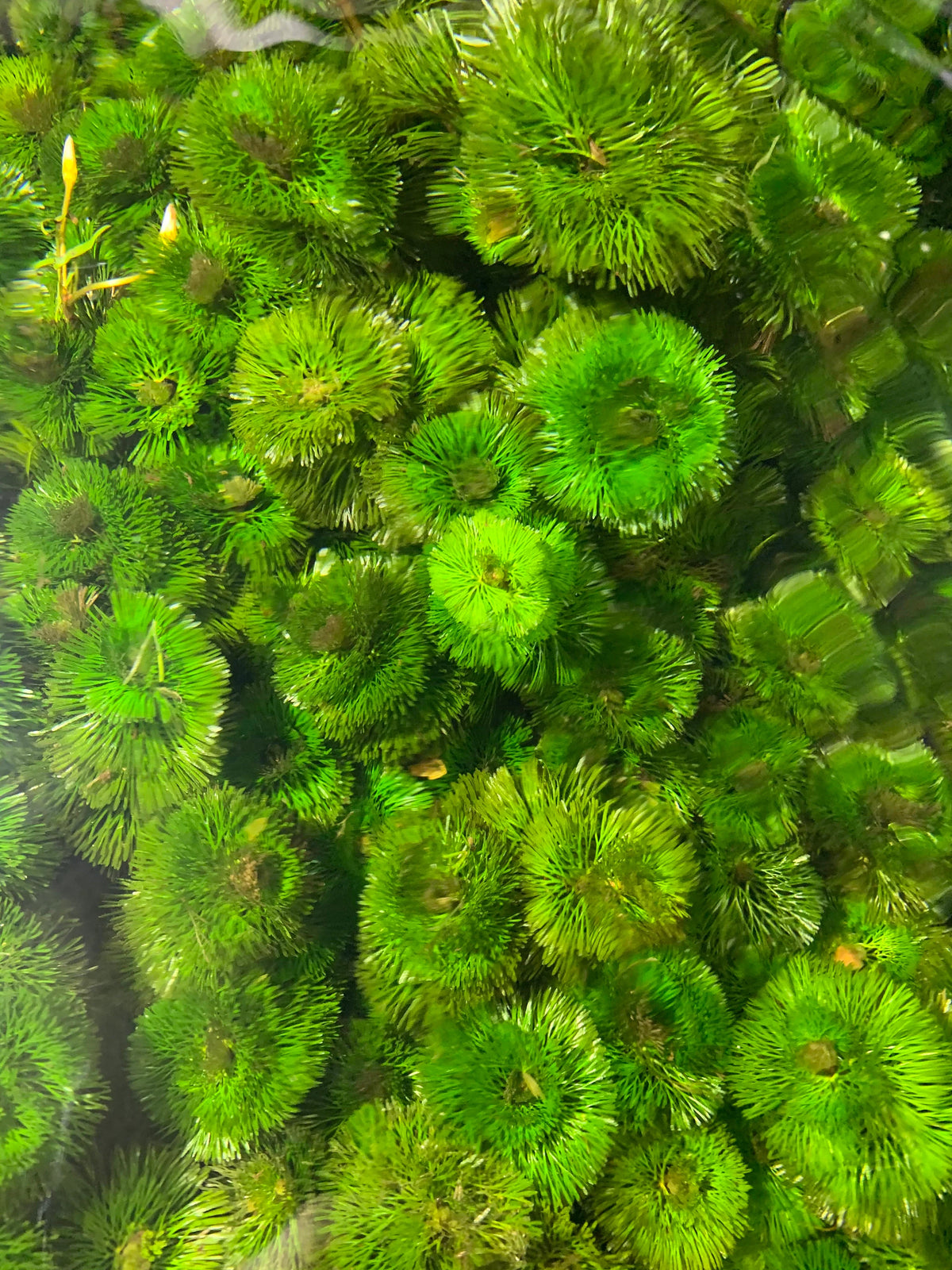
The classic feathered stem plant, and one of the most misjudged. Each leaf splits into dozens of fine segments arranged in a flat fan, so a healthy stand reads as a soft green cloud rather than individual leaves. Under good light it grows fast enough to watch, throws pink-tinged new tips, and gives shrimp and fry the densest cover of any common aquarium plant.
It is also not the beginner plant its price suggests. Cabomba is sold cheaply everywhere and fails constantly, because it wants strong light, soft water and stable conditions, and it responds to anything less by shedding from the bottom up. Given what it actually needs, it is one of the fastest and most rewarding stem plants available. Given a dim tank and hard tap water, it will be a bare stalk within a month.
Light is the whole decision.
This plant needs genuinely strong lighting — not a hood lamp, not an LED strip chosen for looks. In moderate or low light it stretches, thins, drops its lower leaves and collapses into a stem with a tuft on top. If your tank is low-tech and dimly lit, buy Hygrophila, Vallisneria or Java Fern instead and you will be far happier.
Care Snapshot
| Scientific name | Cabomba caroliniana |
| Also known as | Green Cabomba, Carolina Fanwort, Fanwort |
| Family | Cabombaceae |
| Origin | The Americas; widely naturalised elsewhere |
| Plant type | Rooted stem plant |
| Placement | Background, planted in groups |
| Height | To the surface and along it if left untrimmed |
| Growth rate | Fast — weekly trimming once established |
| Lighting | High — the single most important requirement |
| CO2 | Not essential, but transforms growth and density |
| Temperature | 22–28 °C — prefers the cooler half |
| pH | 6.0–7.2 — acidic preferred |
| Hardness | Soft to moderately soft — struggles in hard water |
| Substrate | Fine sand or aquasoil, 5 cm deep |
| Flow | Gentle — brittle stems break in strong current |
| Difficulty | Moderate — easy given light, unforgiving without it |
Planting It
- Separate the stems before planting. Bunches arrive banded together. Remove the band, discard any crushed section, and plant each stem 2–3 cm apart. A bunch left banded rots at the base within days.
- Strip the lowest whorl of leaves and bury 3–4 cm of bare stem. Leaves buried in substrate decay and take the stem with them.
- Handle it gently. The stems are brittle and the foliage collapses out of water. Use planting tweezers rather than fingers.
- Plant in groups of five or more. A thicket looks intentional; three scattered stems look like an accident.
- Keep it out of the filter outflow. Strong directional current shreds the fine foliage and snaps stems.
- Feed the water column. This plant takes most of its nutrients through the leaves, so a liquid fertiliser with iron and a full trace mix matters more than root tabs.
What Usually Goes Wrong
It melts in the first two weeks. Almost always a transition shock — the plant was grown emersed or under different light, and it drops its old growth while adapting. Do not pull it out. Leave the stems in place, keep the light and fertiliser steady, and wait for new tips. If the stem stays firm, it will recover.
It goes bare at the bottom. The classic Cabomba failure: leggy stems with foliage only near the surface. That is a light problem, not a fertiliser problem. Either increase lighting or accept that you need to uproot, trim the tops and replant them regularly.
It gets smothered by algae. Fine feathered foliage traps hair algae and no algae-eater can clean it out. The cure is upstream — stable CO2, balanced nutrients, a shorter photoperiod. Once a stand is badly affected, cut clean tops and start again rather than trying to rescue it.
Trimming & Propagation
Cut a healthy stem anywhere along its length, strip the lowest leaves from the cutting and replant it. The cutting roots within days and the parent stem branches below the cut, so every trim thickens the stand and gives you free plants. Once growth is going properly, expect to do this weekly. Unlike most stem plants, Cabomba does not respond well to repeated hard cutting of the same old stem — it is better to replace a tired stand with fresh tops every few months.
Never Release It — This One Matters
Cabomba caroliniana is one of the most serious aquarium plant invasives in the world. A single broken fragment can root and establish, and in warm, nutrient-rich water it forms dense mats that choke out native vegetation, deoxygenate the water column and block waterways. It is regulated or banned outright in several countries and has naturalised well outside its native range, including in parts of Asia. Never put trimmings into a drain, a pond, a lake, a canal or a storm water line. Dry cuttings out completely, or bag them and put them in household waste. Give surplus plants to another aquarist instead. This takes ten seconds and it is the single most important thing on this page.
Growing It In Indian Conditions
- Hard alkaline tap water is the main obstacle. This plant wants soft, slightly acidic water, which is the opposite of most Indian municipal supplies. It can be grown in harder water with strong light and good CO2, but growth is thinner and the stand needs replacing more often. Blending in RO water, or running an aquasoil substrate, makes a visible difference.
- Watch summer temperatures. Cabomba prefers the cooler half of its range and deteriorates above about 28 °C — stems soften, leaves drop, algae moves in. In the plains through April and May, expect to lose density and plan on replanting fresh tops afterwards.
- Bengaluru, Pune and hill-station tanks hold it far more easily year-round.
- Dispose of trimmings responsibly. Warm Indian water bodies are exactly the conditions in which this species establishes and spreads. Dry cuttings fully before discarding, and never rinse them down an outdoor drain.
What You Receive
A banded bunch of healthy stems, grown and held at our Bengaluru facility. Stem length and branching vary naturally. Remove the band and separate the stems before planting. Some transition melt in the first fortnight is normal and is not a fault — keep the stems in place and new growth will follow.
Covered by the Best4Pets live arrival guarantee. Please film an unboxing video before opening the bag — it is required for any DOA claim.