- Product
- Cabomba piauhyensis

Cabomba piauhyensis
Couldn't load pickup availability
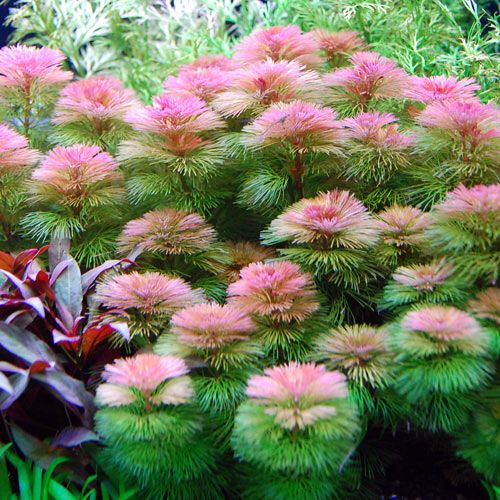
The hardest plant in this catalogue, and the one people keep coming back to. Red Cabomba carries the same fine feathered structure as its green relative, rendered in deep wine red through to purple-magenta, with fresh tips that glow almost pink under strong light. A properly grown stand is one of the genuine showpieces of the planted tank. Most stands are not properly grown.
This plant has a reputation for being impossible, and the reputation is half-earned. It is not fussy in a complicated way — it wants very strong light, injected CO2, soft acidic water and complete stability, and it wants all four at once. Give it those and it grows fast and holds colour indefinitely. Miss one and it dismantles itself from the bottom up over a fortnight.
This is a high-tech plant. There is no low-tech version of it.
Injected CO2 and high light are requirements, not improvements. Liquid carbon is not a substitute, and in some formulations actively melts this genus. If your tank is not running pressurised CO2 under strong lighting, this plant will die and nothing in your fertiliser routine will prevent it. For red colour in a lower-tech setup, Ludwigia or Rotala rotundifolia are far better choices and we would honestly rather sell you those.
Telling it apart from Green Cabomba
Beyond colour, the arrangement differs: this species carries its leaves in whorls of three around the stem, while Cabomba caroliniana carries them in opposite pairs. Useful when stock arrives poorly coloured, since a starved red cabomba can look green. The name Cabomba piauhyensis is widely used in the trade; the currently accepted name for this plant is Cabomba furcata.
Care Snapshot
| Scientific name | Cabomba piauhyensis (accepted: C. furcata) |
| Also known as | Red Cabomba, Purple Cabomba, Forked Fanwort |
| Family | Cabombaceae |
| Origin | Tropical Central and South America |
| Plant type | Rooted stem plant |
| Placement | Background or mid-ground accent, in tight groups |
| Growth rate | Fast when conditions are right; stalls completely when not |
| Lighting | Very high — required for both growth and colour |
| CO2 | Pressurised injection essential |
| Temperature | 24–28 °C |
| pH | 5.5–7.0 — acidic required |
| Hardness | Soft, low KH — hard water is the usual killer |
| Substrate | Aquasoil strongly preferred over inert sand |
| Fertilisation | Daily water-column dosing; iron and full traces |
| Flow | Gentle but even — stems are brittle, distribution matters |
| Difficulty | Advanced — one of the most demanding stem plants in the hobby |
Planting It
- Plant it the day it arrives. This species deteriorates faster out of established water than almost anything else you can buy. Have the tank ready before you order.
- Cut the band and separate every stem. Discard any crushed section. A banded bunch rots at the base within days, and here it will take the whole bunch with it.
- Strip the lowest whorl and bury 3–4 cm of bare stem, spacing stems 2–3 cm apart so light reaches the lower foliage.
- Put it directly under the strongest part of the light. Not shaded by hardscape, not behind taller plants. Red colour is a response to light intensity; in shade it reverts to green and then thins.
- Get CO2 stable before planting, not after. Fluctuating CO2 is the most common cause of collapse, more than any nutrient deficiency.
- Dose iron consistently. The red pigment is iron-dependent and this plant is a heavy feeder. Small daily doses beat one large weekly dose.
- Do not let nitrate bottom out. Unlike some red plants, starving it of nitrogen to force colour simply kills it. Keep the water column fed.
What Usually Goes Wrong
It melts in the first fortnight. Expect some. Stock grown under different light and CO2 sheds its old foliage while adapting. Leave the stems in place, hold conditions absolutely steady, and watch the growing tips — if they are producing new whorls, it is recovering. Resist the urge to move it, re-dose heavily, or change anything.
It turns green. Insufficient light reaching the plant, or an iron shortfall. Colour is not a variety trait you have bought — it is maintained daily by intensity and nutrition.
It strips from the bottom and floats away. The end stage of a light or CO2 shortfall. Once a stem loses its lower half it will not refoliate. Cut the healthy tops, replant them, and discard the old stalks.
It gets buried in hair algae. The fine foliage traps filament algae and cannot be cleaned — no shrimp or otocinclus will get it out. Fix the cause (CO2 stability, photoperiod, nutrient balance) and restart from clean tops. Trying to salvage an algae-covered stand almost never works.
Trimming & Propagation
Cut a healthy stem, strip the lowest whorl from the cutting, and replant it alongside the parent. Cuttings root within days when the tank is running well. This species does not tolerate repeated hard pruning of old stems the way Rotala does, so the sustainable approach is rolling replacement: take fresh tops regularly and retire the tired lower stalks. A stand maintained this way holds its density and colour for years. One left uncut becomes a bare-stemmed mess.
Never Release It — This One Matters
Cabomba is among the most damaging aquarium plant invasives worldwide. A single broken fragment can root and establish, and in warm, nutrient-rich, low-flow water these species form dense mats that displace native vegetation, strip oxygen from the water column and block waterways and irrigation channels. Members of this genus have naturalised well outside their native range, including in tropical Asia, and the aquarium trade is the documented pathway. Never put trimmings into a drain, pond, lake, canal or storm water line. Dry cuttings out completely, or bag them and put them in household waste. Better still, pass surplus stems to another aquarist. This takes ten seconds and it is the most important thing on this page.
Growing It In Indian Conditions
- Hard alkaline tap water is the single biggest obstacle. This plant needs soft, low-KH, acidic water, which is the opposite of most Indian municipal supplies. Unlike Green Cabomba, it does not simply grow more slowly in hard water — it generally fails. Plan on an RO blend and an aquasoil substrate, or choose a different red plant.
- Summer heat compounds everything. Above 28 °C, CO2 solubility drops, oxygen falls and algae accelerates — the exact conditions in which this plant collapses. Through April and May in the plains, expect to lose ground and replant fresh tops afterwards.
- Bengaluru, Pune and hill-station tanks hold it far more reliably year-round, and are where it is genuinely worth attempting.
- Dispose of trimmings responsibly. Warm Indian water bodies are precisely the conditions in which this genus establishes and spreads. Dry cuttings fully before discarding and never rinse them into an outdoor drain.
What You Receive
A banded bunch of healthy stems, grown and held at our Bengaluru facility. Stem length, branching and colour intensity vary naturally, and colour will shift to match your own lighting and dosing within a few weeks. Remove the band and separate the stems before planting. Some transition melt in the first fortnight is normal for this species and is not a fault.
Covered by the Best4Pets live arrival guarantee. Please film an unboxing video before opening the bag — it is required for any DOA claim. We recommend confirming your tank is running stable pressurised CO2 under high light before ordering.