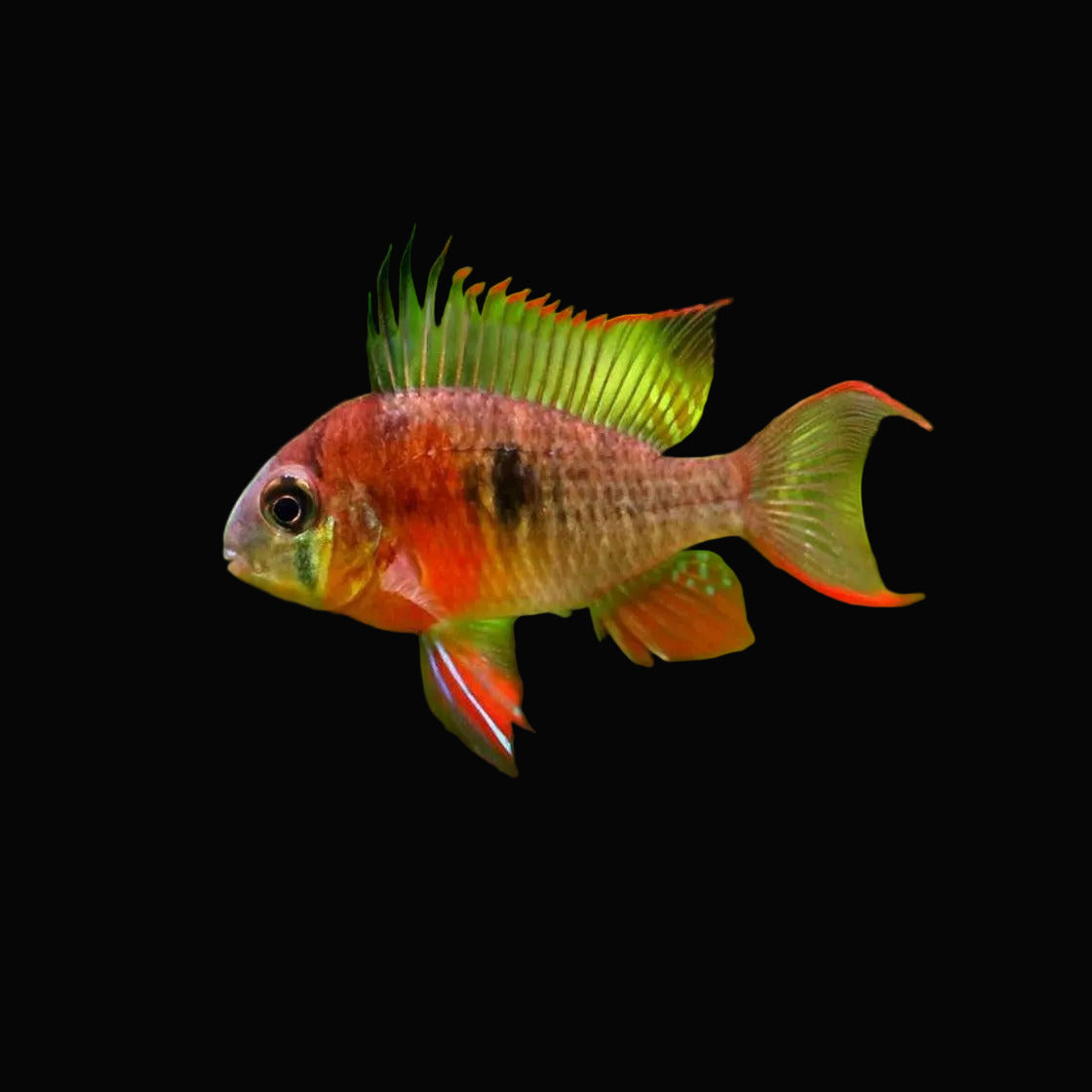
Bolivian Ramirezi 1.75inch (Pair)
Couldn't load pickup availability
This is the dwarf cichlid that actually survives Indian tap water. Everyone wants a German Blue Ram until they lose one to 30 °C and a pH of 8. The Bolivian Ram gives you the same behaviour — the sand-sifting, the fin-flaring standoffs, the parents shepherding fry across the substrate — in a fish that tolerates hard, alkaline water and does not need to be kept in a heated pressure cooker.
A mature specimen is warm gold over a smoky grey base, with a black vertical bar through the eye, a dark blotch mid-flank, and red-orange edging along the dorsal, anal and tail fins. Males extend the front dorsal rays into upright spines and the tail into points. It spends its day working the sand, picking through it mouthful by mouthful, and displaying at whatever else in the tank happens to be nearby.
Sand substrate, not gravel. This fish feeds by taking mouthfuls of substrate and sieving them through the gills. On gravel it cannot do that, and you lose both the natural feeding behaviour and a large part of why the fish is interesting. Fine sand is the single most important decision on this list.
Care Snapshot
| Scientific name | Mikrogeophagus altispinosus |
| Also known as | Bolivian Butterfly, Ruby Crown Cichlid |
| Origin | Tank-bred; native to the upper Rio Madeira basin, Bolivia and Brazil |
| Adult size | 7–8 cm (males slightly larger) |
| Lifespan | 4–6 years |
| Minimum tank | 100 litres for a pair, minimum 75 cm length |
| Temperature | 23–28 °C |
| pH | 6.0–8.0 — unusually wide tolerance |
| Hardness | 2–20 dGH |
| Diet | Omnivore, substrate sifter — sinking foods essential |
| Temperament | Peaceful; territorial only when breeding |
| Care level | Easy — the beginner's dwarf cichlid |
| Swimming zone | Bottom and lower middle |
Bolivian Ram Or German Blue Ram?
They are different fish, and the choice matters more than most buyers realise. The German Blue Ram is the more spectacular of the two — electric blue speckling, higher price — but it wants soft, acidic water held at 28–30 °C, is short-lived, and is frequently weakened by hormone treatment and intensive farming. It is a fish for an experienced keeper with a dedicated tank.
The Bolivian Ram is hardier in every direction: wider pH range, wider hardness range, comfortable at ordinary room temperature, and roughly twice the lifespan. It is less flashy and larger. If this is your first cichlid, or your tap water is hard and alkaline, this is the correct choice — and it is the one that will still be alive in three years.
Setting Up For It
- Fine sand, and plenty of open floor. Sharp gravel damages the gills during sifting. Leave clear sand areas rather than carpeting the whole base with plants.
- Break the sightlines. Driftwood, rock, and clumps of planting divide the floor into territories. Two pairs in an undivided tank means constant confrontation; the same two pairs with visual barriers largely ignore each other.
- Flat stones and caves. They spawn on a cleaned flat surface — a slate tile, a smooth rock, sometimes a broad Anubias leaf. Provide at least one per pair.
- Gentle to moderate flow, low light. Floating plants and leaf litter suit them. Under a bright light over a bare tank they stay pale and hug the back glass.
- Clean water, no shortcuts. Hardier than a German Blue Ram, but still a cichlid — sensitive to nitrate accumulation and to any ammonia. Do not add them to a tank under three months old.
Tank Mates
Good matches
Rummynose, Ember and Cardinal Tetra, Harlequin and Espei Rasbora, Hockey Stick Tetra, Congo Tetra, Corydoras (with care — they compete for the same floor), Otocinclus, Bristlenose Pleco, Hatchetfish, Honey Gourami. A mid-water shoal above them is what makes the tank work.
Keep away from
Dwarf shrimp — Neocaridina and Caridina will be eaten. Also avoid Tiger Barbs and other nippers, aggressive or larger cichlids including Angelfish in smaller tanks, Bettas, and anything fast enough to strip the food before a slow bottom-feeder reaches it.
Note: a breeding pair will claim a patch of floor and chase intruders off it. This is display, rarely damage — but it is why tank length and broken sightlines matter.
Feeding
Feeds at the bottom and will not chase food at the surface. Floating flake in a community tank means the tetras eat and the Rams slowly decline — a common and easily avoided failure. Everything you feed them must sink.
From the AQA range, use a sinking pellet or granule sized for a small cichlid as the daily staple, twice a day, with a frozen meaty food two or three times a week for colour and breeding condition. Feed after lights-down if faster fish are dominating.
Foods it responds to particularly well: frozen bloodworm, brine shrimp, mysis, daphnia, and live blackworm for conditioning a pair.
Sexing & Breeding
Sexing is difficult and no single feature is reliable. Males tend to be larger, with more extended points on the tail lobes and longer trailing dorsal rays. Females are smaller and rounder, often with a pinker belly when in condition. The dependable route is to buy six juveniles and let a pair form on its own, then rehome or separate the rest.
Breeding is well within reach for a home aquarium and is the main reason to keep this fish. A bonded pair cleans a flat stone, spawns on it, and both parents guard the eggs and then herd the free-swimming fry around the tank for weeks — genuinely absorbing behaviour. Eggs hatch in around 60 hours; fry are free-swimming a few days later and take baby brine shrimp or powdered fry food. First spawns are often eaten; this is normal and improves with practice.
Keeping It In Indian Conditions
- Hard, alkaline municipal water is not a problem here. This species handles up to pH 8.0 and 20 dGH without difficulty, which is exactly why it succeeds across Indian cities where the German Blue Ram struggles. No RO, no chemicals, no buffering products needed.
- Room temperature suits it across most of the country for most of the year. A heater set to 24 °C is worth having only for northern and hill-station winters.
- In peak summer above 30 °C, add surface agitation and a fan across the water. It copes better with heat than most dwarf cichlids, but appetite and activity drop.
- Widely available fine river sand works well as substrate — rinse thoroughly first. Avoid the sharp-edged crushed gravel sold in many local shops.
What You Receive
Tank-bred juveniles, quarantined and conditioned at our Bengaluru facility before dispatch. Sex cannot be reliably determined at this size — buy a group of six if you want a bonded breeding pair. Full colour and fin extensions develop over several months. Packed with oxygen and insulation for pan-India delivery.
Covered by the Best4Pets live arrival guarantee. Please film an unboxing video before opening the bag — it is required for any DOA claim.