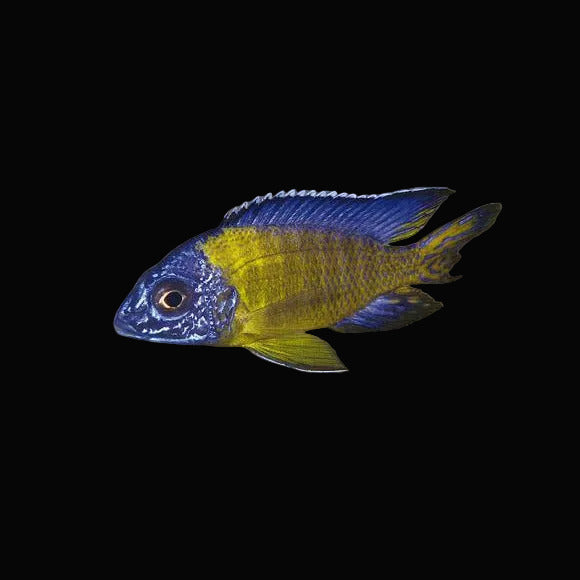
Blue Neon Cichlid 2-2.5inch(Pair)
Couldn't load pickup availability
Blue that seems lit from inside. A mature Blue Neon male carries an intense, almost electric blue across the face, throat and fins, with the body shading into deeper blue and the dorsal fin edged in pale, shining blue-white. Under good aquarium light it looks less like pigment and more like a glow.
This is a named form of Aulonocara stuartgranti, one of the most widely kept peacock cichlids in Lake Malawi. Peacocks live over sand at the edge of rocky areas and hunt small invertebrates buried in the substrate, using sensory pores on the head to find them. That makes them calmer than mbuna and quite different in diet. Only males carry the colour; females are a modest brownish grey, and the real display comes from a male holding his patch of sand.
Peacocks with peacocks — not with mbuna.
Blue Neons are gentle by Malawi standards. Housed with aggressive mbuna, males stay faded, hide and are outcompeted for food. Keep them in a peacock and hap tank, with more females than males, and their colour and behaviour transform.
Care Snapshot
| Scientific name | Aulonocara stuartgranti |
| Also known as | Blue Neon Peacock, Stuartgranti Blue Neon; sometimes sold under Chiwindi or Undu Reef locality names |
| Family | Cichlidae — Lake Malawi peacocks (Aulonocara) |
| Origin | Farm-bred; wild form from sandy-rocky transition zones of Lake Malawi |
| Adult size | 11–15 cm (males larger) |
| Arrival size | 2–2.5 inch |
| Lifespan | 8–10 years |
| Minimum tank | 300 litres, minimum 120–150 cm length for a group |
| Temperature | 24–28 °C |
| pH | 7.6–8.6 |
| Hardness | 10–20 dGH — hard and alkaline |
| Diet | Omnivore, invertebrate hunter — quality sinking pellets |
| Temperament | Peaceful for a Malawi cichlid; males territorial |
| Care level | Easy to moderate |
| Swimming zone | Bottom and middle, over sand |
Setting Up For It
- Sand floor with rock at the edges. Peacocks feed over sand and display over it. Keep a large open sand area with rockwork towards the back and ends.
- One male, several females, or an all-male tank. Either keep one male with three or four females, or keep males only of different peacock species for maximum colour. Avoid one male with one female.
- Hard, alkaline water. pH 7.8–8.4 and good hardness, buffered with aragonite or crushed coral if needed.
- Good filtration, gentle flow. Filtration well over tank volume, 30% weekly changes, but no strong currents across the sand.
- Darker sand or backdrop. The blue stands out best against a darker background and moderate lighting.
Tank Mates
Good matches
Other peacocks of different colour (in all-male tanks), calm haps such as Blue Dolphin, Placidochromis and Copadichromis, and Synodontis catfish.
Keep away from
Aggressive mbuna, large predatory haps that can swallow it, and females of other Aulonocara — peacock females look alike and hybridise easily.
Never keep females of more than one peacock species together if you care about pure fry.
Feeding — Feed The Sand Hunter
Peacocks take more protein than mbuna, because they hunt small invertebrates in the sand. They still do poorly on mammal meat, and overfeeding in a warm tank causes bloat and water-quality trouble.
Feed a quality sinking cichlid pellet once or twice a day as the staple. From the AQA range, a sinking cichlid pellet works well, with frozen crustaceans two or three times a week and a spirulina food occasionally for balance.
Foods they enjoy: frozen mysis, brine shrimp, krill, daphnia, and small chopped prawn.
Sexing & Breeding
Juveniles are difficult to sex. Males begin showing blue on the face and fins from around 6–8 cm and become fully coloured over months. Females remain brownish grey with faint barring.
A maternal mouthbrooder; the female carries eggs and fry for around three weeks. Breeding is straightforward in a calm peacock tank. Keep only one type of peacock female in a breeding setup.
Keeping It In Indian Conditions
- Hard water is your advantage. Much of India's tap and borewell water is already hard and alkaline — close to what Malawi peacocks need.
- Keep summer heat under 28 °C. Aeration and a surface fan through April and May keep oxygen levels up.
- Power cuts: a well-stocked peacock tank needs a battery air pump to see it through outages.
- Good sinking pellets are easy to buy. Choose a quality cichlid pellet rather than cheap high-filler foods.
What You Receive
Farm-bred juveniles and young adults, supplied at 2–2.5 inch, quarantined and conditioned at our Bengaluru facility before dispatch. Young peacocks are hard to sex; pairs are chosen on the best cues visible at this size and sex is not guaranteed. The blue colour develops in males as they mature — juveniles look plain and greyish. Packed with oxygen and insulation for pan-India delivery.
Covered by the Best4Pets live arrival guarantee. Please film an unboxing video before opening the bag — it is required for any DOA claim.