- Product
- Black arrow tetra (pair)


Black Arrow Tetra (Pair)
Couldn't load pickup availability
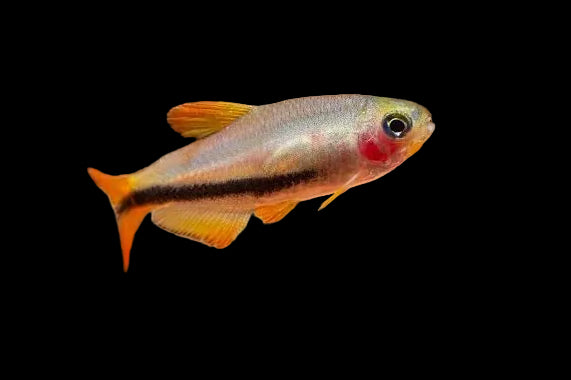
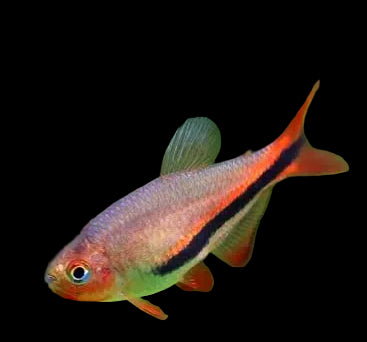
An emperor drawn in charcoal. The Black Arrow Tetra has the compact, high-backed build of the Blue Emperor, but the palette is pared down to a dark lateral band, smoky body tones and clean pale fin edges. In a planted tank a small group reads as a set of sharp, dark darts cutting across the green — understated in the bag, quietly striking once the fish have settled in.
This fish reaches us sold as Inpaichthys luizae, a close relative of the familiar Blue Emperor, and it is still an uncommon sight in Indian shops. Its care runs along the same lines as Inpaichthys kerri: a peaceful, mid-water characin that wants clean, stable, softish water, a planted layout and the company of its own kind. Kept that way, it is a well-behaved and rewarding fish for anyone wanting a tetra that does not look like every other community tank.
Give it a proper group, not just a pair.
Like the emperors it is related to, this fish shows its best colour and confidence only when it has others of its own kind to display to. A pair on its own tends to stay pale and hang back in the planting. Two pairs is a sensible start; three or four pairs is where the group really comes alive.
Care Snapshot
| Scientific name | Inpaichthys luizae (sold as) |
| Also known as | Black Arrow Tetra; traded alongside the emperor tetras |
| Family | Characidae — American tetras |
| Origin | Brazilian Amazon drainage; supplied through the ornamental trade |
| Adult size | around 4–5 cm |
| Lifespan | 3–5 years with good care |
| Minimum tank | 75 litres, minimum 75 cm length for a group |
| Temperature | 23–27 °C |
| pH | 5.5–7.2 |
| Hardness | 2–10 dGH — soft to moderately hard |
| Diet | Omnivore — small dry, frozen and live foods |
| Temperament | Peaceful; keep in a group of 6 or more |
| Care level | Easy to moderate — straightforward once settled |
| Swimming zone | Middle |
Setting Up For It
- Planted sides, open centre. Dense planting along the back and edges gives the group security, while a clear mid-water lane lets males posture at one another — which is when the dark markings look sharpest.
- Dark substrate, softened light. A dark base and some floating cover push the contrast of the black band. Pale gravel under harsh white light washes the fish out.
- Driftwood and leaf litter. Wood and dried catappa leaves gently soften the water and add the tannin tint these Amazonian characins look most at home in.
- Gentle to moderate flow. Any well-maintained standard filter is fine; avoid a strong, unbroken current across the whole tank.
- Stable, mature water. Add them to a tank that has been running for at least six to eight weeks, and keep weekly partial water changes regular rather than large and occasional.
- Cover the tank. Like most tetras, they can jump when startled, especially in the first days after introduction.
Tank Mates
Good matches
Blue Emperor and other peaceful tetras of similar size, Rasboras, Pencilfish, Corydoras, Otocinclus, Bristlenose Pleco, Dwarf Gouramis, Rams, Apistogramma, Kuhli Loach, adult dwarf shrimp.
Keep away from
Fin-nipping barbs, Serpae-type tetras in small numbers, large or territorial cichlids, and any fish big enough to swallow a 4–5 cm tetra.
Males spar and posture among themselves; it looks dramatic but rarely causes damage.
Feeding — Small, Varied And Often
This is an unfussy feeder that takes food in mid-water and as it sinks. The aim is condition and colour rather than volume: small portions two or three times a day, eaten within a couple of minutes, keep the fish sleek and the water clean.
From the AQA range, a small granule or fine flake makes a reliable daily staple. Add frozen or live foods several times a week — this is what deepens the dark band and brings males into display.
Foods they take readily: frozen bloodworm, brine shrimp, daphnia, cyclops, mosquito larvae.
Sexing & Breeding
Sexing follows the emperor pattern: males are usually slightly larger, with longer, more extended fins and stronger markings once mature, while females are rounder-bodied and plainer. Differences are hard to read in young fish.
Expect egg-scattering behaviour in soft, slightly acidic water, with eggs laid among fine-leaved plants, java moss or a spawning mop. The adults will eat eggs and fry, so a separate spawning tank and early removal of the parents give the best results; newly hatched fry need infusoria or a liquid fry food first.
Keeping It In Indian Conditions
- Indian room temperatures suit it for most of the year; a heater is needed only for northern and hill-station winters.
- Keep summers in check. Above 28 °C in April and May, add extra aeration and run a fan across the surface.
- Soften very hard water. Moderately hard municipal supplies are workable, but hard borewell water should be blended with RO or rainwater for a fish of this type.
- Monsoon caution: dechlorinate every change and keep volumes modest while the municipal supply is unsettled.
- Easy to feed anywhere. Standard small dry foods plus frozen bloodworm or brine shrimp, both widely available in Indian cities, are all it needs.
What You Receive
Juveniles and young adults, quarantined and conditioned at our Bengaluru facility before dispatch. A pair here means two fish; male and female cannot be guaranteed at this size. The dark markings are usually muted after transport and develop fully once the fish settle and mature. Packed with oxygen and insulation for pan-India delivery.
Covered by the Best4Pets live arrival guarantee. Please film an unboxing video before opening the bag — it is required for any DOA claim.