- Product
- Baloon hockey stick tetra (pair)

Baloon Hockey Stick Tetra (Pair)
Couldn't load pickup availability
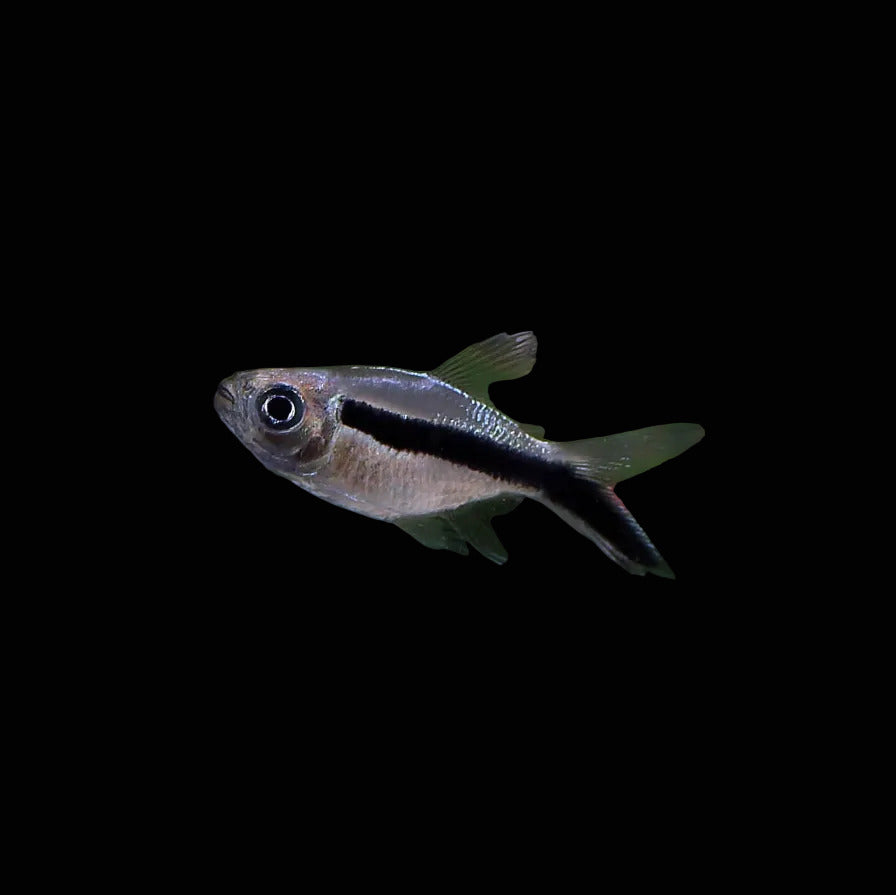
It swims nose-up, and the stripe is the reason it has a name. A bold black band runs down the flank and then hooks sharply into the lower lobe of the tail — the hockey stick. The fish holds itself at a permanent head-up tilt, so a group hanging in mid-water looks like a set of angled brushstrokes rather than a row of fish.
This is the balloon form: a line-bred short-body variant with a deep, rounded profile that exaggerates the tilt and the stripe into something considerably more graphic than the standard fish. Silver-gold body, black marking, translucent fins. Peaceful, active, easy to feed, and a strong mid-water presence in a planted community tank without the size of a barb or a larger tetra.
Sold as a pair — but buy at least three pairs. This is a shoaling species, not a pair-bonding one. Kept as two, it stays hidden, colours down and stresses easily. Six or more is where the shoal forms, the tilt lines up, and the fish actually behaves the way it is meant to.
Care Snapshot
| Scientific name | Thayeria boehlkei — balloon form |
| Also known as | Balloon Penguin Tetra, Short-body Blackline Tetra |
| Origin | Aquacultured in Southeast Asia; species native to the Amazon basin |
| Adult size | 3–4 cm (shorter-bodied than the standard form) |
| Lifespan | 3–4 years |
| Minimum tank | 75 litres for a group of six, minimum 60 cm length |
| Temperature | 23–28 °C |
| pH | 6.0–7.5 |
| Hardness | 2–15 dGH |
| Diet | Omnivore — small dry, frozen and live foods |
| Temperament | Peaceful, shoaling; keep 6+ |
| Care level | Moderate — see the note on balloon forms below |
| Swimming zone | Middle and upper |
What "Balloon" Means, And What It Asks Of You
Balloon forms are produced by selecting for a shortened, compressed spine. The rounded shape people buy them for is a consequence of that, and it comes with real trade-offs: less efficient swimming, a compressed body cavity, and a greater tendency toward swim bladder and digestive problems than the standard-bodied fish. We would rather say so on the listing than have you discover it later.
In practice this means low flow, small frequent meals, and no fasting-then-feasting. Kept that way they do well. Kept in a strong current or overfed on dry food, they are the first fish in the tank to go upside down. If you want the species without the fragility, the standard-bodied Hockey Stick Tetra is the hardier choice and schools just as well.
Setting Up For It
- Keep the flow gentle. A short-bodied fish cannot hold station in a current the way the standard form can. Spray bar, sponge filter, or an outlet aimed at the glass — not an undirected powerhead.
- Open mid-water with planted edges. This fish hangs in the middle of the tank. Plant the back and sides, leave the centre clear so the shoal has somewhere to line up.
- Dark substrate sharpens the stripe. The black band and the gold body both read far better over dark sand than over pale gravel.
- Floating cover settles them. Amazon fish under an open bright light stay skittish. A partial screen of floating plants brings them out into the open, which is where you want them.
- Lid on. Tetras jump when startled, and these are poor swimmers with poor recovery. Do not leave the tank open.
Tank Mates
Good matches
Corydoras, Otocinclus, Bristlenose Pleco, Harlequin and Espei Rasbora, Ember and Rummynose Tetra, Honey Gourami, Apistogramma, Bolivian Ram, Nerite and Mystery snails.
Keep away from
Tiger Barbs, Serpae Tetras and other nippers. Also avoid fast, greedy feeders such as Danios — a balloon-bodied fish will lose every race to the food. No aggressive cichlids, and nothing large enough to swallow it.
Note: adult dwarf shrimp are generally safe alongside them, but shrimplets will be eaten.
Feeding
Feeding is where balloon forms are usually lost. The compressed gut handles small, frequent meals far better than one large daily feed, and dry food that swells after swallowing is the common trigger for swim bladder trouble. Soak pellets before feeding, or use a flake or micro-granule instead.
From the AQA range, use a small-particle community flake or micro granule twice a day, only what is cleared in about a minute. Rotate in frozen daphnia once or twice a week — it is a mild laxative and useful preventative for a fish shaped like this.
Other good foods: frozen brine shrimp, cyclops, finely chopped bloodworm. Avoid large dry pellets and heavy one-off feeds.
Sexing & Breeding
Females are noticeably deeper and fuller in the belly, particularly when in condition. Males are slimmer and slightly smaller. On balloon-bodied fish the difference is subtler than on the standard form, since both sexes already carry a rounded profile — judge by belly depth viewed from above rather than from the side.
The species is an egg-scattering tetra that spawns among fine-leaved plants in soft, acidic, dimly lit water, with the adults removed immediately afterwards. Balloon forms breed less readily than standard-bodied stock and the fry throw a mix of body types. Worth attempting if you enjoy the challenge; not a reliable project.
Keeping It In Indian Conditions
- Room temperature across most of India sits comfortably in the 23–28 °C range for much of the year, so a heater is needed only for northern and hill-station winters. Set it to 24 °C where night-time dips are sharp.
- Above 30 °C in peak summer, metabolism rises and oxygen falls — a bad combination for a fish with restricted swimming ability. Increase surface agitation, run a fan across the water, and cut feeding back slightly.
- Hard, alkaline municipal water is handled well by aquacultured stock. Catappa leaves and driftwood are still worth adding: the tannins soften the water and the darker setting sharpens the black stripe.
- Acclimatise slowly. Balloon forms recover from transport stress more slowly than standard-bodied fish, and should be drip-acclimatised rather than floated and released.
What You Receive
One pair of aquacultured Balloon Hockey Stick Tetras, quarantined and conditioned at our Bengaluru facility before dispatch. Sex is not guaranteed on juveniles. Order multiple pairs to make up a proper shoal of six or more. Packed with oxygen and insulation for pan-India delivery.
Covered by the Best4Pets live arrival guarantee. Please film an unboxing video before opening the bag — it is required for any DOA claim.