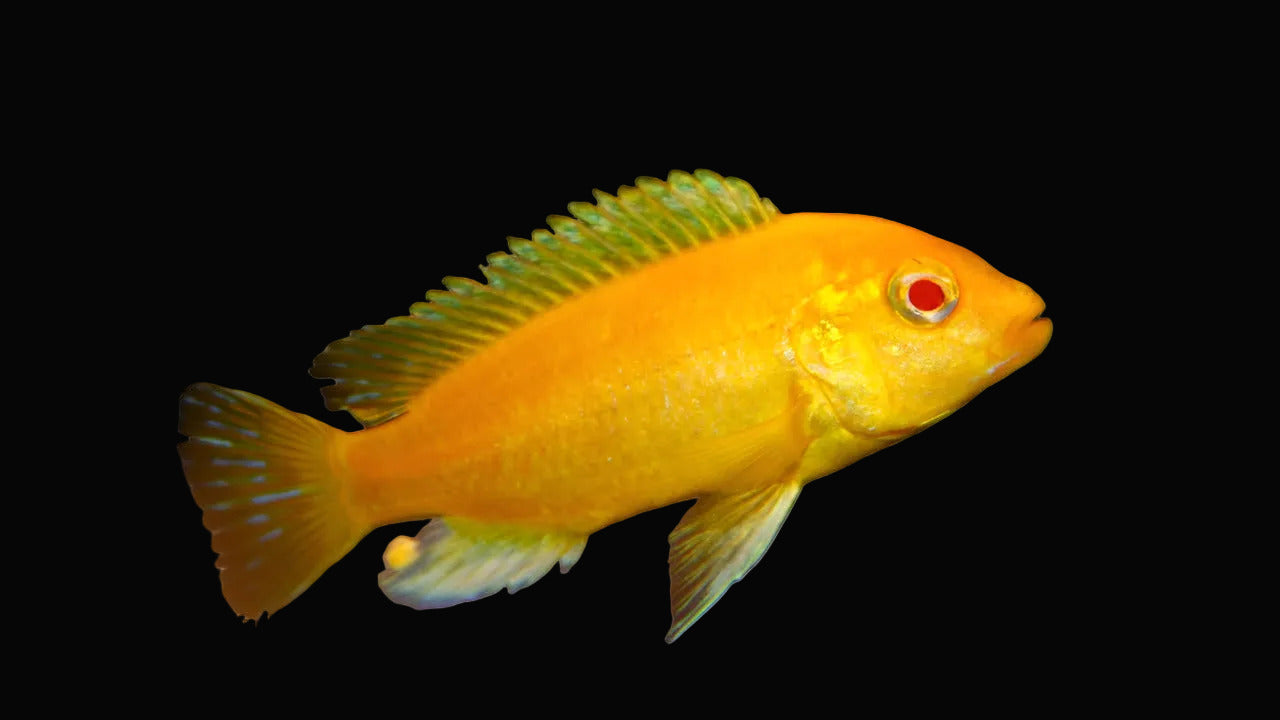
Albino Yellow Lab 1.75-2inch (Pair)
Couldn't load pickup availability
Lemon yellow with red eyes. The albino Yellow Lab keeps the vivid yellow body of the normal fish but loses the black: no dark stripe in the dorsal fin, no black edging, just clean yellow and a pair of bright red eyes. In a rock tank it looks like a drop of sunlight drifting between the stones.
This is a farm-bred colour form of Labidochromis caeruleus, the most even-tempered of the popular mbuna. It shares the normal fish's easy-going nature and its habit of picking small invertebrates off the rocks, so it fits into a mixed mbuna community without becoming the bully. Without dark pigment its eyes are more sensitive and its colour can look paler under harsh light, so a moderate setup suits it best. Some albino strains are less yellow than others; good stock is deep lemon, not cream.
Keep a group, and keep it apart from other yellow mbuna.
A single albino Lab in a busy tank tends to hide. Five or more spread aggression and bring the group out into the open. Equally important, Labs cross readily with other Labidochromis and some Maylandia, and albino lines are especially easy to muddy. If you ever want to breed them, do not house them with other yellow, white or albino mbuna.
Care Snapshot
| Scientific name | Labidochromis caeruleus |
| Also known as | Albino Electric Yellow, Red-eye Yellow Lab; albino is a farm-bred colour form |
| Family | Cichlidae — Lake Malawi mbuna (rock-dwellers) |
| Origin | Farm-bred albino; wild form from the north-western shore of Lake Malawi |
| Adult size | 8–10 cm |
| Arrival size | 1.75–2 inch |
| Lifespan | 6–10 years |
| Minimum tank | 150 litres for a group, minimum 100 cm length; 200 litres and 120 cm for a mixed mbuna tank |
| Temperature | 24–27 °C |
| pH | 7.6–8.6 |
| Hardness | 10–20 dGH — hard and alkaline |
| Diet | Omnivore — mbuna diet with modest protein |
| Temperament | Mild for a mbuna; keep in groups of 5+ |
| Care level | Easy — a good first Malawi cichlid |
| Swimming zone | Bottom and middle, around rockwork |
Setting Up For It
- Rock piles with plenty of caves. Build rockwork along the length of the tank so each fish can find a retreat, with the base stones placed directly on the glass.
- Moderate, not blazing, light. Albino eyes have no protective pigment. Bright lighting makes the fish shy and pales the yellow; moderate light with shaded caves shows them at their best.
- Hard, alkaline water. pH 7.8–8.4 and good carbonate hardness. Aragonite sand or crushed coral helps buffer it.
- Filtration for a stocked tank. Mbuna tanks are kept busy to spread aggression. Filter at four to six times tank volume per hour and change 30–40% weekly.
- Fine sand substrate. Labs sift and pick through the substrate; sand lets them do it without damaging their mouths.
Tank Mates
Good matches
Blue and barred mbuna that look nothing like it: Pseudotropheus saulosi males, Cynotilapia, Rusty Cichlid (Iodotropheus sprengerae), Yellow Tail Acei, Demasoni in a large group, and Synodontis catfish.
Keep away from
Normal and other albino Labs if you want pure lines, yellow mbuna such as Auratus females and yellow Pseudotropheus, very aggressive mbuna that will dominate it, and all soft-water community fish.
Albino Labs are a little slower to find food than normal fish; feed in two spots so they get a fair share.
Feeding — Mbuna Diet, With A Little More Protein
Labs pick snails and insect larvae off the rocks in the wild, so they handle somewhat more protein than algae-scraping mbuna. That does not make them carnivores. A diet built around bloodworm or beef heart still risks Malawi bloat, especially when they share a tank with true herbivores.
Use a good spirulina or vegetable-based cichlid flake or small pellet as the staple, once or twice a day. From the AQA range, a vegetable or spirulina cichlid food makes a sound base, with small frozen crustaceans as an occasional extra.
Good extras: frozen mysis, daphnia, brine shrimp, and blanched spinach or peas.
Sexing & Breeding
Albino Labs are harder to sex than normal ones, because the black fin markings used as a guide are absent. Mature males grow slightly larger with more pronounced egg-spots on the anal fin. Females are a little smaller and rounder. Juveniles are difficult to sex with any confidence.
A maternal mouthbrooder and one of the easier Malawi cichlids to breed. The female carries eggs and fry for around three weeks. Breed albino to albino only, and keep the line away from other Labidochromis and Maylandia.
Keeping It In Indian Conditions
- Hard alkaline water is ideal. The hard borewell water of Bengaluru and many Indian cities is close to perfect for Malawi cichlids. Dechlorinate municipal water and test pH; buffering is often unnecessary.
- Keep under 28 °C in summer. A fan across the surface and an airstone through April and May prevent oxygen stress.
- Plan for power cuts. Mbuna tanks are stocked heavily. A battery air pump keeps them breathing when the filter stops.
- Spirulina flakes and pellets are widely sold in India — the right food for this fish is easy to find and inexpensive.
What You Receive
Farm-bred albino juveniles, supplied at 1.75–2 inch, quarantined and conditioned at our Bengaluru facility before dispatch. Albino Labs lack the black fin markings used for sexing, so pairs are picked on the best cues visible at this size and sex is not guaranteed. The yellow may look pale after transit and deepens over the first week. Packed with oxygen and insulation for pan-India delivery.
Covered by the Best4Pets live arrival guarantee. Please film an unboxing video before opening the bag — it is required for any DOA claim.