- Product
- Albino heckelii 1" (pair)


Albino Heckelii 1" (Pair)
Couldn't load pickup availability
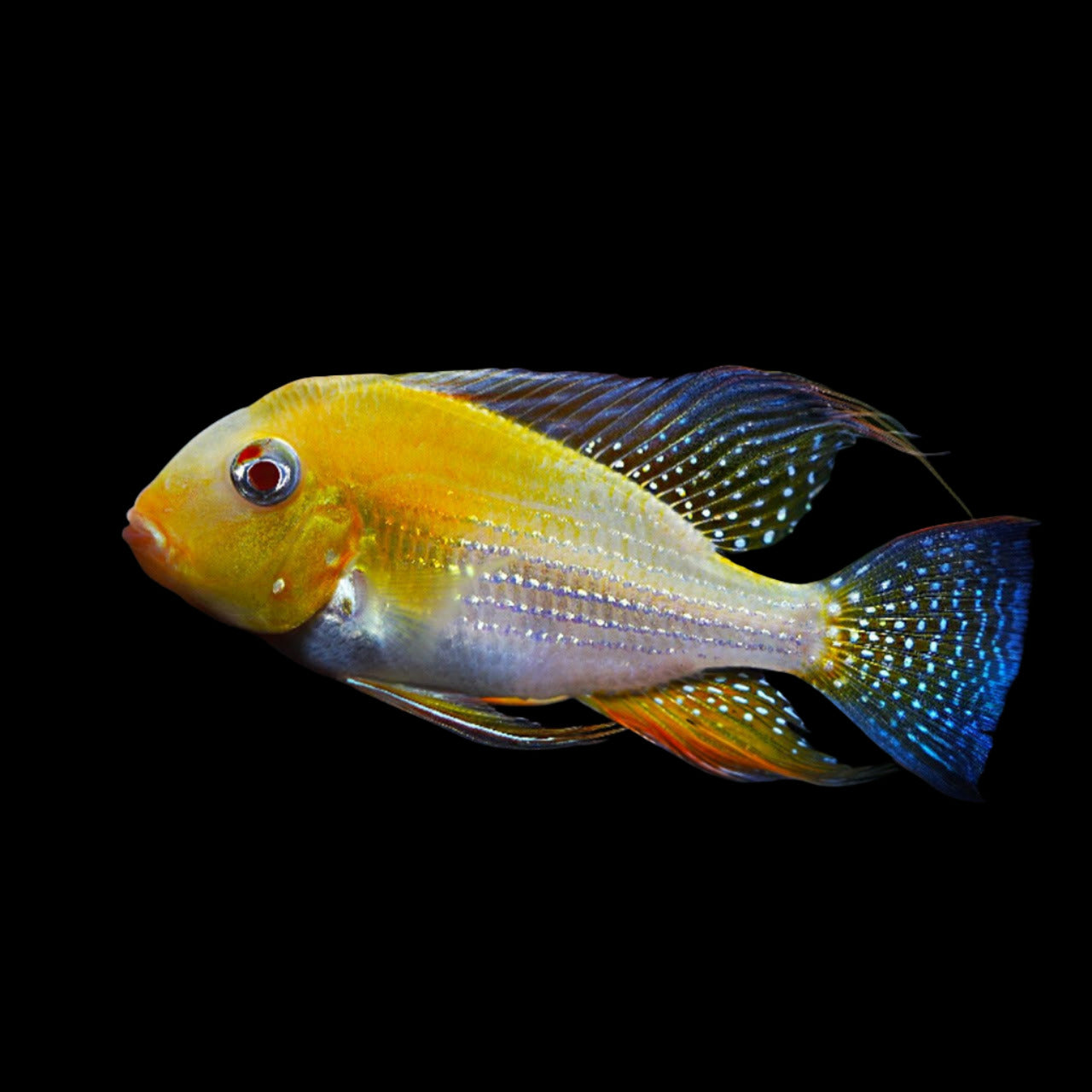
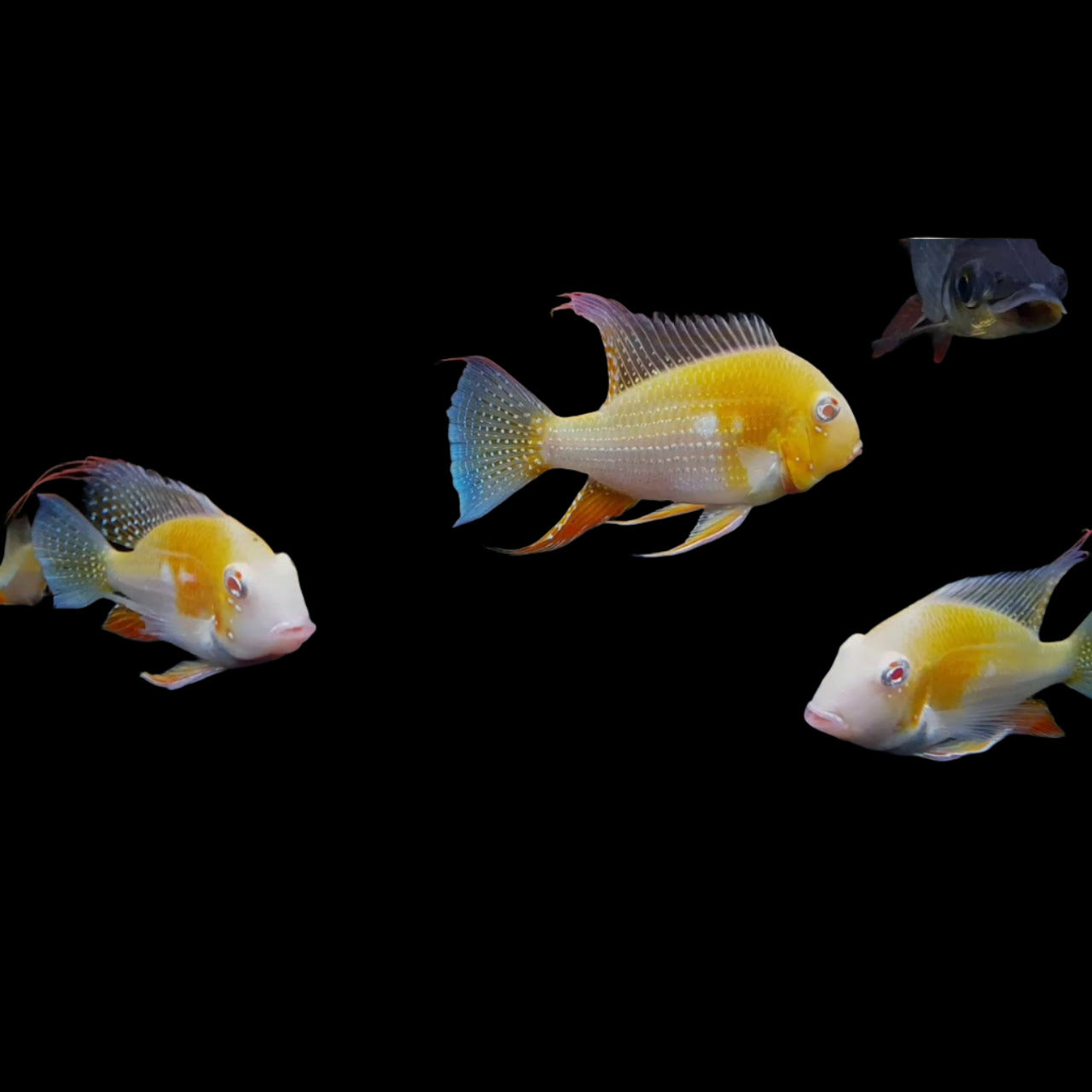
The dorsal fin trails silk. As an adult male matures, the soft rays at the back of the dorsal fin stretch out into long, fine threads that drift behind him like streamers — sometimes reaching well past the tail. In the albino form, those threads glow pale gold and pink against a cream body and ruby eyes, and a pair patrolling a wide stretch of sand is one of the most elegant sights a large South American tank can offer.
Underneath the finnage is a working fish. The Threadfin Acara is a geophagine — an earth-eater — and spends its day taking mouthfuls of sand and sieving them through the gills, moving the substrate around the tank and digging pits under rocks and roots. It is also, for a cichlid of this size, genuinely civil: it squares up and flares at rivals, but it does not hunt down peaceful tank mates the way many large cichlids do. The catch is size. This fish grows big, lives long, and needs a tank planned around what it will be in three years, not what arrives in the bag.
Plan for a 20 cm adult. Buy the tank first.
Most Threadfin Acaras that fail are stunted in a 100-litre tank that seemed fine for the juvenile. A pair needs around 300 litres and a long, wide footprint of open sand. If that tank is not already running, or definitely on its way, choose a smaller geophagine instead — it is the one decision that settles everything else with this species.
Care Snapshot
| Scientific name | Acarichthys heckelii |
| Also known as | Threadfin Acara, Heckel's Acara; albino is a tank-bred colour form |
| Family | Cichlidae — South American geophagine cichlids |
| Origin | Tank-bred albino; wild form native to the Amazon basin and Guiana Shield rivers |
| Adult size | 18–25 cm (males larger, plus dorsal threads) |
| Arrival size | about 1 inch |
| Lifespan | 8–12 years with good care |
| Minimum tank | 300 litres for a pair, minimum 120–150 cm length and 45 cm depth front to back |
| Temperature | 26–30 °C |
| pH | 5.5–7.5 — tank-bred stock tolerates the upper end |
| Hardness | 1–12 dGH — soft to moderately hard |
| Diet | Omnivore, substrate sifter — sinking foods essential |
| Temperament | Peaceful for its size; territorial when spawning |
| Care level | Moderate — straightforward if the tank is big enough |
| Swimming zone | Bottom and lower middle |
Setting Up For It
- Fine sand across most of the floor. Sifting is how this fish feeds and how it behaves. Smooth, rounded river sand, at least 5 cm deep. Sharp gravel wears the gills and stops the sifting entirely.
- Floor space beats height. A long, deep-fronted tank gives a pair room to stake out territory. Tall show tanks waste volume on a fish that lives in the bottom third.
- Give them somewhere to dig in. In the wild they spawn in tunnels and hollows under rocks and roots. Large flat stones set firmly on the base glass — never on the sand, which they will undermine — plus driftwood and a cave or two provide spawning sites and break sightlines.
- Subdued lighting. Albino eyes lack protective pigment. Under harsh light the fish stays pale and squinting at the back; floating plants or a dimmer setting brings it forward and deepens the pink-gold tones.
- Heavy filtration, gentle current. A big, messy feeder in warm water needs real biological capacity — a canister or sump rated well above the tank volume — but with the outflow diffused so the threads are not blown about.
- Root-feed or skip delicate plants. Anything rooted in open sand will be dug up. Anubias and Java fern tied to wood, or potted Amazon swords, survive the excavation.
Tank Mates
Good matches
Severums, Geophagus species such as G. altifrons in very large tanks, Angelfish, Uaru, Festivum, larger tetras like Congo Tetra and Bleeding Heart Tetra, Silver Dollars, Bristlenose and medium L-number plecos, larger Corydoras such as C. sterbai. Warm, calm South American fish that share the same water preferences.
Keep away from
Small tetras, rasboras and anything under about 4 cm — an adult will swallow them without malice. Dwarf shrimp. Aggressive Central American cichlids, Oscars, Flowerhorns and African Rift Lake cichlids, which will bully this calmer fish off the floor. Fin-nippers such as Tiger Barbs, which target the threads.
Two pairs can share a large tank if the floor is broken up with rock and wood, but a bonded breeding pair will claim a generous patch of it.
Feeding — Feed The Sand-Sifter, Not The Surface
This is a bottom feeder through and through. Floating sticks and flake that are fought over at the surface by faster tank mates simply do not reach it, and a large cichlid that looks well fed on day one can lose condition steadily over a few months without anyone noticing.
Use a quality sinking pellet sized for a medium South American cichlid as the daily staple, twice a day, and let some of it settle into the sand where the fish will find it by sifting. From the AQA range, a sinking cichlid pellet works well as the base diet, with frozen meaty foods two or three times a week and some plant matter for balance.
Foods it takes eagerly: frozen bloodworm, mysis, krill, chopped prawn, live blackworm for conditioning, and blanched peas or spinach as a vegetable supplement.
Sexing & Breeding
Males grow larger, with a broader head and much longer dorsal threads and extended pelvic fins once mature. Females are smaller and rounder, with shorter finnage. Juveniles cannot be sexed with confidence — raising a group of five or six and letting a pair form is the reliable route.
A bonded pair excavates a tunnel or hollow beneath a stone or root and spawns inside it, out of sight. Both parents guard the eggs and then lead the fry around the tank in a tight cloud for several weeks — absorbing to watch, and the main reason serious keepers buy this species. Expect the pair to become noticeably more territorial during this time, and give tank mates room to get out of their way. Fry take baby brine shrimp and crushed fry food from free-swimming.
Keeping It In Indian Conditions
- Indian summers suit it well. This is a warm-water fish that is comfortable at 28–30 °C, so April and May heat is far less of a worry than for most species. Watch only for tanks creeping above 31 °C; add surface agitation and a fan at that point, because warm water holds less oxygen and a big tank carries a lot of fish weight.
- Run a heater in winter, even in the south. Bengaluru and Pune nights, and anywhere north, regularly pull room temperature into the low 20s. Below about 24 °C this fish loses appetite and colour and becomes prone to disease. Set a correctly sized heater to 27 °C and leave it.
- Plan for power cuts. A 300-litre tank of large, warm, heavily fed cichlids uses oxygen quickly once the filter stops. A battery-backed air pump or an inverter line for the filter is cheap insurance.
- Hard borewell water needs softening. Tank-bred stock handles moderately hard municipal supplies, but very hard, alkaline borewell water leads to poor colour and stalled breeding. Blend with RO water and add catappa leaves and driftwood. Rinse local river sand thoroughly before use — it often carries silt and fine debris.
What You Receive
Tank-bred albino juveniles, supplied at about 1 inch, quarantined and conditioned at our Bengaluru facility before dispatch. Sex cannot be determined at this size, and the long dorsal threads only appear as males mature over many months. Juveniles look plainer and paler than the adult photographs — the pink and gold tones build with age, diet and subdued lighting. Packed with oxygen and insulation for pan-India delivery.
Covered by the Best4Pets live arrival guarantee. Please film an unboxing video before opening the bag — it is required for any DOA claim.