- Product
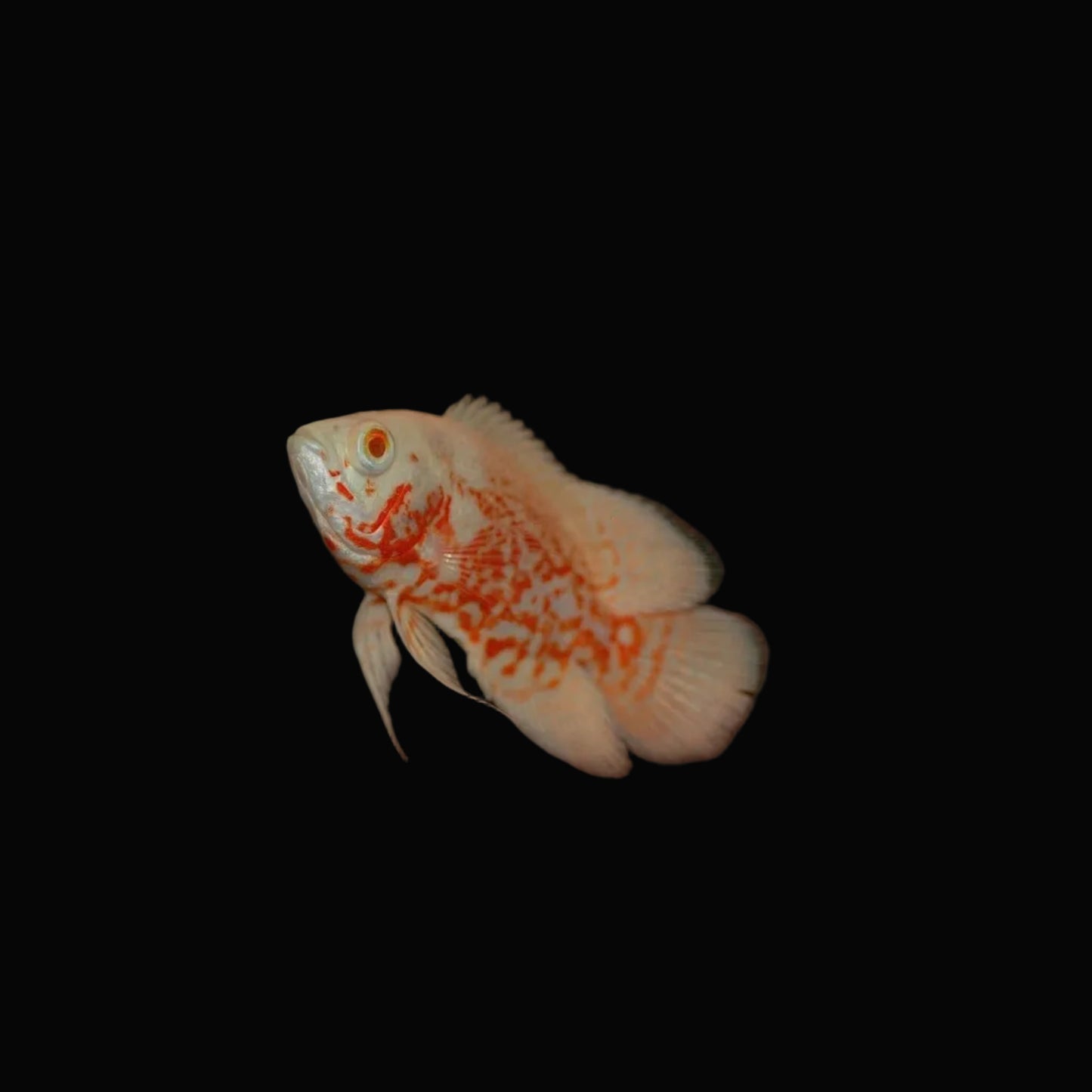
- Albino oscar cichlid 4.5"

Albino Oscar Cichlid 4.5"
Couldn't load pickup availability
A pet that happens to have fins. Oscars learn faces, beg at the glass, sulk when the furniture is moved and follow you round the room. The albino form adds a cream-white body splashed with orange-red, and a pink eye, to one of the most characterful fish you can keep. Very few aquarium fish build anything like this kind of relationship with their owner.
It is also one of the most underestimated fish sold in India. The palm-sized juvenile in the shop grows fast — 15 cm within a year is normal — and settles at 30 cm or more of heavy-bodied cichlid that produces a lot of waste and eats anything it can fit in its mouth. The albino and albino red forms are line-bred colour varieties of the same species, Astronotus ocellatus, with the same needs as any other Oscar. Buy it as a long-term pet with a long-term tank, and it rewards you for a decade or more.
Budget for 300–400 litres, not the tank it arrives in.
An adult Oscar needs a tank of at least 300 litres on its own, and 400 litres or more with company, with a footprint of around 150 × 50 cm. Kept smaller, it stunts, develops hole-in-the-head and lives a shortened, miserable life. If that tank is not part of the plan, this is not the fish.
Care Snapshot
| Scientific name | Astronotus ocellatus |
| Also known as | Albino Red Oscar, Albino Tiger Oscar, Velvet Cichlid; albino forms are line-bred colour varieties |
| Family | Cichlidae — South American cichlids |
| Origin | Farm-bred colour form; wild species native to the Amazon basin |
| Adult size | 30–35 cm |
| Arrival size | about 4.5 inch |
| Lifespan | 10–15 years, sometimes longer |
| Minimum tank | 300 litres for one adult, 400+ litres with tank mates; minimum 150 cm length |
| Temperature | 24–29 °C |
| pH | 6.0–7.8 |
| Hardness | 2–15 dGH — adaptable |
| Diet | Carnivore leaning omnivore — large pellets as staple |
| Temperament | Semi-aggressive; predatory towards anything mouth-sized |
| Care level | Easy to keep alive, demanding to keep well — tank size and water changes |
| Swimming zone | All levels, mostly middle |
Setting Up For It
- Oversize the filtration. Oscars are famously messy eaters with a heavy bio-load. Use a canister or sump rated for two to three times the tank volume, and plan on 30–50% weekly water changes.
- Heavy, stable décor only. They redecorate. Large rounded stones set on the base glass, big driftwood, and nothing that can topple onto the glass or a heater.
- Guard the heater. Adults bump, bite and break glass heaters. Use a guarded heater, an inline heater or one placed in a sump.
- Sand or smooth gravel. Oscars dig and mouth the substrate, so keep it rounded and fine enough not to jam.
- Skip delicate plants. They will be uprooted or eaten. Anubias and Java fern tied to wood are the only plants with a real chance.
- A heavy, tight lid. A startled Oscar can jump hard enough to lift a loose cover.
- Subdued lighting. Albino eyes lack protective pigment, and albinos are calmer and show more colour under softer light or partial floating cover.
Tank Mates
Good matches
Other Oscars raised together, Severums, Green Terrors and Jack Dempseys of similar size, Silver Dollars, large Plecos such as Common or Sailfin Pleco, Clown Knifefish and Arowana only in very large systems, Bichirs of matching size.
Keep away from
Anything that fits in an adult Oscar's mouth — tetras, guppies, small barbs, small catfish, shrimp. Fin-nippers such as Tiger Barbs. Very aggressive cichlids such as Flowerhorns and large Central American species that will bully a placid Oscar.
A single Oscar in its own big tank is a perfectly good way to keep one; it bonds more with you when it is the only fish.
Feeding — Pellets, Not Feeder Fish
Oscars eat greedily and will happily be overfed, and feeder fish from a shop tank are the most common way disease enters an Oscar tank. A good pellet diet produces a healthier, longer-lived fish with far less risk.
Feed juveniles two or three times a day and adults once a day, with one fasting day a week. From the AQA range, a floating or slow-sinking cichlid pellet sized to the fish makes the ideal staple, supplemented with frozen and fresh meaty foods. Variety and vitamin content matter, as poor diet is linked to hole-in-the-head.
Foods it takes eagerly: large cichlid pellets and sticks, frozen krill, prawn, mussel and earthworms, chopped fish fillet, and the occasional pea or piece of fruit.
Sexing & Breeding
Oscars cannot be sexed reliably from outside. Males are sometimes larger and more colourful at the dorsal base, but the only sure sign is the breeding tube when a pair spawns — the female's broader and blunter. Raising four to six juveniles together and letting a pair form is the usual route, though most homes cannot house that many adults.
A pair cleans a flat stone and lays a large batch of eggs, guarded by both parents. Fry are easy to raise but the batches are huge, and there is limited demand for hundreds of young Oscars, so think about where they will go before encouraging a spawn.
Keeping It In Indian Conditions
- Summer heat is manageable. Oscars are comfortable up to about 30 °C, but a big tank of heavily fed fish loses oxygen quickly in April and May. Add an air stone and a fan across the surface and feed lighter in the hottest weeks.
- Power cuts are the real danger. A 300–400 litre tank holding a large Oscar can crash within an hour or two without filtration. A battery air pump or inverter line for the filter is essential, not optional.
- Tap or borewell water is usually fine. Farm-bred Oscars tolerate both soft and moderately hard water. Very hard borewell water can be used, just dechlorinate it and keep it stable rather than chasing numbers.
- Heater in winter. Bengaluru and northern winter nights can drop room temperature towards 20 °C; set a guarded heater to 26 °C.
- Water changes are the hard part. Changing 100+ litres a week is the real commitment. A hose and drain set-up from the start makes it routine instead of a chore.
What You Receive
Farm-bred albino juveniles, supplied at about 4.5 inch, quarantined and conditioned at our Bengaluru facility before dispatch. Sex cannot be determined at this size. The orange-red markings on albinos vary from fish to fish and change as they grow — some develop heavy red, others stay paler. Pair listings are two unsexed fish, not a proven breeding pair. Packed with oxygen and insulation for pan-India delivery.
Covered by the Best4Pets live arrival guarantee. Please film an unboxing video before opening the bag — it is required for any DOA claim.