
- Product
- Albino dolphin 3-3.5inch (pair)
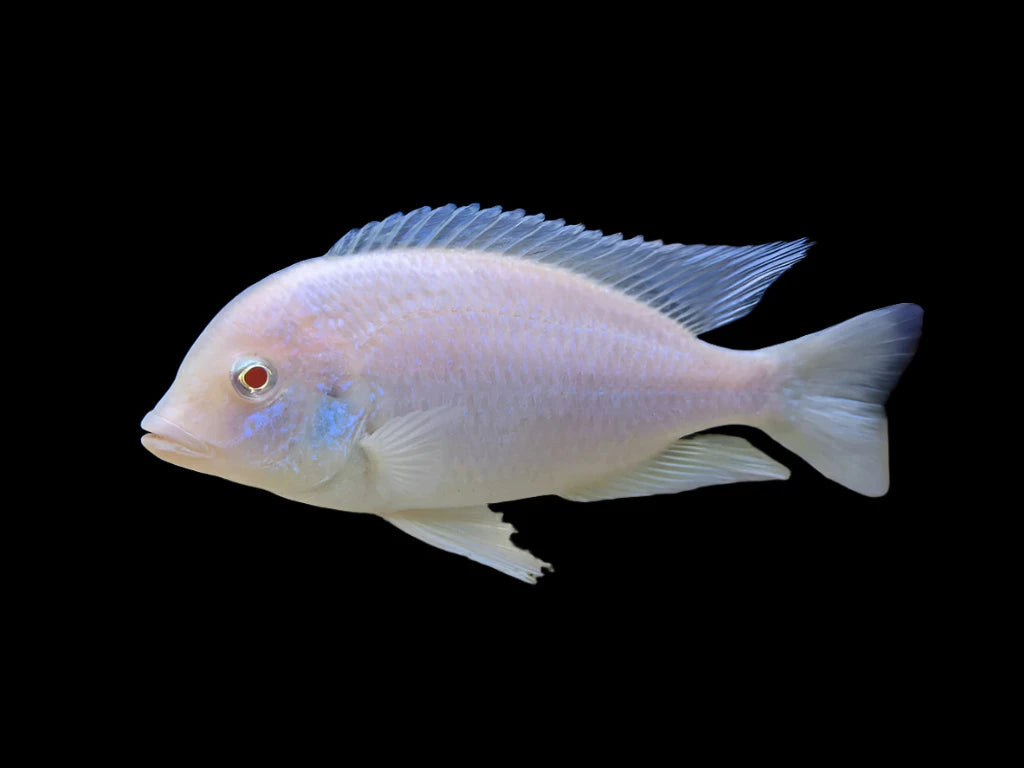

Albino Dolphin 3-3.5inch (Pair)
Couldn't load pickup availability
A pearl-white dolphin with ruby eyes. Take away the blue pigment from a Blue Dolphin and you get a soft, pearly white fish with a pink flush through the fins and bright red eyes. The tall forehead and long, smiling snout are still there, and a group of grown albinos gliding over pale sand has a quiet, almost porcelain look.
This is a farm-bred colour form of Cyrtocara moorii, a calm, open-water hap from Lake Malawi. Care is the same as for the normal fish: a large tank with plenty of sand, hard alkaline water and peaceful company. The albino is a little more sensitive to bright light and slower to spot food, so it rewards a tank set up with that in mind. Expect a long-lived, steady fish that becomes tame and confident once settled.
A hap tank with soft light — not a mbuna tank.
Albino Dolphins are gentle and see less well than their tank mates. Among aggressive mbuna they are pushed off food and pecked at constantly. House them with calm haps and peacocks in a spacious tank with moderate lighting, and they do very well.
Care Snapshot
| Scientific name | Cyrtocara moorii |
| Also known as | Albino Blue Dolphin, Albino Hump-head Cichlid; albino is a farm-bred colour form |
| Family | Cichlidae — Lake Malawi haplochromines (haps) |
| Origin | Farm-bred albino; wild form from shallow sandy areas throughout Lake Malawi |
| Adult size | 18–22 cm |
| Arrival size | 3–3.5 inch |
| Lifespan | 10–15 years |
| Minimum tank | 400 litres, minimum 150 cm length for a group |
| Temperature | 24–28 °C |
| pH | 7.5–8.6 |
| Hardness | 10–20 dGH — hard and alkaline |
| Diet | Omnivore — sinking pellets with some vegetable matter |
| Temperament | Peaceful for its size; males territorial when breeding |
| Care level | Easy to moderate — straightforward in the right tank |
| Swimming zone | Middle and lower water |
Setting Up For It
- Moderate light, shaded corners. Albino eyes have no protective pigment. Under harsh lighting the fish hangs back and stays washed out; moderate light with some shaded areas brings it forward.
- Open sand and a clear middle. Fine sand across the floor and rockwork kept to the ends and back gives these open-water fish room to cruise.
- Plan for the adult size. A group needs around 400 litres and 150 cm of length. Juveniles grow slowly but steadily.
- Hard, alkaline water with strong filtration. pH 7.8–8.4, good hardness, a canister or sump with real capacity and 30% weekly water changes.
- Smooth decor. Rounded stones only — the forehead and pale skin show every scrape.
Tank Mates
Good matches
Peacocks (Aulonocara), normal Blue Dolphins, Placidochromis, Copadichromis, other calm haps of similar size, and Synodontis catfish.
Keep away from
Mbuna of any kind, small fish that fit in its mouth, fast, greedy feeders that beat it to food, and soft-water community species.
Albino and normal Blue Dolphins will interbreed; keep the lines apart if you want to raise true albino fry.
Feeding — Make Sure The Food Reaches Them
Albinos find food more slowly than normal-coloured fish, and in a busy tank they can lose condition while others thrive. Feed in more than one spot and watch that every fish gets a share.
Use a quality sinking cichlid pellet once or twice a day as the staple. From the AQA range, a sinking cichlid pellet suits it well, with frozen foods two or three times a week and some spirulina-based food for balance. Avoid beef heart and other mammal meat.
Foods they take readily: frozen mysis, krill, brine shrimp, chopped prawn and spirulina pellets.
Sexing & Breeding
Juveniles cannot be sexed reliably. Mature males grow larger with a taller hump and longer, more pointed fins. Females are slightly smaller and rounder. Growing a group up together is the dependable way to get a pair.
A maternal mouthbrooder; the female carries eggs and fry for around three weeks. To keep the albino line, breed albino with albino only and keep other Cyrtocara or haps that could cross with it out of the breeding tank.
Keeping It In Indian Conditions
- Hard tap or borewell water works in your favour. Malawi fish want what much of India already has: hard, alkaline water. Dechlorinate, test pH, and you are close to ideal.
- Keep summer temperature under 28 °C. Extra aeration and a surface fan during April and May. Large fish in warm water need plenty of oxygen.
- Prepare for power cuts. A big hap tank depletes oxygen fast once the filter stops. A battery air pump or inverter line is worth having.
- Avoid bright, unshaded tanks near windows. Strong daylight plus aquarium lights is hard on albino eyes and also feeds algae in Indian summers.
What You Receive
Farm-bred albino juveniles and young adults, supplied at 3–3.5 inch, quarantined and conditioned at our Bengaluru facility before dispatch. Young fish cannot be reliably sexed; pairs are chosen on the best cues available, but sex is not guaranteed. The forehead hump develops gradually as the fish grow. Packed with oxygen and insulation for pan-India delivery.
Covered by the Best4Pets live arrival guarantee. Please film an unboxing video before opening the bag — it is required for any DOA claim.
