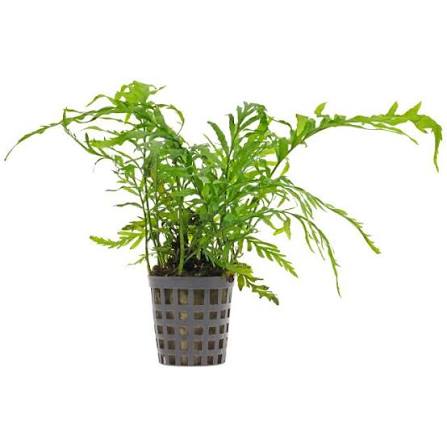
African Water Fern (Bolbitis heudelotii) — Submersed Grown
Couldn't load pickup availability
Dark green, translucent, and built for moving water. Bolbitis grows on rock and submerged wood in fast West African streams, and its deeply cut, slightly crinkled fronds are shaped by that current — thin enough that light passes through them, tough enough not to tear. In a tank with decent flow the whole plant moves constantly. Nothing else in the hobby has that combination of texture and motion.
It is an epiphyte, not a rooted plant. The rhizome fastens to hardscape rather than going into substrate, which means it works in a bare-bottom tank, a sand tank, or wedged into a rock wall, and it can be moved without disturbing anything. Slow-growing, long-lived, and one of the few plants that genuinely improves a hardscape rather than just filling space around it.
Never bury the rhizome.
The thick dark creeping stem the fronds grow from must stay in open water, tied or glued to wood or rock. Push it into substrate and it rots, taking the whole plant with it — exactly as with Anubias and Java Fern. Only the fine roots may touch the substrate, and they do not need to. If you are unsure, tie it to a piece of driftwood and leave it there.
Why submersed-grown matters here
Most aquarium plants are grown out of water at the nursery and convert once submerged, shedding their original leaves in the process. Bolbitis handles that badly — it is slow, so it takes months to replace what it drops, and emersed-grown stock frequently stalls or fails outright during the transition. These plants have been grown underwater throughout. What you receive is what will keep growing, with no melt-back period and no gamble.
Care Snapshot
| Scientific name | Bolbitis heudelotii |
| Also known as | African Water Fern, Congo Fern, African Fern |
| Family | Dryopteridaceae — a true fern |
| Origin | Nursery-propagated; the species is West African |
| Habitat | Rocks and wood in fast-flowing streams and rapids |
| Plant type | Epiphyte — rhizome attaches to hardscape |
| Placement | Mid-ground to background, on wood or rock |
| Size | Roughly 15–40 cm tall, spreading along the rhizome |
| Growth rate | Slow — patience required |
| Lighting | Low to medium; strong light invites algae on slow leaves |
| CO2 | Not required; growth is considerably faster with it |
| Temperature | 20–26 °C — prefers the cooler end |
| pH | 6.0–7.5 — slightly acidic preferred |
| Hardness | Soft to moderately hard |
| Flow | Moderate to strong — genuinely important |
| Fertilisation | Water column only — root tabs do nothing for an epiphyte |
| Difficulty | Moderate — easy to keep alive, harder to keep thriving |
Attaching It
- Tie or glue the rhizome to wood or rock. Cotton thread, fishing line or a dab of cyanoacrylate gel on the underside of the rhizome. The plant grips on its own within a few weeks and thread can be left to rot away.
- Driftwood over rock. It attaches faster and holds better on wood, and the dark fronds against wood grain is the look the plant is bought for.
- Put it in the current. This is not optional decoration advice — moving water keeps the fronds clean, delivers nutrients to a plant with no substrate access, and is what the species is adapted to. A spot in front of the filter outflow is ideal.
- Mount it where you can see through it. The fronds are semi-translucent. Backlit, or with open water behind them, they look completely different from a plant pressed against a background.
- Dose the water column. An epiphyte feeds entirely from the water. A general liquid fertiliser with iron and traces is what keeps the fronds dark rather than pale.
- Do not expect speed. A few new fronds a month is normal progress. This is a plant you place once and watch fill in over a year.
What Usually Goes Wrong
Algae on the fronds. The classic Bolbitis problem. A slow-growing leaf under strong light in still water is an ideal surface for black brush algae. The answers are more flow and less light, not more scrubbing — the fronds are too finely cut to clean. Amano shrimp and otocinclus help at the margins.
The rhizome rots. Almost always because it was buried, or because it was pressed flat against a surface with no water movement around it. Lift it, cut away any soft black sections, and reattach the firm parts.
Fronds go pale or brown at the edges. Usually nutrient shortage in the water column, sometimes prolonged heat. Check dosing first, temperature second.
Propagation
Cut the rhizome with a sharp blade, leaving at least three or four fronds on each piece, and attach the division somewhere new. Smaller pieces survive but take a long time to become anything. A healthy plant also produces adventitious plantlets on older fronds, which can be detached once they have their own roots and fronds. Either way this is a slow business — divide once a year at most, and only when the parent has clearly outgrown its position.
What It Pairs With
Shrimp-safe and snail-safe, and tough enough to ignore most community fish — nothing grazes it, and it has no substrate to be uprooted from, so it survives Corydoras, loaches, and larger cichlids that would wreck a rooted plant. It is the obvious partner for the hillstream and fast-water fish in our range, where the same current it wants is already in place: hillstream loaches, Stiphodon gobies, danionins. It also sits naturally with Anubias and Java Fern on the same hardscape, all three on identical care.
Growing It In Indian Conditions
- Temperature is the real constraint, not water chemistry. This is a cool-stream plant that does best below about 26 °C. In a warm tank it slows further, stops producing fronds, and becomes an algae magnet. Through April and May across the plains and the coast, expect it to stall — and plan for a fan across the surface if you want it to hold.
- Bengaluru, Pune and hill-station tanks suit it far better, and are where it is genuinely worth the investment.
- Hard alkaline tap water is workable but not ideal. It prefers slightly acidic and softer conditions. Driftwood and catappa in the tank help, and if you already run a blackwater setup this plant fits it well.
- Flow is cheap and it is the highest-return thing you can add. A small circulation pump aimed across the plant does more for Bolbitis in an Indian tank than lighting or fertiliser upgrades, and it helps with summer oxygen at the same time.
What You Receive
Submersed-grown, nursery-propagated plants held and conditioned at our Bengaluru facility. No wild-collected stock. Because these have been grown underwater throughout, there is no emersed-to-submersed conversion and no melt-back period — the fronds you receive are the fronds that continue growing. Frond size and count vary naturally between plants. Attach the rhizome to wood or rock; do not bury it.
Covered by the Best4Pets live arrival guarantee. Please film an unboxing video before opening the bag — it is required for any DOA claim.